
Riding stable6 min read
Monthly bill in a livery yard: boarding, extras, QR-bill
What goes on a livery yard’s monthly bill: boarding in advance, dated extras, part months, expenses under the Code of Obligations and the QR-bill payment part.
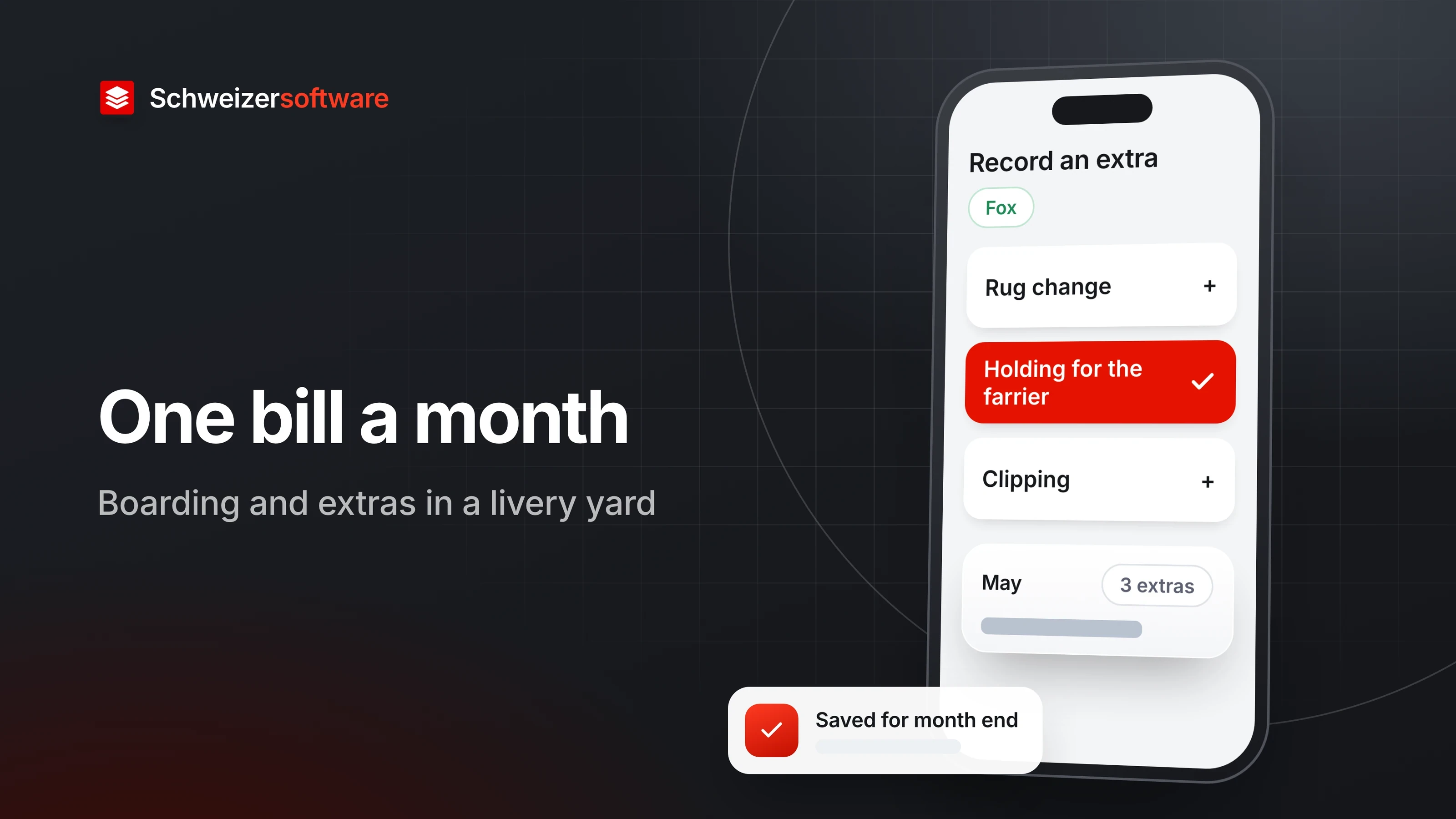
A livery yard in the Zurich Oberland has eighteen horses and fifteen clients. The boarding is similar for everyone; the bills are not. One client has a rug that the yard staff change morning and evening. Another has a farrier visit where someone held the horse, and a daughter’s riding lesson. On the 25th of the month the yard manager sits at the kitchen table and pieces together slips of paper, a diary and WhatsApp messages.
This article describes what such a monthly bill usually contains, where figures and dates tend to get lost, and what is worth knowing about the payment part of the QR-bill. It describes and does not advise: contracts, prices and tax questions are for each yard to decide.
What belongs on the bill
A monthly bill in a livery yard is made of lines that come from very different places. It helps to keep them apart:
| Line | Where it comes from | Typical |
|---|---|---|
| Boarding | contract, place and monthly amount | often in advance for the coming month |
| Recurring extras | contract, for example rug changes or turnout service | every month until they end |
| One-off extras | an entry in the yard with a date | only in the month they occur |
| Riding lessons | timetable or 10-card | lessons held so far and not yet billed |
| Credits | earlier corrections | deducted |
The difference between the first two lines and the one-off extras is why month-end billing is laborious. Boarding is in the contract and rarely changes. One-off extras arise in daily life, often on the move: a phone call with the farrier, a note on the stable door. Anyone who collects them only at the end of the month has to remember days and horses.
An example with invented figures for one horse:
| Line | Amount |
|---|---|
| Boarding box 3, June | CHF 950.00 |
| Rug change, June (monthly) | CHF 80.00 |
| Holding for the farrier, 12.06. | CHF 50.00 |
| Total | CHF 1 080.00 |
Printing the horse’s name and the date on every line helps clients with several horses: they see what belongs to which animal without asking.
Boarding and extras in the contract and in the law
The Code of Obligations (OR) regulates the contract of deposit in Art. 472 to 477. Under Art. 472 para. 2 OR the keeper can demand payment only if it was expressly agreed or was to be expected in the circumstances. The Liebegg agricultural centre describes, on its page on boarded horses, the yard as the keeper, the horse owner as the depositor and the horse as the thing deposited, and notes that no written agreement is needed for this. Whether a specific boarding contract is to be assessed this way depends on its content.
Two further provisions are useful for the bill:
- Expenses. Art. 473 para. 1 OR says the depositor is liable for the expenses necessarily connected with performing the contract. Liebegg gives special feed or bedding as examples, where they cannot be used for other boarded horses. Such expenses appear on the bill as a line of their own.
- Return at any time. Under Art. 475 para. 1 OR the depositor can reclaim the thing at any time, even if a fixed period was agreed. Para. 2 states that they reimburse the keeper for the expense the keeper incurred in view of the agreed time. Liebegg writes that an agreed notice period does not have to be observed.
What this means for a part month is left open by the law. One option yards choose is calculating by days: the monthly amount is divided by the days of the month and multiplied by the days the horse stood in the yard. With CHF 950.00 and a departure after 19 of 31 days, that is CHF 582.26 arithmetically, CHF 582.25 rounded to five centimes. Which rule applies is in the contract, not in the law.
Recording extras when they happen
Many yards keep a list at the stable door or a note on the phone. That works as long as one person knows everything. As soon as several people work in the yard, four details matter:
- Which horse? For clients with several horses, this decides the line.
- Which date? Not the date of the bill, but the day of the service.
- Which price? From a price list the yard set beforehand. A price changed afterwards should not alter earlier entries.
- Who recorded it? For queries, if a client disputes a line.
A price list with fixed items saves discussions at month end. Typical items are recurring ones (rug change, turnout service, hemp bedding), single services (holding for the farrier or vet, clipping, mane and tail) and consumed items (a bag of concentrate feed). Anyone who records a note without a price needs a moment where the price is added before the bill goes out.
The payment part of the QR-bill
The QR-bill replaced the Swiss payment slips on 1 October 2022, as SIX describes on its page on the QR-bill. It consists of a receipt and a payment part. The Swiss QR code in the payment part contains all the information for the payment in digital form; the same information also appears as text beside it, so payers can check it before approving or enter it by hand.
Three points are practical for a small yard, two of them from the Federal Government’s SME portal:
- Paper needs perforation. For the QR-bill on paper, the perforation between the invoice details, the payment part and the receipt is mandatory. It allows automatic processing and helps visually impaired people.
- Standing orders had to be changed. Standing orders based on the orange payment slip (ESR) stopped working after 30 September 2022. The SME portal names adjusting them to the QR-IBAN and the QR reference of the QR-bill as the way forward.
- Printed or digital. SIX describes the QR-bill as an invoice issued in print or digitally. The yard chooses whether it reaches clients by post or as a PDF.
For small businesses: check, then send
Between recording and sending lies a step many yards deliberately keep: checking. The yard manager reads each client’s bill once, corrects a line, strikes a double entry and sends only then. A draft that assembles itself from the contracts and the month’s entries saves the hunting, not the checking.
That is how we picture the monthly bill in the riding stable idea we are building: the app will put boarding in advance, recurring and one-off extras with horse and date, and lessons together into one draft per client, with the QR-bill payment part. Only what a person releases is sent.
Sources
- 1.Obligationenrecht (OR, SR 220), Art. 472–476 Hinterlegungsvertrag (checked on 6 November 2026)
- 2.SIX: QR-Rechnung (checked on 6 November 2026)
- 3.KMU-Portal des Bundes: Ablösung der Einzahlungsscheine am 30.09.2022 (checked on 6 November 2026)
- 4.Landwirtschaftliches Zentrum Liebegg: Rechtliches rund um Pensionspferde (checked on 6 November 2026)
Be told when it launches
This idea is still being planned. Sign up and we will write to you once, when it becomes an app. Signing up is non-binding – no newsletter, no advertising.
View the idea