
Driving school9 min read
Driving school admin: where the time goes in running a small school
Lessons, package credits, QR-bills to parents and the training card required by the driving instructor ordinance: the admin of a small driving school at a glance.
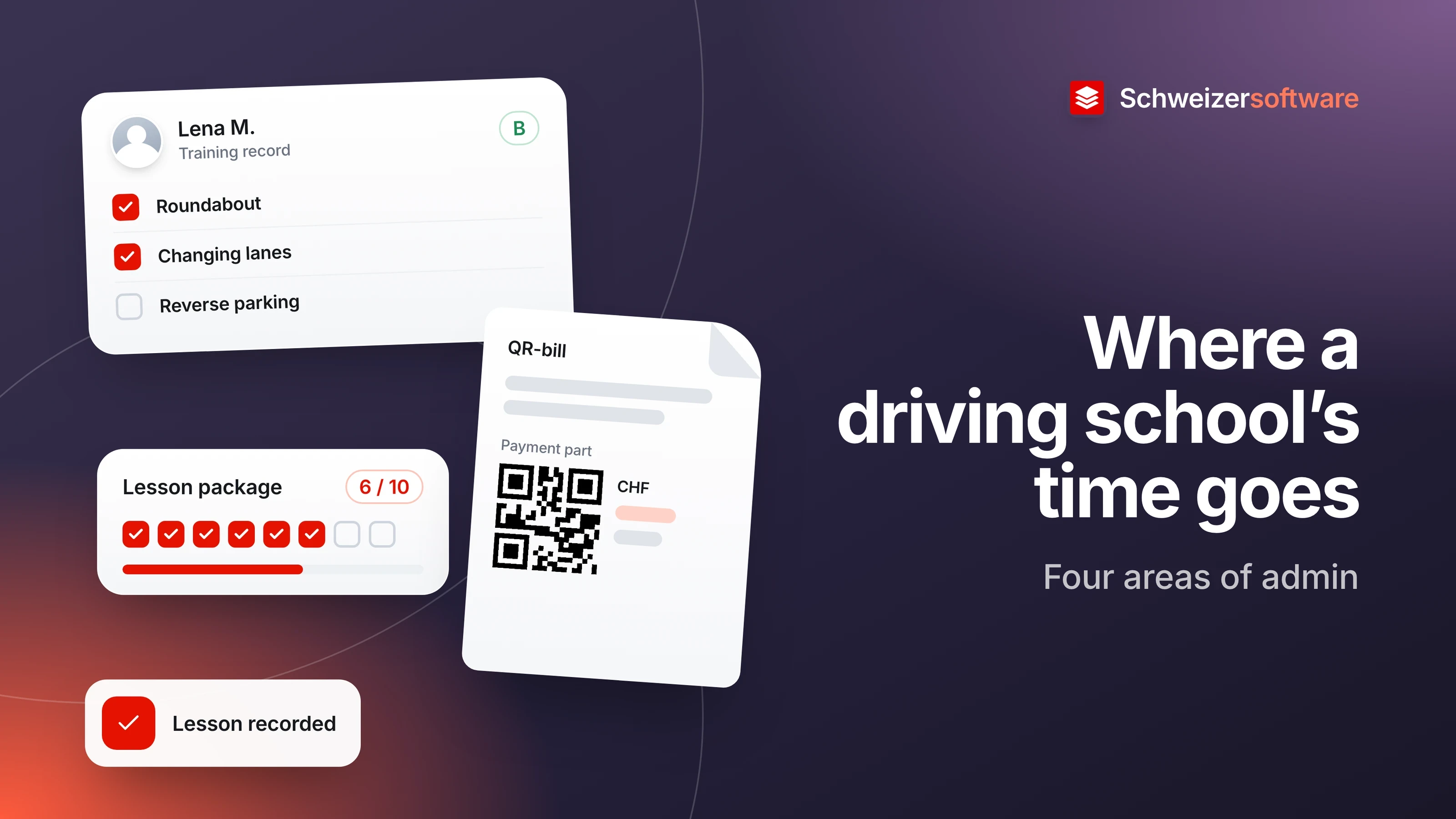
On an ordinary Tuesday, a driving instructor in Thun teaches seven lessons. At half past six she parks the car, and the second half of her day begins. Two messages want a lesson moved. A father asks how many hours are left in his daughter’s package. Three invoices have been open for weeks, and for one of them she is no longer sure whether the payment has come in. And on the training card of this afternoon’s learner, the entry is still missing that merging onto the motorway now works.
None of these tasks is hard. Together, though, they fill the evenings, and they depend on one another: a moved lesson changes the calendar, the credit, later the invoice and the entry on the state of training. This article goes through the four areas where a small driving school spends most of its admin time, and shows what is a requirement and what is organisation.
Lessons and appointments: the back and forth
Most appointments in a driving school are not made in one go but in conversation: at the end of a lesson in the car, by phone, by message. Whoever works alone enters them afterwards into a diary, on paper or on the phone. Whoever works with several instructors often also has a shared plan for the vehicles.
The time goes less into the entry itself than into the cross-checking: has yesterday evening’s message already replaced Thursday’s lesson? Is the school car free on Saturday morning? Every rescheduling is a small process with several steps, and in a driving school it happens often, because lessons are planned around school, apprenticeships and work.
How appointments can be organised online, with free slots, meeting points and cancellation deadlines, is covered in a separate article. For admin, one thing matters above all here: every lesson driven or cancelled has consequences for the credit, the invoice and the training card.
Lesson packages and keeping track of credit
If a driving school offers packages as well as single lessons, say ten lessons at once, this is easy to follow for learners and parents. For the school it creates a credit that has to be updated with every lesson.
An example of what such an account looks like over a few weeks:
| Date | Event | Lessons | Credit |
|---|---|---|---|
| 2 Sept. | Package of 10 lessons paid | +10 | 10 |
| 4 Sept. | Lesson driven | −1 | 9 |
| 9 Sept. | Double lesson driven | −2 | 7 |
| 11 Sept. | Cancelled in good time | 0 | 7 |
| 16 Sept. | Cancelled at short notice, rule: charged | −1 | 6 |
| 18 Sept. | Lesson driven | −1 | 5 |
The table shows where the questions arise. Does a double lesson count as two lessons? What applies to a cancellation at short notice? And what happens to the remaining credit if someone passes the test earlier than expected, or stops the training? These are not questions of arithmetic but rules the school sets itself, for instance in its terms and conditions. The more clearly they are stated there, the less there is to discuss.
In practice it helps above all if credit and calendar come from the same source. If the credit is kept separately, for example in a spreadsheet, every rescheduling has to be entered twice, and discrepancies only show up when a father asks.
Invoices, the QR-bill and open amounts
The QR-bill
Since 1 October 2022 the QR-bill has replaced the former payment slips in Switzerland. According to SIX, it contains all payment information twice: digitally in the Swiss QR Code and in plain text. It can be sent on paper or digitally, for instance as a PDF. The Implementation Guidelines from SIX are authoritative; version 2.3 is currently valid, and according to SIX version 2.4 is announced for November 2026, which changes nothing technically for invoices in CHF.
Matching payments
For a driving school with many small invoices, the question of how an incoming payment is matched to the right invoice matters. The QR-bill has references for this:
| Variant | What the bank reports back |
|---|---|
| QR-IBAN with QR reference | the reference assigned to the invoice |
| IBAN with Creditor Reference (SCOR) | the reference according to ISO 11649 |
| IBAN without reference | only a message from the payer, if there is one |
According to UBS, the QR reference must always be used with the QR-IBAN, and the Creditor Reference with the normal IBAN. With a reference, an incoming payment can be matched to a specific invoice without anyone comparing names and amounts. Without one, it comes down to comparing, and with two invoices of the same amount to two siblings that quickly becomes unclear.
When the parents pay
If the parents pay for the lessons, a third person comes into play. The QR-bill has its own field for the person liable to pay, “Payable by” (in German “Zahlbar durch”). UBS describes this information as optional; it is not needed to execute the payment. So the invoice can be addressed to the parents while the lessons are in the daughter’s name. What then matters more is the message on the invoice that shows what is being paid for: which package, for whom.
Open amounts and reminders
The Swiss Code of Obligations (OR) regulates when someone is in default on a payment. Under Art. 102 OR, a debtor is put in default on a due claim by a reminder; if a specific due date was agreed, default occurs as soon as that day has passed. For monetary debts in default, Art. 104 OR names default interest of five percent a year. Whether and how a driving school sends reminders is its own decision; one option is a friendly payment reminder before a formal reminder follows. Both presuppose that it is visible at a glance which amounts are open.
Bookkeeping and retention
For bookkeeping the OR distinguishes by size. Sole proprietorships and partnerships with less than CHF 500,000 in turnover in the last financial year keep books only on income, expenses and the financial position, under Art. 957 para. 2 OR. That can apply to self-employed driving instructors. Business records and accounting vouchers must be kept for ten years under Art. 958f OR, on paper or electronically, as long as they can be made readable at any time.
State of training: the training card under the driving instructor ordinance
What someone practised in the last lesson is not just a memory aid. The Driving Instructor Ordinance (Fahrlehrerverordnung, FV) requires two so-called records in Art. 15:
- a training card for every learner, with the theoretical and practical lessons given by date and time, the state of training and, where applicable, the driving tests taken;
- a weekly sheet showing the practical lessons given per day and per week in minutes, and for employed instructors the theoretical ones as well.
According to the ordinance, both are to be kept up to date continuously. Their purpose is stated in the same article: they serve to monitor working and teaching time. Art. 14 FV allows on average nine, but at most eleven hours of practical driving instruction a day, balanced out within six months; for employed instructors a maximum working week of 55 hours applies in addition.
Owners of a driving school keep training cards and weekly sheets for two years at their business address under Art. 16 FV. Anyone who employs instructors also keeps a record of total working time and makes the cards and weekly sheets available to the employees.
In daily work the card is also the tool for preparing the next lesson. If it only says “Lesson 7, 50 min”, it helps little. If it says that roundabouts and lane changes are fine but reverse parking is not yet, the next lesson can pick up from there, even if a colleague takes it over for once. For the parents who help pay, this state of training is often the real question behind “How many more hours will she need?”.
Because the card contains personal data, the principles of the Federal Act on Data Protection (FADP) apply to it as well. Under Art. 6 FADP, personal data is processed only for a recognisable purpose and destroyed or anonymised as soon as it is no longer needed for it. The two-year retention under the FV is such a purpose; what happens to the cards afterwards is a question every driving school may ask itself at some point.
Where it adds up: the link between the four areas
Taking the four areas together shows why the admin takes more time than any single task:
| Event | Calendar | Credit | Invoice | Training card | Weekly sheet |
|---|---|---|---|---|---|
| Lesson driven | ✓ | ✓ | ✓ ¹ | ✓ | ✓ |
| Lesson rescheduled | ✓ | ||||
| Cancelled at short notice | ✓ | ✓ ² | ✓ ² | ||
| Package bought | ✓ | ✓ | |||
| Instructor changes | ✓ | ✓ |
¹ for single lessons ² depending on the school’s rule
One lesson driven touches up to five places. Whoever enters it by hand in five places does the same work five times, and each place can drift from the others. The records required by the FV remain a duty either way, however well organised everything else is.
What helps here is less discipline than fewer places. If calendar, credit, state of training and invoice draw on the same lessons, a lesson is entered once and counted correctly everywhere. That holds for an instructor working alone just as for a school with three instructors and two cars.
What remains once it is organised
The admin never disappears entirely. A conversation with parents about the state of training, an invoice that has to be corrected by hand once, an exception for a cancellation: that remains work that takes judgement. What can be reduced is the mechanical part: entering, cross-checking and adding up.
That is exactly where our idea for driving schools starts. The app will base calendar, lesson packages, state of training and QR-bills in CHF on the same lessons, so that a lesson driven is entered once, and it will store the learners’ data in Switzerland.
Sources
- 1.Verordnung über die Zulassung von Fahrlehrern und Fahrlehrerinnen und ihre Berufsausübung (Fahrlehrerverordnung, FV, SR 741.522), Art. 14–16 (checked on 9 October 2026)
- 2.Obligationenrecht (OR, SR 220), Art. 102, 104, 957 und 958f (checked on 9 October 2026)
- 3.SIX: QR-Rechnung (checked on 9 October 2026)
- 4.UBS: Häufige Fragen zur QR-Rechnung für Rechnungssteller (checked on 9 October 2026)
- 5.Bundesgesetz über den Datenschutz (DSG, SR 235.1), Art. 6 (checked on 9 October 2026)
Be told when it launches
This idea is still being planned. Sign up and we will write to you once, when it becomes an app. Signing up is non-binding – no newsletter, no advertising.
View the idea