
Driving school7 min read
Booking driving lessons online: how a driving school can set it up
Free slots in the instructor’s calendar, meeting points, cancellation deadlines and reminders: how online booking works in a driving school, including for parents.
Updated on
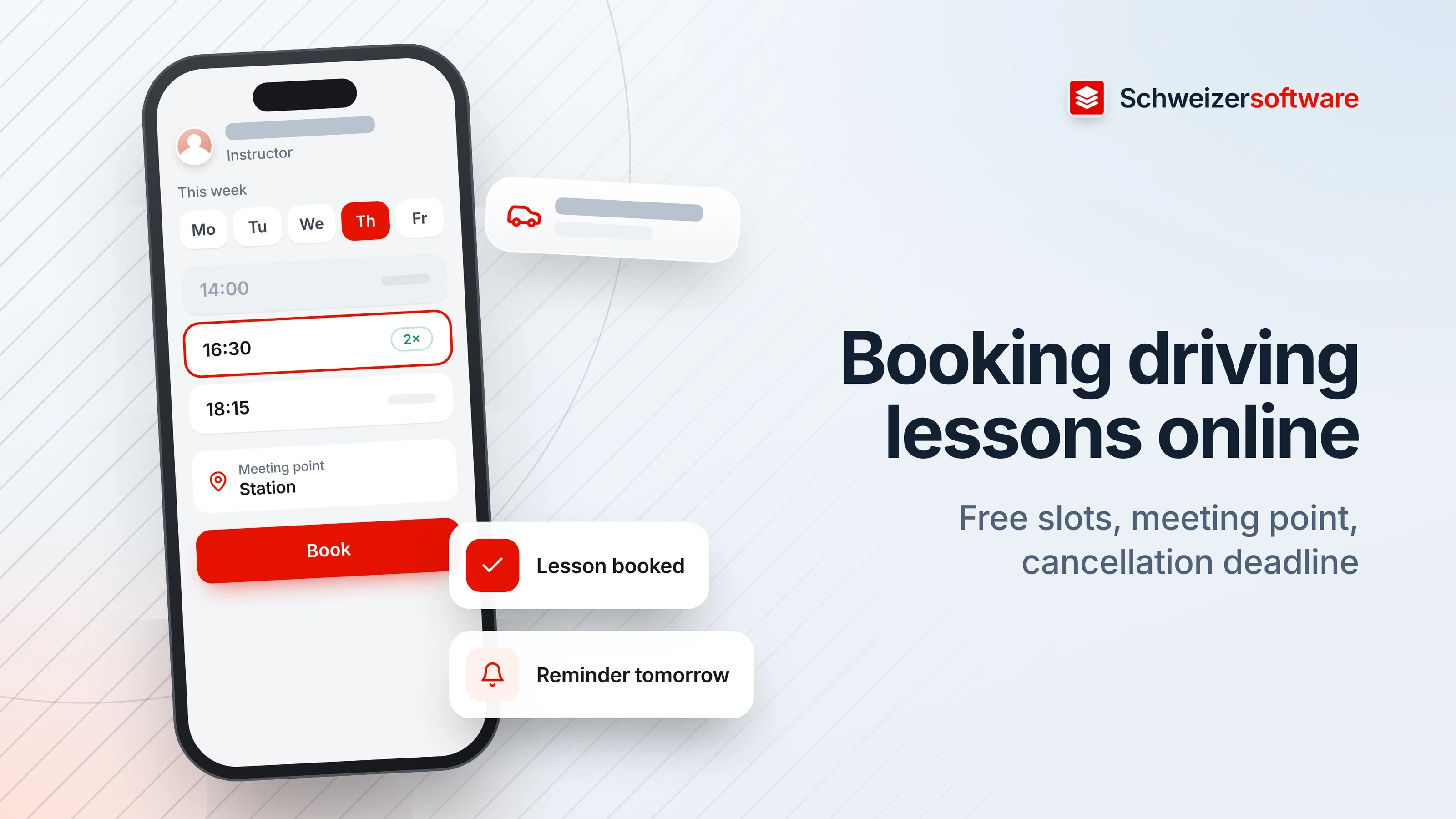
On Sunday evening a driving instructor in Winterthur receives eleven messages. Three learners ask about a lesson next week, a mother would like to move her son’s Wednesday lesson to Friday, and someone asks whether he can be picked up at the cantonal school instead of at Oberwinterthur station. Every answer needs a look at the diary, and every answer can overtake another: the Friday afternoon he offers the mother has already been promised to someone else ten minutes earlier.
Online booking moves this back and forth to a place where everyone sees the same thing. Learners choose from times the instructor has released, and the rules that are otherwise negotiated in conversation are fixed from the start. What that looks like in a driving school depends on a few decisions that can be made beforehand.
What belongs to a booked lesson
A driving lesson is more than a time slot. To take place, it needs at least:
| Detail | Example | Why it matters |
|---|---|---|
| Time and length | Thursday, 4.30 pm, double lesson | determines the place in the calendar |
| Instructor | the instructor who trains the learner | every instructor has their own calendar |
| Meeting point | station, school, home address | determines the travel time between two lessons |
| Vehicle | school car, automatic or manual | a car cannot drive twice at the same time |
| Person | learner | credit, invoice, state of training |
If these details are captured when booking, nobody has to ask the evening before where to meet. If a driving school only allows certain combinations, for instance only meeting points from a short list, the calendar stays plannable.
The instructor’s calendar
Releasing free times
The core of online booking is that the instructor decides which times can be booked. An instructor who works in another job in the mornings releases only afternoons and Saturday. One who gives traffic theory lessons blocks the evenings when his course runs. What has not been released, learners do not see.
Time between lessons
If every lesson starts at a different meeting point, time is needed in between. If one lesson ends in Seen and the next starts at Winterthur station, a seamless connection will not work. This can be solved in different ways: with a fixed buffer after every lesson, with meeting points that can only be chosen at certain times of day, or by having the next lesson start where the previous one ended.
The maximum times under the driving instructor ordinance
A calendar in which learners book themselves can fill up faster than one maintained by hand. The Driving Instructor Ordinance (Fahrlehrerverordnung, FV) sets a limit: under Art. 14 FV, self-employed and employed instructors alike give on average nine, but at most eleven hours of practical driving instruction a day, balanced out within six months. For employees a maximum working week of 55 hours applies in addition. Art. 15 FV requires a weekly sheet showing the practical lessons per day and week in minutes.
A booking calendar can take this limit into account from the start by releasing per day only as many times as the instructor wants and is allowed to drive. The booked lessons then also form the basis for the weekly sheet.
Public holidays
Public holidays are not the same everywhere in Switzerland. In the canton of Zurich they are determined, according to the canton, by the cantonal law on days of rest and shop opening hours, and nine statutory holidays apply, including St Stephen’s Day; Berchtold’s Day on 2 January and the Sechseläuten are not among them. A driving school in Winterthur that does not drive on Berchtold’s Day anyway blocks that day itself. If the school enters public holidays and days off as blocked time in the calendar, nobody accidentally books a lesson on Ascension Day.
Cancelling and rescheduling: set the rules beforehand
After “When?”, a driving school sooner or later gets “Can I reschedule?”. Online booking does not answer this question, but it makes visible the answer the school has set beforehand. The rules can be reduced to a few variants:
| Rule | What it means for learners |
|---|---|
| Free cancellation up to a deadline | cancel or reschedule yourself until the deadline |
| Charged after the deadline | the lesson counts as if it had been driven |
| After the deadline only on request | cancel by message, the school decides |
| Exceptions | for instance illness with a message, case by case |
Which deadline a driving school chooses, 24 or 48 hours or another, and whether it charges anything for a late cancellation, is its decision. Learners and parents know the rule when it is visible before the first booking, for instance in the terms and conditions and in every booking confirmation.
For the calendar, a clear deadline has a practical side effect: if a lesson is cancelled online in good time, the slot is free again immediately and someone else can book it. A cancellation by message the evening before, by contrast, often remains a gap.
Reminders that actually help
A reminder before the lesson is the simplest measure against forgotten appointments. What it contains decides whether it also saves questions:
- date, time and length
- the meeting point, as precisely as possible (“Oberwinterthur station, bus station side”)
- what to bring, such as the learner’s permit
- until when a free cancellation is still possible, with a link to it
There is no fixed rule for the timing. A reminder the day before still leaves room to reschedule. A second one, shortly before the lesson, helps mainly with early appointments. Who receives the reminder is a question of its own, which leads to the next section.
Learners and parents: who books, who pays, who sees what
The minimum age for category B is 17 under Art. 6 of the Ordinance on the Admission of Persons and Vehicles to Road Traffic (VZV). Anyone who obtained the learner’s permit before their 20th birthday is, under Art. 22 para. 1bis VZV, admitted to the practical test only once they have held it for at least a year. For young learners, there is therefore at least a year between the learner’s permit and the test.
If the parents are involved during this time, because they pay, ride along privately or want to know how things stand, a few questions arise for online booking that the driving school can answer:
- Who books? The learners themselves, the parents, or both.
- Who receives confirmations and reminders? Only the person who drives, or a parent as well.
- Who pays? On the QR-bill the person liable to pay can appear in the “Payable by” field (in German “Zahlbar durch”). According to UBS, this information is optional; an invoice can therefore go to the mother while the lessons are in the son’s name.
- Who sees the state of training? Notes from the lessons are personal data of the learners themselves, not of the parents.
In practice this means: what is asked for at booking can be limited to what the lesson needs, that is name, contact, meeting point and possibly the parents’ billing address. And it can be decided beforehand who sees which details, instead of deciding case by case.
What changes and what stays
With online booking, not every conversation about appointments disappears. A learner who needs two lessons close together before the test will still call, and an exception for a cancellation remains the instructor’s decision. What changes is the normal case: free times that everyone sees, rules that are known beforehand, meeting points that are part of the booking, and reminders that arrive on their own. The Sunday evening with eleven messages becomes rarer.
Our idea for driving schools starts from exactly this process. The app will give every instructor their own calendar in which learners book and reschedule released times, within the rules the school sets, with meeting point and vehicle in every lesson and with the data in Switzerland.
Sources
- 1.Verordnung über die Zulassung von Fahrlehrern und Fahrlehrerinnen und ihre Berufsausübung (Fahrlehrerverordnung, FV, SR 741.522), Art. 14 und 15 (checked on 9 October 2026)
- 2.Verkehrszulassungsverordnung (VZV, SR 741.51), Art. 6 und 22 (checked on 9 October 2026)
- 3.Bundesgesetz über den Datenschutz (DSG, SR 235.1), Art. 6 und 19 (checked on 9 October 2026)
- 4.Kanton Zürich: Feiertage (checked on 9 October 2026)
- 5.UBS: Häufige Fragen zur QR-Rechnung für Rechnungssteller (checked on 9 October 2026)
Be told when it launches
This idea is still being planned. Sign up and we will write to you once, when it becomes an app. Signing up is non-binding – no newsletter, no advertising.
View the idea