
Dog school6 min read
Compulsory dog courses in Zurich and Basel-Stadt at a glance
What the cantons of Zurich and Basel-Stadt require of dog keepers and what it means for a dog school: lessons, deadlines, permit, AMICUS and the Kursrapport form.
A dog trainer in Winterthur has been getting different phone calls since early summer 2025. Before, people asked whether they could join the group with their young dog. Now they ask whether the lessons “count”, whether they also need the theory, and by when everything has to be done. Anyone working for a dog school knows these questions, and also has to know what their own courses mean for the authorities.
This post summarises what the cantons of Zurich and Basel-Stadt state on their own pages for dog keepers and dog schools. It is an overview, not a substitute for the cantons’ pages, which remain authoritative.
No federal rule, but cantonal duties
Switzerland once had a national proof-of-competence requirement for dog keepers. Parliament abolished the national obligation, and the amendment to the Animal Protection Ordinance came into force on 1 January 2017. Since then, cantons can provide their own courses in their dog laws, so the rules differ from canton to canton.
Two cantons have recast their duty recently: Basel-Stadt from 1 April 2025 and Zurich from 1 June 2025. Both are tied to taking over a dog, in Zurich the practical course applies to every further dog as well.
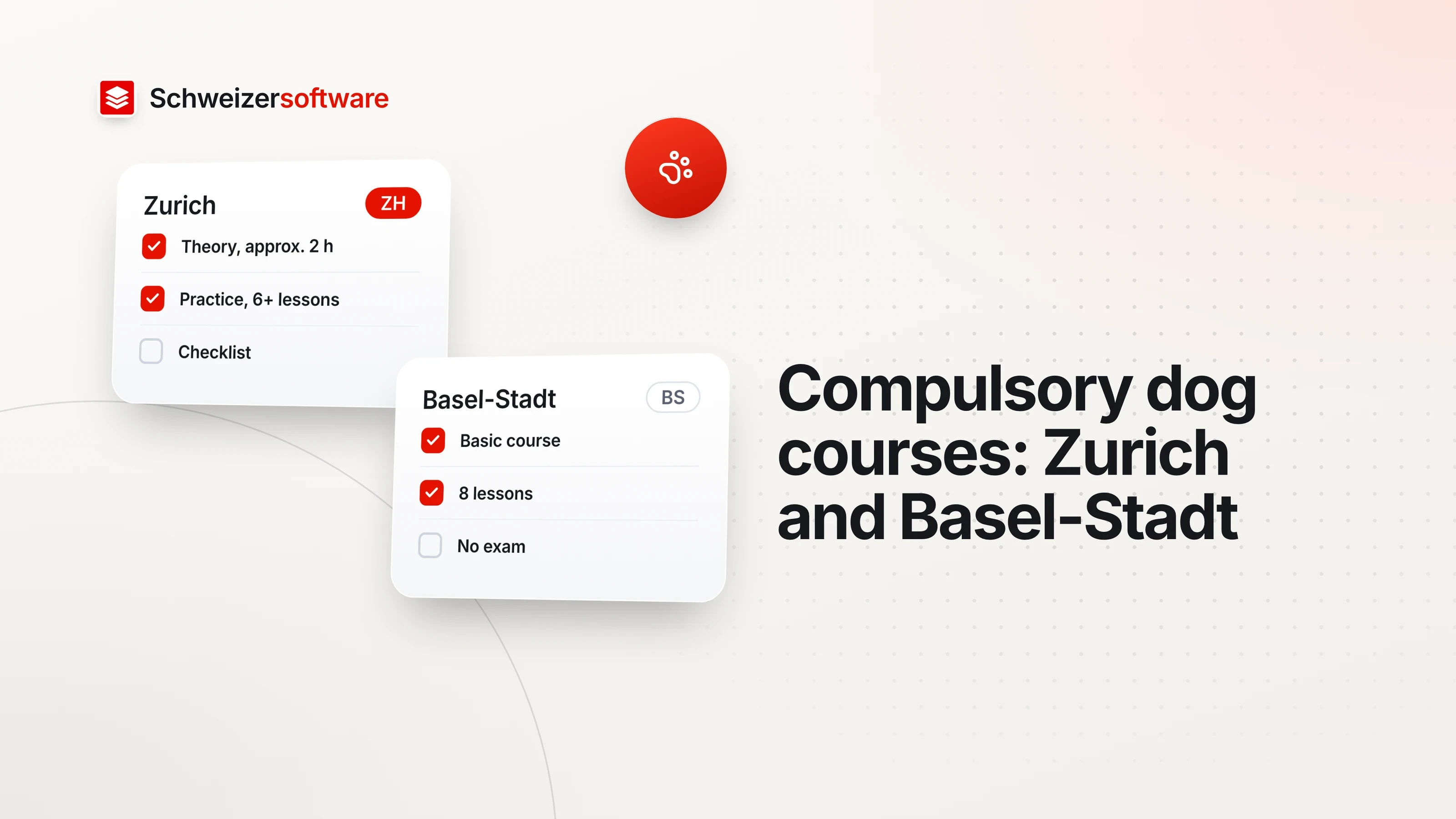
Zurich: theory and practice
According to the canton’s page, the course duty applies to people who keep a dog in a Zurich municipality for at least three months, including when moving in. It has two parts.
| Theory course | Practical course | |
|---|---|---|
| Who | First-time keepers and people who have not had a dog for over ten years | All dog keepers, regardless of breed and size |
| Scope | About two hours on average, with an exam | At least 6 lessons, until all learning goals of the Veterinäramt are met |
| Time window | At the earliest one year before, at the latest two months after taking over the dog or moving in | From the dog’s sixth month, within 12 months of taking over or moving in |
| Proof | Exam confirmation | Checklist (Lernerfolgskontrolle) |
The canton’s page lists many exemptions, for example for people who kept a dog for at least six months in the past ten years (theory) or for dogs older than ten years when taken over (practice). Dogs from an animal shelter recorded as such in AMICUS are also exempt from the practical course. The full list of who is exempt and when is on the canton’s page.
For dog schools, the permit is the key point. The courses must be taken with a trainer who holds a permit from the Veterinäramt, and the office keeps a list of these people. According to the press release, they need a theory exam and a practical exam for this. The course leader records completion in AMICUS, the dog database, within 10 days and, for the practical course, hands over the checklist. For the theory course she issues an exam confirmation. Keepers submit the theory confirmation to their municipality.
Basel-Stadt: the basic course for first-time keepers
Basel-Stadt chooses a smaller frame. Since 1 April 2025 the duty applies to people keeping a dog for the first time. Anyone who has had a dog before is exempt. The required course is the “Basiskurs Mensch & Hund Basel-Stadt”.
- 8 practical lessons with some theory elements, no exam;
- within 12 months of taking over the dog;
- dog at least 4 months old at the start of the course;
- course leader with the NHB-Fachperson qualification. The association Kynologie Ausbildungen Schweiz (VKAS) reviews, recognises and publishes the courses.
According to the Veterinäramt, puppy play hours do not count as the basic course. In addition, the canton knows training courses it can order for conspicuous or potentially dangerous dogs. The office then sets the number of lessons and the deadline in a decision and encloses Part A of a “Kursrapport”. The keeper hands it to the course leader, who completes Part B at the end and sends the report directly to the Veterinäramt.
The two cantons side by side
| Zurich | Basel-Stadt | |
|---|---|---|
| In force since | 1 June 2025 | 1 April 2025 |
| Who | All dog keepers (practice), first-time and returning keepers (theory) | First-time keepers |
| Lessons | at least 6, plus theory | 8 |
| Exam | Theory with exam | none |
| Minimum dog age | 6 months | 4 months |
| Deadline | 12 months | 12 months |
| Course leader | Permit from the Veterinäramt | NHB-Fachperson |
| Reporting | AMICUS entry within 10 days | Kursrapport only for ordered courses |
What this means in a dog school’s daily work
These rules create tasks that have little to do with ordinary teaching.
Which lesson counts? Zurich requires a permit for the course leader, Basel-Stadt an NHB qualification, and in the basic course puppy play hours do not count. A school with several trainers therefore has to clarify who teaches which lesson on which evening and whether that person meets the requirement.
Where does a dog stand on its way? Six lessons and a list of learning goals spread over up to twelve months are hard to keep in view on a tally sheet. An overview per dog helps: lessons attended, goals ticked, deadline.
When is the deadline? It starts with taking over the dog or moving in, not with the start of the course. The date of takeover and the canton of residence are therefore the most important details at registration.
Who reports what to whom? In Zurich it is the 10 days for the AMICUS entry, in Basel-Stadt the Kursrapport form for ordered courses. Both are tasks with deadlines that easily get lost at the end of a course.
When a lesson is cancelled. If a course date is cancelled because of a thunderstorm, the participants’ deadline keeps running. A replacement date therefore belongs in the plan soon.
One possible sequence
An example for a school with a Zurich permit: a client registers in March for the practical course and states that she took over the dog in February. The school notes the deadline (February of the following year), counts the lessons attended, ticks the learning goals, and after the last lesson ten days remain for the AMICUS entry and handing over the checklist. It is not a complicated procedure, but it consists of many small steps.
How we see the idea
Our idea for dog schools is meant to prepare these steps: counted lessons, deadline, checklist, certificate and the data for the authority. The app will not decide who needs a course and will not be connected to AMICUS; the dog school remains responsible for that. What costs time in daily work is gathering things together, and that is where it is meant to help.
Sources
- 1.Kanton Zürich: Hunde (Hundekurse, Ausnahmen, Liste der Hundeausbildenden mit Bewilligung) (checked on 6 November 2026)
- 2.Kanton Zürich: Obligatorische Hundekurse für alle Hundehaltenden ab Juni 2025 (Medienmitteilung vom 21. März 2025) (checked on 6 November 2026)
- 3.Kanton Basel-Stadt, Veterinäramt: Hundekurse (checked on 6 November 2026)
- 4.Kanton Basel-Stadt: Revision der Hundeverordnung in zwei Punkten (Medienmitteilung 2025) (checked on 6 November 2026)
- 5.LAWNEWS: Bund: Abschaffung des Hundekurs-Obligatoriums (23.05.2017) (checked on 6 November 2026)
Be told when it launches
This idea is still being planned. Sign up and we will write to you once, when it becomes an app. Signing up is non-binding – no newsletter, no advertising.
View the idea