
Image tools6 min read
Staff photos on the company website: what applies
The right to one’s own image, consent and withdrawal: what the Civil Code, the FADP and the FDPIC say when a business shows its team on its website.
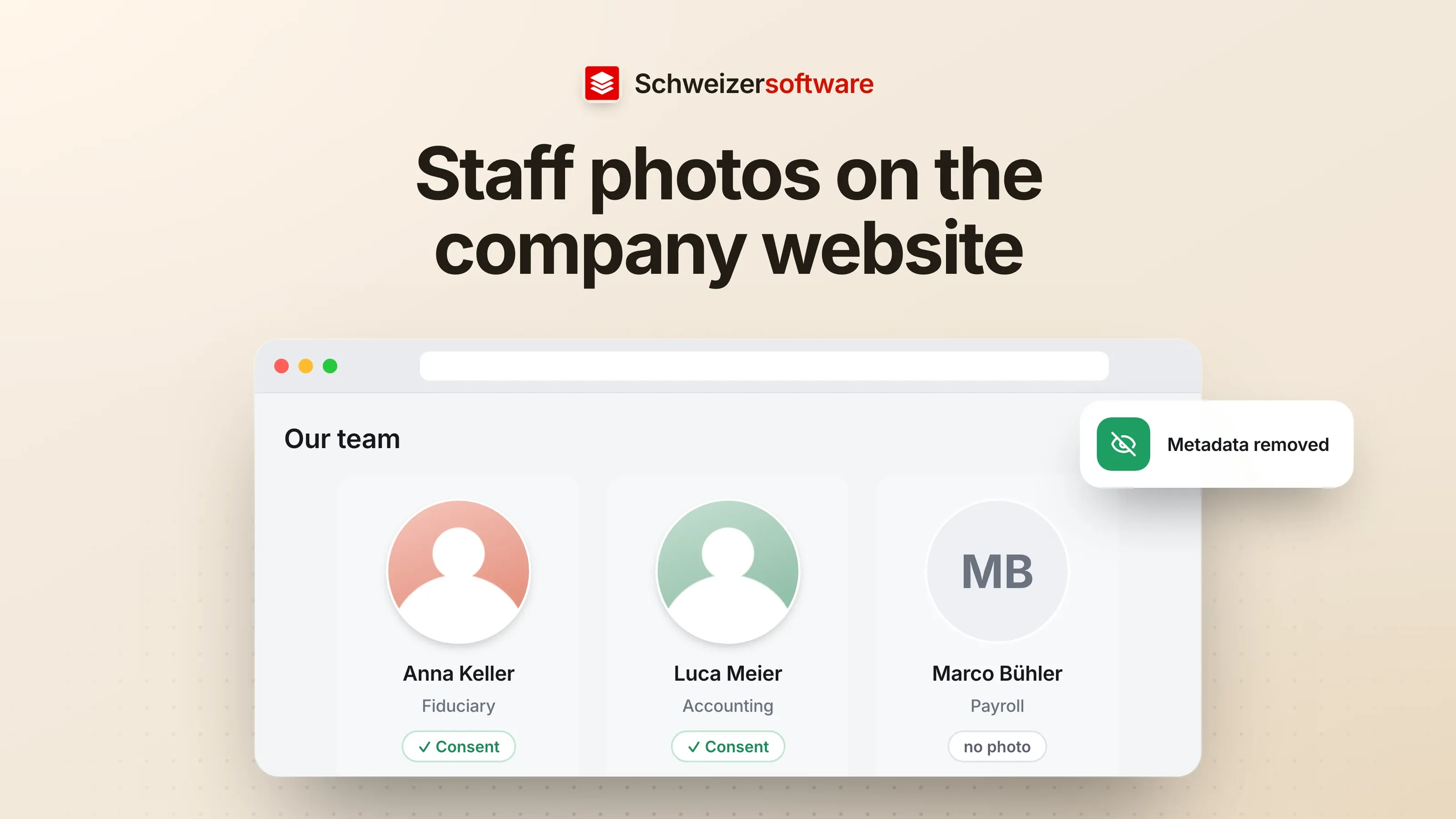
A fiduciary office in Frauenfeld is redesigning its website. Six people work there, and the new “Team” page is to show them: photo, name, role, one sentence on their areas of focus. Clients should see who they are dealing with. The photos are quickly taken, one afternoon in front of the office wall.
Before they go online, a question comes up that is easily overlooked: who actually decides whether a photo of a person appears on the internet? The short answer: first and foremost, the person themselves.
The right to one’s own image
The Swiss Civil Code protects personality. Anyone whose personality is unlawfully infringed can apply to the court; an infringement is unlawful unless it is justified by consent, by an overriding private or public interest or by law (Art. 28 CC).
The FDPIC sums this up for photos: every person has a right to their own image. In principle, they decide themselves whether and in what form a picture of them is taken and published. As soon as a person shown is recognisable, the photo is also personal data, and the Data Protection Act applies.
The FADP follows the same logic: an infringement of personality is unlawful unless it is justified by consent, an overriding interest or the law (Art. 31 para. 1 FADP).
Why a business needs consent
For employers, a specific rule is added. They may only process data about employees as far as it concerns their suitability for the job or is necessary for performing the employment contract (Art. 328b CO). A photo on the website does not usually fall into that — the work can be done without it.
On its page on data processing by employers, the FDPIC states that publishing photos of employees on the intranet or internet requires the consent of the persons concerned. One of its reasons is that a photo can in some cases allow conclusions about characteristics such as religion or physical impairments. This also applies to photos from events such as apéros or company outings. And it recommends asking beforehand whether publication is indispensable for the tasks to be done.
What makes consent valid
Consent is only valid if it is given freely for one or more specific processing activities after adequate information (Art. 6 para. 6 FADP). For photos, the FDPIC distinguishes:
| Situation | What the FDPIC says |
|---|---|
| Group photo | People are to be informed about the photo being taken and how it will be published |
| Individual photo | The person should be able to see the picture that is to be published |
| When in doubt | Obtain the consent of those concerned |
| Older photos | Consent is still needed; personality rights last a lifetime |
For the fiduciary office, this means in practice: each person sees their photo before it goes online and knows where it will appear — on the team page, and not also in an advertising campaign, for instance.
In an employment relationship, the word “freely” deserves particular attention. When the boss asks, it is easier to say yes than one would like. A team page on which names alone can stand next to photos makes it possible to say no without a fuss.
Group photos and events
The FDPIC assesses group photos somewhat differently: the infringement of personality weighs less if no single person is singled out. Images in which people cannot be recognised, for example because of a small format or low resolution, can avoid an infringement altogether.
On the company outing to Lake Constance, the group picture on the shore is therefore a different case from the close-up of a colleague holding a glass. Anyone who wants to put event photos on the website can announce beforehand that photos will be taken and what for, and ask separately for individual close-ups.
Withdrawal and leaving
According to the FDPIC, consent once given can in principle be withdrawn at any time; from then on, publication is no longer permitted. The FDPIC points out that a withdrawal may in some cases cause costs for which the person withdrawing is responsible, for example with brochures already printed.
On a website, removing a photo is usually a small step. Leaving is a separate question: whoever leaves the office is no longer part of the team, and the photo on the team page has served its purpose. Personal data is destroyed or anonymised as soon as it is no longer needed for the purpose of processing (Art. 6 para. 4 FADP). A fixed item on the leaver checklist — take photo and name off the website — makes sure it is not forgotten.
What else is in the picture
A photo from a phone or camera often contains more than a face. The image file can carry the date taken, the camera model and, if location was switched on, the exact place where it was taken. For a portrait in front of the office wall, that is the office address; for a photo an employee took at home and sent in, it is their home address.
Three steps are therefore worthwhile before uploading:
- Crop. Show only what should be shown — the face, not the screen with client data in the background.
- Shrink. A team page does not need a ten-megabyte file. A smaller file loads faster and is less useful to someone who wants to reuse it.
- Remove metadata. Location and device data do not belong on the website.
What goes next to the photo
The text next to the picture is personal data too: name, role, perhaps a direct email address and phone number. Personal data is only processed as far as is proportionate to the purpose (Art. 6 para. 2 FADP). For a team page meant to show clients who works at the office, name and role are often enough; enquiries can go through a shared address.
Personal details such as hobbies, marital status or place of residence only belong on the page if the person wants them there. What is on the internet is also picked up by search engines and cannot always be fully retrieved.
Alternatives to the photo
Not every team page needs photos. Some businesses work with names and roles alone, with a group picture taken from some distance, or with drawn portraits. Others show photos only of the people who want that, and a neutral area with initials for the rest. None of these options is more correct than the others; they give employees a real choice.
For the fiduciary office in Frauenfeld
The office settles on this: each person sees their photo in advance and briefly confirms by email that it may appear on the team page. One colleague does not want a photo; their card shows name, role and initials. The pictures are cropped, shrunk and uploaded without metadata, and removing them from the website is on the leaver checklist.
The image tools we are building will crop, shrink, convert and strip metadata from images — processed in Switzerland, in memory, without any image being kept, and in confidential mode entirely on your own device. Whether and which photos belong on a website is for the people in them to decide.
Sources
- 1.Schweizerisches Zivilgesetzbuch (ZGB, SR 210), namentlich Art. 28 (checked on 25 September 2026)
- 2.Bundesgesetz über den Datenschutz (DSG, SR 235.1) (checked on 25 September 2026)
- 3.Obligationenrecht (OR, SR 220), namentlich Art. 328b (checked on 25 September 2026)
- 4.EDÖB: Umgang mit Fotos (checked on 25 September 2026)
- 5.EDÖB: Datenbearbeitung durch den Arbeitgeber (checked on 25 September 2026)
Be told when it launches
This idea is still being planned. Sign up and we will write to you once, when it becomes an app. Signing up is non-binding – no newsletter, no advertising.
View the idea