
Driving school9 min read
Driving licence in Switzerland: the road to category B
First-aid course, eye test, theory exam, learner’s permit, VKU, practical exam, probation and WAB: the steps to a category B licence, and what changes in 2027.
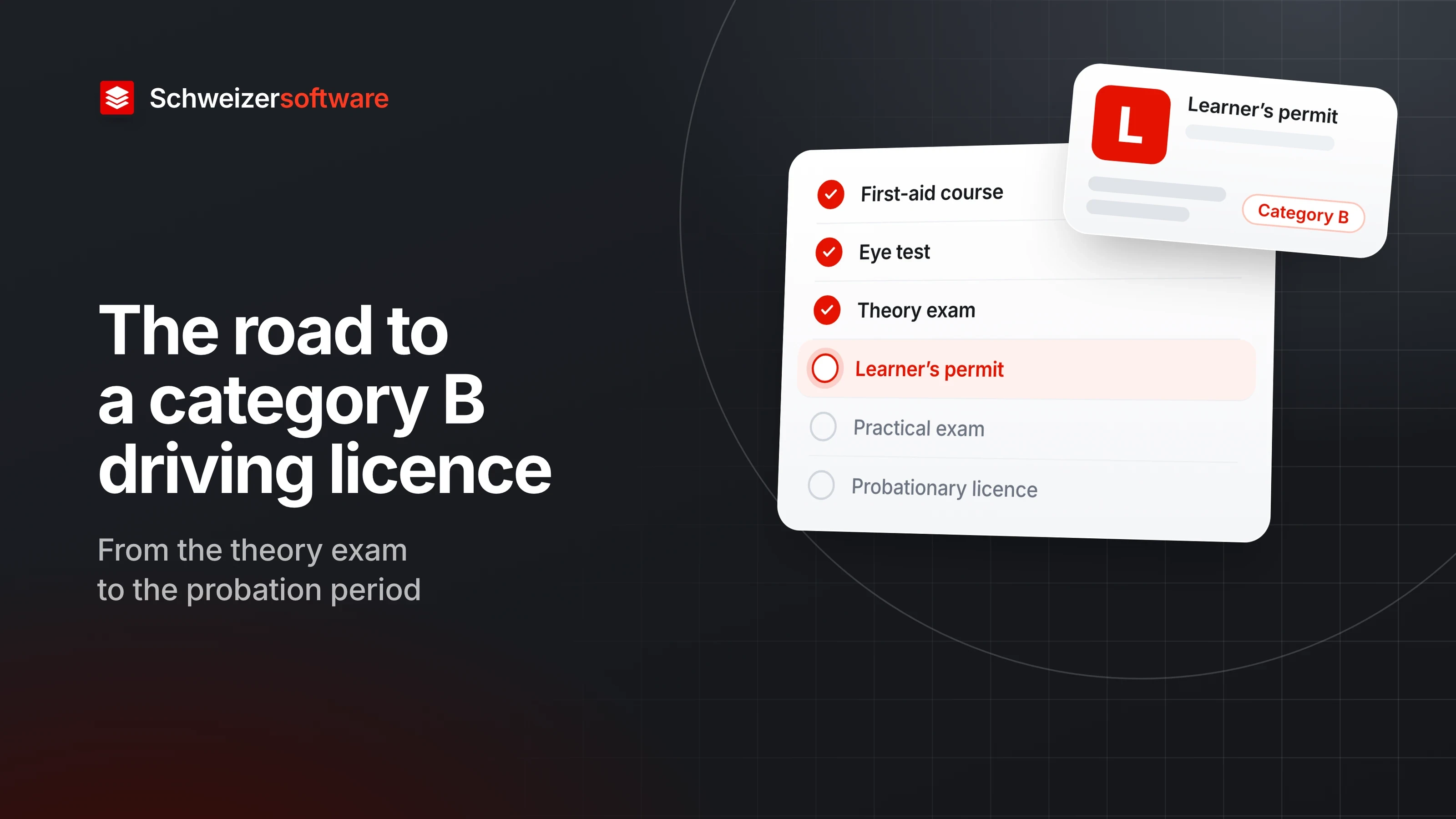
A secondary-school student in Aarau turns 17 in the spring. She wants to learn to drive, and her parents want to know what comes in which order and how long the whole thing takes. Among her friends she hears three versions: the VKU, the compulsory traffic-theory course, comes before the theory exam, after it, or only shortly before the driving test. The probation period lasts two years, three years, or has been abolished.
The rules are set out in the Road Traffic Act (SVG) and in the Ordinance on the Admission of Persons and Vehicles to Road Traffic (VZV). The cantons apply them through their road traffic offices. This article traces the path to a category B licence, meaning one for passenger cars, as those texts describe it. It is written for learners, for parents and accompanying drivers, and for driving schools that explain the sequence to their students.
The sequence at a glance
| Step | What the SVG and VZV provide |
|---|---|
| First-aid course (Nothelferkurs) | Certificate from an institute recognised by the Federal Roads Office (ASTRA), no more than 6 years old |
| Eye test | By a doctor, optician or optometrist, no more than 24 months old |
| Application to the canton | Form, first-aid certificate, photo; the first time in person with ID |
| Theory exam (basic theory) | At the earliest one month before the 17th birthday |
| Learner’s permit | After passing the theory exam, valid for 24 months |
| VKU | 8 hours with a driving instructor |
| Practical exam | Under 20: at the earliest after one year with the learner’s permit |
| Probationary licence | Three years of probation |
| Further-training course (WAB) | One day, 7 hours, within 12 months |
| Full driving licence | After the probation period and with the further-training course completed |
Before the application: first-aid course and eye test
Anyone registering for the category B theory exam must, under Art. 10 VZV, show proof of a course in life-saving first aid, commonly called the Nothelferkurs. The certificate is issued by an institute recognised by ASTRA, and only if the person attended the whole course. The course must not be more than six years old. It covers how to secure an accident scene, raise the alarm, position injured people, and act in cases of respiratory arrest, severe bleeding and cardiac arrest. Doctors and qualified nursing staff, among others, are exempt.
Then there is the eye test (Art. 9 VZV). It is carried out by a doctor practising in Switzerland or by a qualified optician or optometrist, and covers visual acuity, field of vision and eye movement. When the application is submitted it must not be more than 24 months old.
Application and theory exam
The application goes to the licensing authority of the canton of residence, with the completed form, the first-aid certificate and a recent passport photo, in digital form too where the canton allows it. For a first application you appear in person and show valid photo ID (Art. 11 VZV).
The minimum age for category B is 17 (Art. 6 VZV). The theory exam may be taken one month before that at the earliest (Art. 13 VZV). The canton decides what the exam looks like in practice. The canton of Zurich, for example, sends the login details by post after the application and names 50 questions in 45 minutes for the basic theory, with at most 15 error points; the exam is offered in German, French, Italian or English. Anyone who fails can try again there at the earliest the next day.
After passing the theory exam the learner’s permit is issued (Art. 15 VZV). For category B it is valid for 24 months (Art. 16 VZV) and, according to the canton of Zurich, can be neither extended nor interrupted. A second learner’s permit is available under Art. 16 para. 4 VZV only under certain conditions.
What changes from 2027
With the amendment of 19 December 2025 the VKU becomes a requirement for registering for the theory exam, for everyone who does not yet hold a licence in category A or B (or A1, B1). It may be attended at the earliest six months before the minimum age, so from 16½ for category B. The VKU content becomes part of the theory exam. The canton of St. Gallen mentions 55 questions instead of 50, now including questions on driver-assistance and automation systems.
For the transition, Art. 151q of the amended VZV applies: anyone who passed the theory exam under the old law but has not yet attended the VKU shows proof of it when registering for the practical exam.
Practice drives: accompanying driver, “L” and motorways
With a category B learner’s permit you do not drive alone. Under Art. 15 SVG the accompanying person must be at least 23 years old and have held a category B licence for at least three years, no longer a probationary one. They make sure the practice drive is safe and breaks no traffic rules. The canton of Zurich points out that an “L” must always be displayed on the vehicle and that the handbrake must be within reach of the passenger seat.
According to ASTRA, motorways and expressways are allowed on practice drives only once the learner is ready for the exam. The private accompanying person or the driving instructor judges that.
For category B the VZV does not prescribe a minimum number of lessons with a driving instructor. How much someone practises with a driving school and how much privately depends on the situation: some families have a car and time for practice drives at the weekend, others do not. Anyone who teaches driving commercially needs a driving instructor’s licence (Art. 15 para. 3 SVG).
The traffic-theory course (VKU)
The VKU (Kurs über Verkehrskunde, in French cours de théorie de la circulation) is the part of the training that must take place with a driving instructor. It lasts eight hours in total and is meant to motivate a defensive, responsible way of driving through road-sense training and hazard awareness (Art. 18 VZV). At the end the instructor issues a confirmation. Anyone who already holds a licence in category A, B, A1 or B1 is exempt.
Until the end of 2026 attending the course requires the learner’s permit, and taking part is a condition for admission to the practical exam (Annex 12 VZV). From 2027 the VKU comes before the theory exam, as described above. The course itself stays at eight hours, now spread over four days with one two-hour block each.
The practical driving test
You are admitted to the category B practical exam if you hold a valid learner’s permit and, until the end of 2026, have attended the VKU. If you obtained the learner’s permit before turning 20, you must have held it for at least one year (Art. 22 para. 1bis VZV). ASTRA justifies this learning phase with the aim of reducing the accident risk of new drivers. Someone who starts at 17 can therefore sit the exam at 18 at the earliest. Someone who receives the learner’s permit after their 20th birthday is not affected by the waiting period.
According to Annex 12 VZV the exam lasts at least 60 minutes, of which at least 45 minutes in public traffic. The traffic expert assesses whether someone can drive a vehicle with foresight and consideration even in difficult situations. After two failed exams, a third attempt requires a certificate from a driving instructor that the training is complete; after three, it requires a test confirming fitness to drive (Art. 23 VZV).
| Situation | What it means for the timetable |
|---|---|
| Learner’s permit at 17 | Exam after 12 months at the earliest, so at 18 |
| Learner’s permit at 19 | Exam also after 12 months at the earliest |
| Learner’s permit at 20 or older | No waiting period, exam as soon as the conditions are met |
| Learner’s permit expires after 24 months | Second learner’s permit only under conditions |
Probationary licence and further-training course (WAB)
After passing the exam you receive the probationary licence (Führerausweis auf Probe). The probation period lasts three years (Art. 15a SVG). If the licence is withdrawn during that time because of a moderately serious or serious offence, the probation period is extended by one year. A further such offence during the probation period causes the licence to lapse; a new learner’s permit is then possible after one year at the earliest and only with a traffic-psychology assessment.
During the probation period the further-training course is due, often called WAB (short for Weiterausbildung). It lasts seven hours on one day and takes place in groups of six to twelve people, in principle with your own vehicle (Art. 27a VZV). According to ASTRA the main contents are full emergency braking and an environmentally friendly, energy-efficient way of driving. It is attended within twelve months of the probationary licence being issued (Art. 27c VZV). According to ASTRA, anyone who misses this deadline may still drive but must expect a fine of CHF 300 at every traffic check.
The full licence is issued once the probation period has ended and the further-training course has been attended (Art. 15b SVG).
For parents, accompanying drivers and driving schools
For the family in Aarau this means: the first-aid course and the eye test can be done before the 17th birthday. If the start falls in 2027, the VKU comes next, at the earliest half a year before the birthday, then the theory exam. After that comes a year of practice drives, private and with a driving school, before the practical exam is possible. And after the exam there are twelve months left for the WAB.
For a driving school the same path means many appointments over more than a year: VKU blocks, driving lessons, exam preparation. Our idea for driving schools starts here. The app it is meant to become will keep lessons, VKU groups and each student’s progress in one place, with data in Switzerland.
Sources
- 1.Verordnung über die Zulassung von Personen und Fahrzeugen zum Strassenverkehr (Verkehrszulassungsverordnung, VZV, SR 741.51), Stand 1. Januar 2026, Art. 6, 9, 10, 13, 15–18, 22–24a, 27a–27d und Anhang 12 (checked on 9 October 2026)
- 2.Strassenverkehrsgesetz (SVG, SR 741.01), Stand 1. Juli 2026, Art. 15, 15a und 15b (checked on 9 October 2026)
- 3.ASTRA: Fragen und Antworten zur Revision der Führerausweisvorschriften (OPERA-3) (checked on 9 October 2026)
- 4.ASTRA: Änderungen vom 19. Dezember 2025 (VZV und Verordnung über den Kurs über Verkehrskunde, in Kraft ab 1. Januar 2027) (checked on 9 October 2026)
- 5.ASTRA: Änderung der Verkehrszulassungsverordnung vom 19. Dezember 2025 (provisorische Fassung) (checked on 9 October 2026)
- 6.ASTRA: Verordnung des ASTRA über den Kurs über Verkehrskunde (VKUV) vom 19. Dezember 2025 (provisorische Fassung) (checked on 9 October 2026)
- 7.Kanton Zürich: Lernfahrausweis (checked on 9 October 2026)
- 8.Kanton Zürich: Theorieprüfung (checked on 9 October 2026)
- 9.Kanton St. Gallen: Fahrausbildung 2027 – was ändert? (checked on 9 October 2026)
Be told when it launches
This idea is still being planned. Sign up and we will write to you once, when it becomes an app. Signing up is non-binding – no newsletter, no advertising.
View the idea