
PDF tools6 min read
Electronic signatures in Switzerland: what the ESigA regulates
Simple, advanced, regulated and qualified signatures: how the ESigA distinguishes them, what Art. 14 CO treats as equal, and what a signature image is.
A property maintenance firm in Olten wants to move away from paper. Tenants are to sign handover records on a tablet, quotes are to be confirmed by email, and a new employee’s employment contract is not to be printed at all. In the office, the same term keeps coming up: electronic signature. Yet it is used for very different things — from a scanned signature to a signature with a certificate.
Swiss law makes precise distinctions. The differences determine what an electronic signature is sufficient for.
The levels of electronic signature
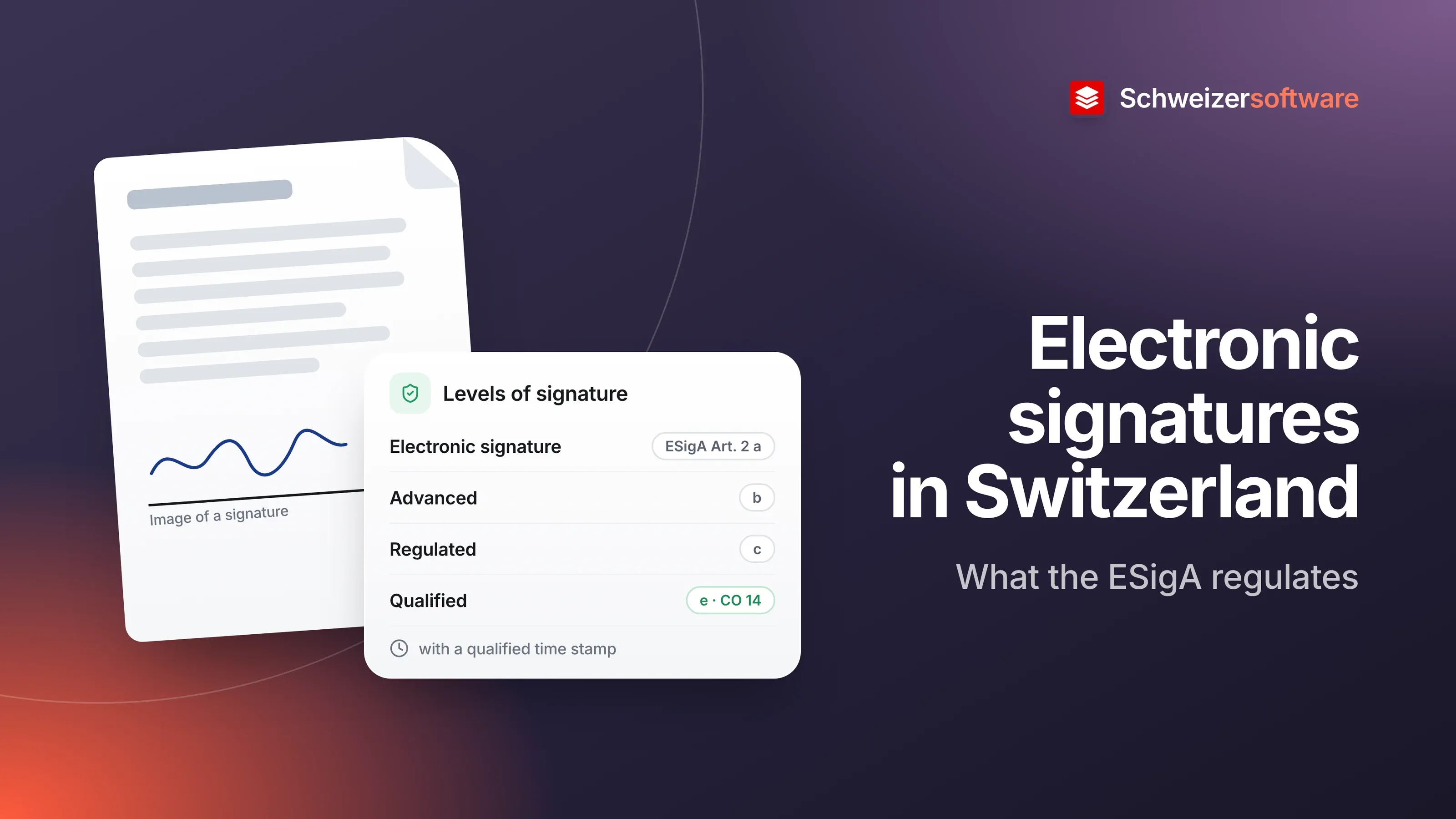
The Federal Act on Electronic Signatures (ESigA) defines several levels that build on one another (Art. 2 ESigA):
| Level | What defines it |
|---|---|
| Electronic signature | Data in electronic form that is attached to or logically linked with other data and serves to authenticate it |
| Advanced electronic signature | Uniquely linked to the holder, identifies them, created under their sole control, and linked to the data in such a way that any subsequent change can be detected |
| Regulated electronic signature | An advanced signature with a secure signature creation device and a regulated certificate for a natural person |
| Qualified electronic signature | A regulated signature based on a qualified certificate |
In addition, the Act provides for the regulated electronic seal, issued to a business with a UID, and the qualified electronic time stamp, which confirms that certain data existed at a certain point in time. Regulated and qualified certificates are issued by certification service providers recognised under the ESigA.
When a signature is needed at all
Most contracts do not need a signature. The CO states: contracts require a special form to be valid only if the law prescribes one (Art. 11 para. 1 CO). A contract is concluded by a mutual expression of intent, which may also be implied (Art. 1 CO). A quote confirmed by email can therefore be sufficient.
It is different where the law prescribes written form. The contract must then bear the signatures of all persons who are to be bound by it (Art. 13 para. 1 CO). Two examples from the CO:
- The assignment of a claim requires written form to be valid (Art. 165 para. 1 CO).
- A non-compete clause for the period after employment ends requires the employee to undertake the obligation in writing (Art. 340 para. 1 CO).
The parties can also agree on a form between themselves. It is then presumed that they do not intend to be bound before that form is fulfilled (Art. 16 para. 1 CO).
What is treated as equal to a handwritten signature
The CO requires the signature to be written by hand (Art. 14 para. 1 CO). For the electronic route there is an explicit rule: a qualified electronic signature under the ESigA combined with a qualified electronic time stamp is treated as equal to a handwritten signature; differing provisions of law or contract are reserved (Art. 14 para. 2bis CO).
This equivalence therefore applies to one particular level — not to every form that looks like a signature on the screen.
The time stamp
Besides the qualified signature, Art. 14 para. 2bis CO requires a qualified time stamp. The ESigA describes an electronic time stamp as a confirmation that certain digital data existed at a certain point in time. It is qualified if it is issued by a provider recognised under the Act and bears a regulated electronic seal (Art. 2 let. i and j ESigA). The time stamp thus records when a document was signed — a point that often matters for contracts.
The inserted signature image
In everyday use, “signing electronically” often means something simpler: drawing your signature on a tablet or inserting an image of your signature into a PDF. It looks like a signature and is quick to do.
Measured against the requirements of the ESigA, such an image lacks one thing above all: it is not linked to the document in such a way that a subsequent change can be detected — one of the requirements of an advanced signature (Art. 2 let. b no. 4 ESigA). Anyone who changes the PDF afterwards changes it without the image registering anything.
That does not mean a signature image is worthless. Where the law does not require a form, it shows that someone has seen and confirmed a document — much like an email saying “I agree”. But it does not replace a qualified electronic signature where one is meant.
What an advanced signature shows
An advanced or higher-level signature has a property that is useful in everyday work: its link to the data is meant to make any subsequent change detectable (Art. 2 let. b no. 4 ESigA). Anyone checking a signed file can thus establish whether it has been changed since it was signed. For the property maintenance firm, this means: a signed handover record cannot later have a line added to it unnoticed.
Signing and archiving
Signatures also play a role in retention. The Ordinance on Business Records (GeBüV) allows modifiable storage media for business records and accounting vouchers if technical procedures such as digital signatures ensure integrity and the time of storage can be proven, for instance by time stamps (Art. 9 GeBüV). How format and filing work together in archiving is described in the post PDF/A for archiving.
The choice in the business
For the property maintenance firm in Olten, the documents fall into groups:
| Document | Form required by law | Possible approach |
|---|---|---|
| Quote confirmation | no special form | Email or PDF with an inserted signature |
| Handover record | no special form | Signature on the tablet, PDF to both sides |
| Employment contract with non-compete clause | written undertaking (Art. 340 CO) | Paper or qualified electronic signature |
Which form a particular contract needs depends on its content and on what the parties have agreed. Where there is uncertainty, a professional is the right person to ask.
For the property maintenance firm in Olten
The firm switches over where that is straightforward: quotes are confirmed by email, handover records are signed on the tablet and sent to both sides as a PDF. For employment contracts with a non-compete clause, it stays with paper for now — until the firm has set up a solution with qualified electronic signatures.
The PDF tools we are building will, among other things, add text and insert a signature into a PDF — processed in Switzerland, in memory, without any file being kept. A signature inserted this way will be an image and not a qualified electronic signature within the meaning of the ESigA.
Sources
- 1.Bundesgesetz über die elektronische Signatur (ZertES, SR 943.03), namentlich Art. 2 (checked on 25 September 2026)
- 2.Obligationenrecht (OR, SR 220), namentlich Art. 1, 11, 13, 14, 16, 165 und 340 (checked on 25 September 2026)
- 3.Verordnung über die Führung und Aufbewahrung der Geschäftsbücher (GeBüV, SR 221.431) (checked on 25 September 2026)
Be told when it launches
This idea is still being planned. Sign up and we will write to you once, when it becomes an app. Signing up is non-binding – no newsletter, no advertising.
View the idea