
Photography6 min read
Quote, contract, deposit: holding a wedding date
How a quote becomes a contract and what a deposit means under Swiss law: earnest money, withdrawal money and contractual penalty, described for photographers.
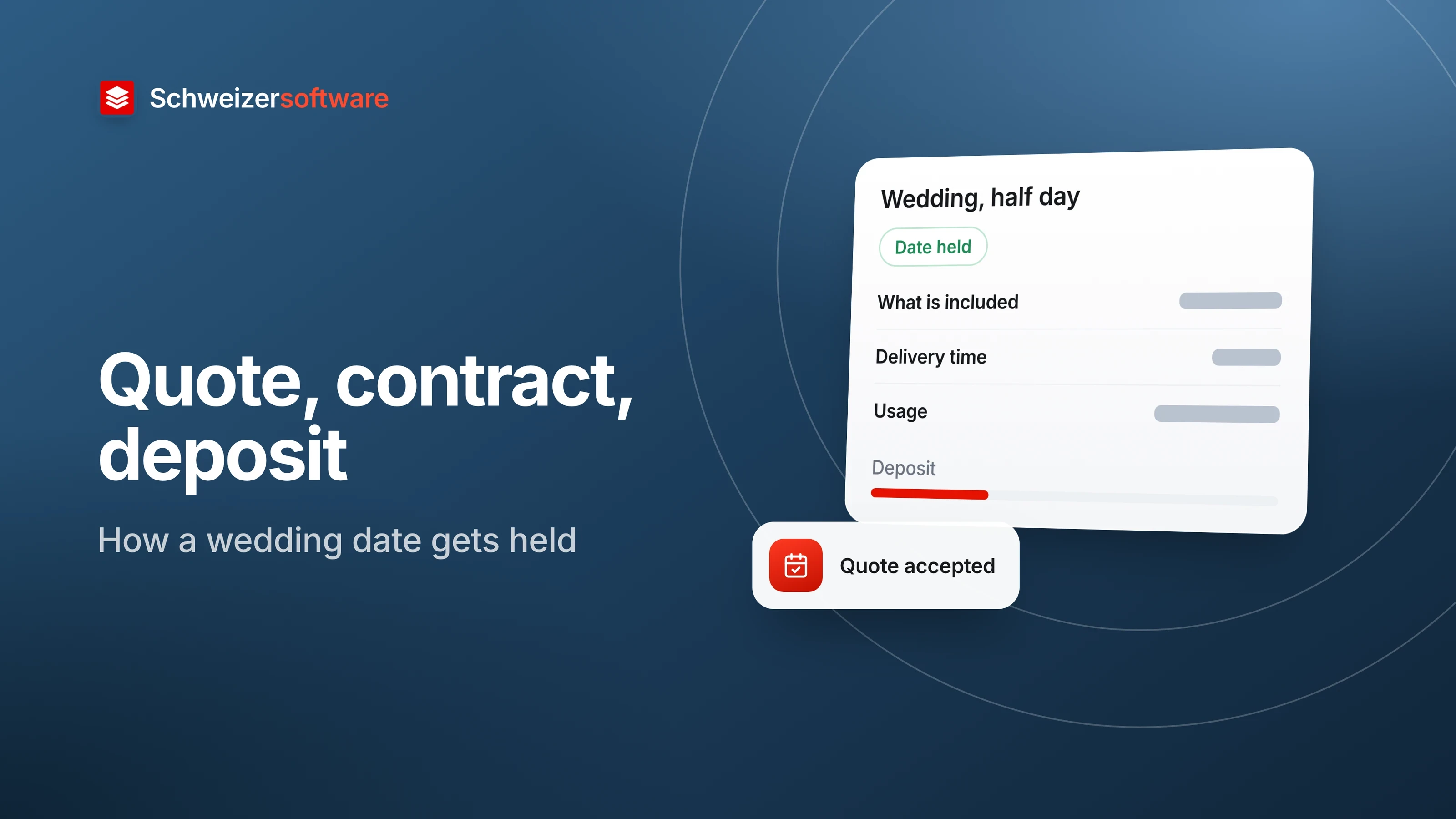
In January a photographer in Winterthur receives an enquiry from a couple: a wedding on a Saturday in August, half a day, with a second photographer. She writes a quote, the couple replies “That works, we’ll take it”, and the date goes into her calendar. No deposit has been mentioned. In April the couple writes again: they have changed their minds.
A situation like this is conceivable, and it hangs on one point: what exactly did the two sides agree, and from when? This post describes what the Swiss Code of Obligations says about quote, acceptance and deposit, and what a quote can state. It describes; it does not advise, and an individual case may differ.
When a quote becomes a contract
For a contract the law requires the “mutual expression of the parties’ matching intent”, which can be express or implied (Art. 1 CO). One side makes an offer, the other accepts. For a photographer’s quote that means: her quote is the offer, the couple’s yes is the acceptance.
Three further provisions matter for a quote:
- Time limit for acceptance. Whoever makes an offer and sets a time limit for acceptance remains bound until it expires. If the acceptance does not arrive in time, the offeror is free again (Art. 3 CO). A quote with a validity date, such as “valid until 15 February”, follows this logic.
- Reservation. The offeror is not bound if the offer comes with a statement rejecting it, or if such a reservation follows from the nature of the business or the circumstances. Merely sending tariffs or price lists does not in itself amount to an offer (Art. 7 CO). A price list on a website is therefore something different from a quote for a particular date.
- No form required. A contract needs a particular form only where the law prescribes one (Art. 11 CO). A handshake, an e-mail or a click on “Accept” can therefore be enough. An acceptance that can be traced later is easier for both sides to recall than a conversation on the phone.
What a quote can state
The law prescribes no content. Because a quote becomes the contract once accepted, it is worth looking at which details come up later:
| Detail | Why it is needed later |
|---|---|
| Date, start, length | The couple and the photographer mean the same day and the same time. |
| What is included | What is in and what is not: second photographer, album, travel. |
| Price and deposit | The total in CHF, the size of the deposit and when it is due. |
| Delivery time | Within what period the pictures are delivered. |
| Use of the pictures | What the client may do with the pictures (a separate post). |
| Cancellation terms | What applies if someone cancels, and until when it is free. |
| Validity of the quote | Until when the couple can say yes. |
If the parties have agreed on the essential points and only minor points remain open, it is presumed that the contract is binding anyway (Art. 2 CO). Where the sides later disagree, it helps if the quote says clearly what was meant.
Deposit: earnest money, not withdrawal money
The Code of Obligations separates terms that get mixed up in everyday speech. What is given as a deposit when the contract is concluded counts as earnest money (Haftgeld), not as withdrawal money (Reugeld). Unless contract or local custom provides otherwise, the recipient keeps the earnest money without deduction from their claim (Art. 158 paras. 1 and 2 CO). In other words, a deposit is first of all part of the price.
Withdrawal money exists only if it was agreed. Then the giver can withdraw by leaving what has been paid, and the recipient by returning double the amount (Art. 158 para. 3 CO). An example: with a total price of CHF 2,400 and a deposit of 30 per cent, so CHF 720, agreed withdrawal money would mean the couple can withdraw and leave CHF 720, while the photographer could withdraw by returning CHF 1,440.
A fixed sum in case of cancellation can be agreed as a contractual penalty. It is promised for the case of non-performance or improper performance. Unless otherwise agreed, the creditor can then demand either performance or the penalty (Art. 160 para. 1 CO). The parties set the amount; the judge reduces excessively high penalties at their discretion (Art. 163 paras. 1 and 3 CO).
| Term | What the law says | When it applies |
|---|---|---|
| Deposit, earnest money | Counts towards the price and stays with the recipient (Art. 158 paras. 1–2 CO) | At conclusion, unless agreed otherwise |
| Withdrawal money | Withdrawal by leaving it, or by returning double (Art. 158 para. 3 CO) | Only if agreed |
| Contractual penalty | Promised sum on non-performance; excessive amounts are reduced (Art. 160, 163 CO) | Only if promised |
When one side cancels
What applies on cancellation depends on how the contract is classified legally. The law has different rules, and which one applies follows from what the contract contains. Two examples from the Code:
- In a contract for work, where the contractor undertakes to produce a work (Art. 363 CO), the client can withdraw at any time while the work is unfinished, against payment for the work already done and full compensation of the contractor (Art. 377 CO).
- In a mandate, either side can revoke or terminate at any time; if this happens at an inopportune moment, the party withdrawing owes compensation for the damage (Art. 404 CO).
Whether a photo assignment, such as covering a wedding followed by editing the pictures, is closer to one or the other cannot be said in general. Anyone who does not want to leave the consequences of a cancellation to the law can describe them in the quote: until when a cancellation is free, what applies afterwards, and what happens to the deposit.
Holding the date until the deposit is in
In practice the question shows up mostly in the calendar: from when is a date taken? Between the couple’s yes and the deposit payment there are often days. In the quote a photographer can state that the date is held until the deposit arrives, for example for seven days after acceptance, and that a follow-up comes after that. Both sides then know where they stand, and a second enquiry for the same Saturday is not left uncertain.
A sequence that can be shown in a quote:
- The quote goes to the couple with a validity date.
- The couple accepts; the time and the version of the quote are recorded.
- The deposit is due within the stated period, for example by TWINT or QR-bill.
- Until then the date is marked as held in the calendar.
- Once the deposit is in, it counts as booked.
What we are building for this
We are building a web app for photographers in Switzerland. It will turn an enquiry into a quote in a few minutes, which the couple accepts by link; the accepted quote is meant to become a contract as a PDF, with date, price, delivery time, cancellation terms and the time of acceptance. The deposit will hold the date in the calendar until it is paid. Whether a deposit is taken, how much, and which cancellation terms apply, is up to you.
Sources
- 1.Obligationenrecht (OR, SR 220), Art. 1–11: Vertragsabschluss, Antrag und Annahme, Form (checked on 6 November 2026)
- 2.Obligationenrecht (OR, SR 220), Art. 158–163: Haftgeld, Reugeld und Konventionalstrafe (checked on 6 November 2026)
- 3.Obligationenrecht (OR, SR 220), Art. 363, 377 und 404: Werkvertrag und Auftrag (checked on 6 November 2026)
Be told when it launches
This idea is still being planned. Sign up and we will write to you once, when it becomes an app. Signing up is non-binding – no newsletter, no advertising.
View the idea