
Pool service4 min read
Recording water values in a pool report: what counts per visit
What a pool report can record per visit: pH, disinfectant, temperature, photos and parts. And why a firm’s notes are not an official water test.
On the phone, a client in Thun says her pool has looked cloudy since the weekend. Whoever has the report from the last visit at hand sees what was measured on 26 May, what was used and what the photos showed. Whoever does not has to ask the client or drive out.
This article describes what a pool report can record per visit and what the water values in it are for. It does not say which values are right or what to do at which value; that is for specialists at the pool to decide. It does not replace a legal assessment of an individual case.
What a report can record
A report per visit does not have to be long. It can consist of these parts:
- The visit’s checklist: what was done, for example baskets emptied, filter backwashed, floor cleaned
- Water values as numbers: pH, disinfectant, temperature, and depending on the pool also alkalinity or salt
- Materials: care products and spare parts used, with quantities
- Photos: before, after, anything unusual about the plant
- Hours per person
- A follow-up for next time, such as a dripping pump seal
It is the interplay that makes the report useful: the hours and materials produce the invoice, the follow-up a quote, and the water values show how a pool develops over the season.
The history matters more than a single value
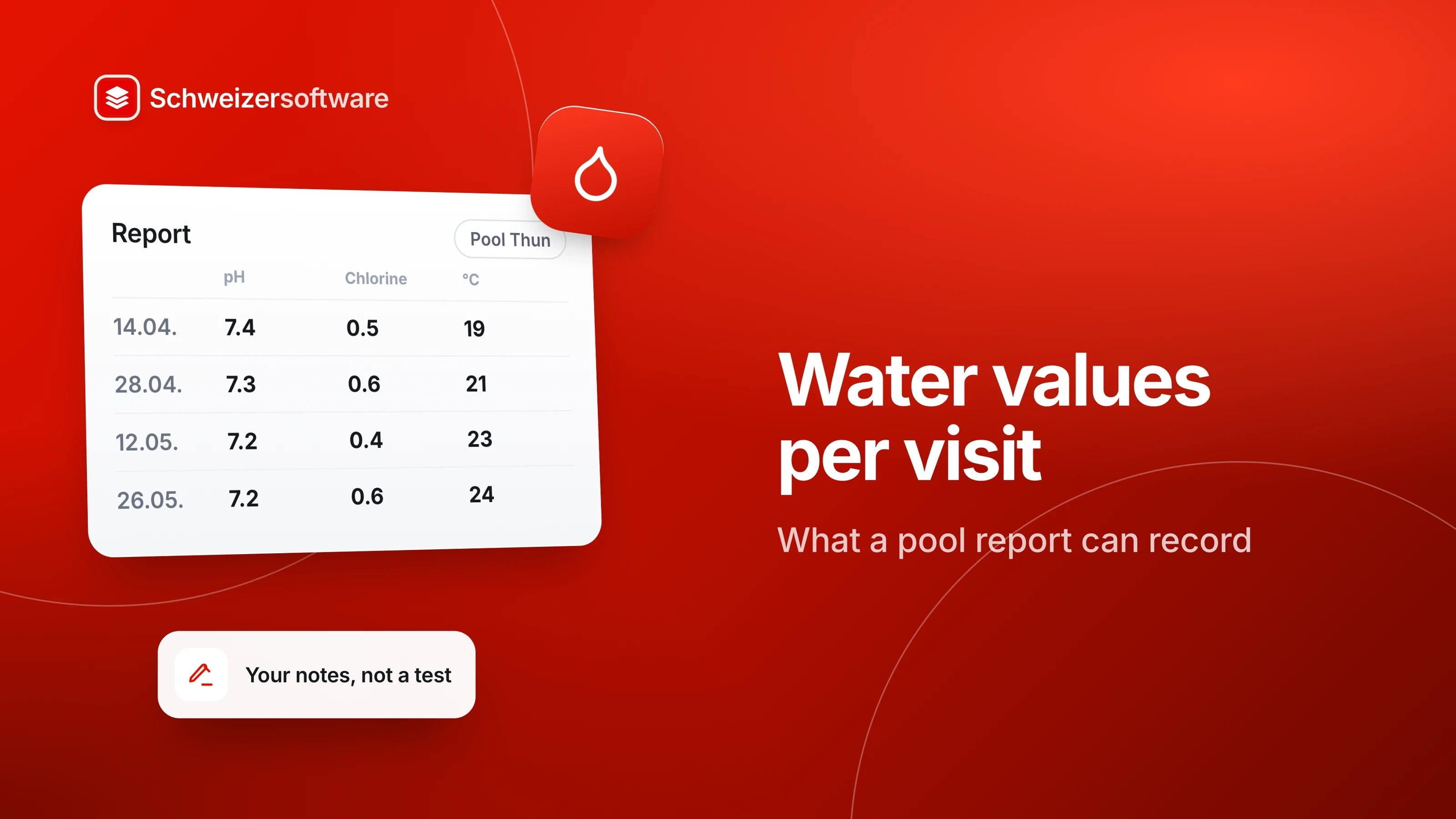
A single number says little unless it sits next to what was entered at the previous visit. An example of a history view:
| Date | pH | Chlorine (mg/l) | Temperature (°C) | Note |
|---|---|---|---|---|
| 14.04. | 7.4 | 0.5 | 19 | Opening, water clear |
| 28.04. | 7.3 | 0.6 | 21 | |
| 12.05. | 7.2 | 0.4 | 23 | Filter backwashed |
| 26.05. | 7.2 | 0.6 | 24 |
The numbers in this table are invented and judge nothing. Only the form is shown: the same fields at every visit, in the same unit, with the date before. Whoever stands at the pool sees at a glance what was entered last time.
On the disinfectant, the leaflet of the canton of Solothurn for private swimming pools states that in practice the chlorine content of bathing water is 0.2 to 0.8 mg of free chlorine per litre (as of March 2026). The leaflet deals with waste water, not with water care; the figure only shows the order of magnitude in which such values occur.
Notes are not an official water test
Baths open to the public have their own rules. The ordinance on drinking water and water in publicly accessible baths and shower facilities (TBDV) defines a publicly accessible bath as one that is open to the general public or to an authorised group of people and is not intended for family use. On its page about community baths, the Federal Office of Public Health (FOPH) describes that the TBDV sets, among other things, minimum and maximum disinfectant concentrations and microbiological limits. For self-monitoring it refers to the SIA standard 385/9, and the cantons oversee the hygiene of these facilities.
Water values in the report of a private pool are something else: they are the firm’s notes on a visit. That is no reason to keep them imprecisely. But it means a report is not a test certificate, and software that keeps it does not judge the numbers. Which pools fall under the TBDV, for example those in apartment blocks, is not answered in this article.
Recording the materials used
In many reports, care products are lines of their own, with quantity and unit: “chlorine tablets, 2 kg”, “pH minus, 0.3 kg”. The invoice comes from them, and at the next visit it is visible what was used last.
In a press release in June 2026, the Food Safety and Veterinary Office of the canton of Fribourg reminded owners of private swimming pools to follow the instructions for use and storage of treatment products and to use only biocidal products approved in Switzerland, recognisable by an approval number beginning with “CHZ”. Whether a firm keeps this number in the report or in its price list is its own decision.
Photos and a look at the plant
Photos show what numbers do not: the colour of the water, the state of the cover, a pump housing with traces of moisture. A photo of the pool often shows the house and garden too. One way to deal with that is a hint in the camera view such as “Photograph the pool and the plant, not people”.
How the idea fits
Our idea for pool service firms makes the report its centrepiece: on the phone the app will take a checklist, water values, photos, materials used and hours, and show the values of the last visit beside the fields. It will neither judge the numbers nor recommend a dose; the fields are the firm’s notes. The invoice with QR-bill is meant to come out of the report.
Sources
- 1.Amt für Umwelt Kanton Solothurn: Merkblatt Private Schwimmbäder, Abwasserbeseitigung (Stand März 2026) (checked on 6 November 2026)
- 2.BAG: Gute Wasser- und Luftqualität in Schwimmbädern (checked on 6 November 2026)
- 3.Verordnung des EDI über Trinkwasser sowie Wasser in öffentlich zugänglichen Bädern und Duschanlagen (TBDV, SR 817.022.11) (checked on 6 November 2026)
- 4.Kanton Freiburg, LSVW: Medienmitteilung zur Wasserqualität in Schwimmbädern (22. Juni 2026) (checked on 6 November 2026)
Be told when it launches
This idea is still being planned. Sign up and we will write to you once, when it becomes an app. Signing up is non-binding – no newsletter, no advertising.
View the idea