
Nail studio8 min read
Running a nail studio: refill appointments and regular clients
Why the refill rhythm shapes a nail studio calendar, and how follow-up appointments, reminders and the client file fit together.
Updated on
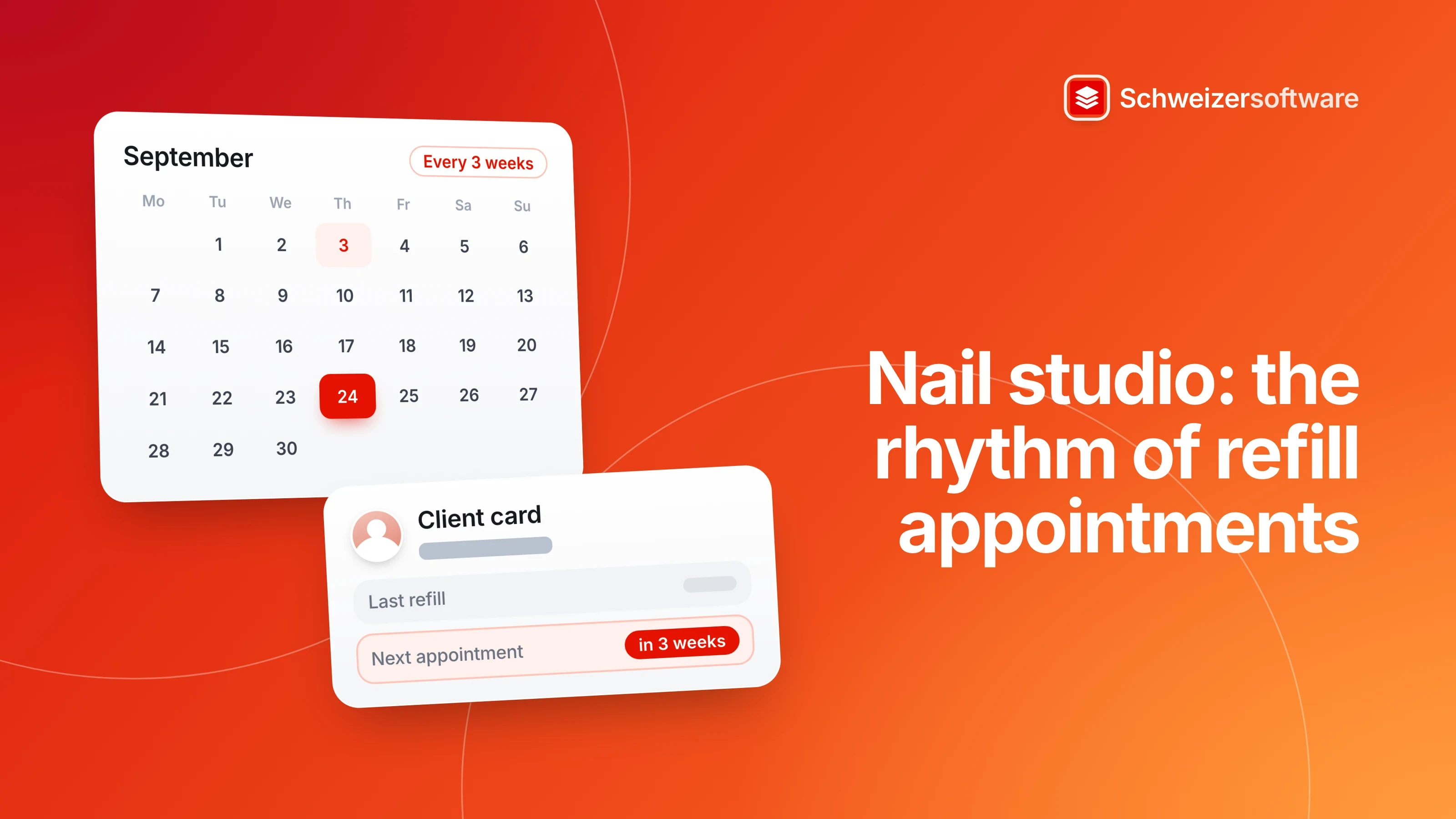
A nail studio in Baden, one nail technician, one workstation, four days a week. Around sixty clients come regularly, most for gel, some for acrylic. On Tuesday the calendar is half empty, while Saturday is full for the next three weeks. A regular client calls because her nails are due in four days, and there is nothing left. Another has not been in for six weeks, and nobody has noticed.
None of this is a mistake. It is the result of a business that runs to a fixed beat: an extension grows out, and after a few weeks the refill is due. That beat shapes the calendar of a nail studio more than in almost any other business with individual appointments. Anyone who knows it can plan for it.
Why the refill rhythm decides the calendar
At a hair salon, a client comes when she feels it is time. At a nail studio, the extension sets the moment. The rhythm a nail technician agrees with her clients is her own decision and differs from client to client. At the studio in Baden it is three to four weeks for most.
From that, the calendar can almost be calculated. If sixty regular clients come every three and a half weeks on average, that is a good seventeen refill appointments a week, before a single new set, manicure or pedicure has been entered.
| Assumption for the studio in Baden | Value |
|---|---|
| Regular clients with extensions | 60 |
| Average rhythm | 3½ weeks |
| Refill appointments per week | around 17 |
| Length of a refill | 75 to 90 minutes |
| Working time spent on refills | around 23 of 32 hours |
The figures are an example, but the arithmetic applies generally: a large part of the week is already taken before it begins. Free time for new clients only appears where regulars do not want to be. And because many working clients prefer Saturday or early evening, the appointments pile up in the same places.
The follow-up appointment before she leaves
The most effective remedy for the full Saturday is as old as the trade: the next appointment is agreed before the client leaves the studio. Someone who books today for three weeks from now still finds a slot at the time she wants. Someone who only calls when her nails are due takes what is left.
There are three common ways to handle the follow-up appointment:
- Fixed at the till. The nail technician suggests the appointment at the usual interval, and the client agrees or picks another day. This fills the calendar early and reliably, but it depends on someone remembering at the end of every treatment.
- Booked by the client, with a prompt. The client books online later but receives a message after the appointment saying roughly when the next refill is due. This leaves her the choice, but the popular times can run empty until others have taken them.
- A fixed series. Some regulars have come every third Friday at 5 pm for years. For them the studio enters several appointments at once and sorts out holidays when needed.
Many studios mix the three. What matters is less the form than the habit: a follow-up appointment that is only sometimes agreed leaves exactly the gaps that stand out in the example from Baden.
When the rhythm breaks
A rhythm is a plan, and plans break. Holidays, a move, a switch back to natural nails or a busy month at work, and three weeks become six. For the studio this has two consequences.
The first is practical: the longer the break, the more has grown out, and the longer the refill takes. The studio in Baden therefore allows a quarter of an hour extra after more than five weeks, or discusses whether a new set makes more sense.
The second is less obvious: a client who stops coming rarely says so. She is simply missing. A calendar only shows who comes, not who stays away. A client list with the date of the last visit makes it visible: someone who has not been in for eight weeks although her rhythm is three weeks may just have missed the follow-up appointment, or may have found another studio. Either is information that only stands out in hindsight.
The client file as the studio’s memory
With regular clients, remembering is half the craft. Which shape, which length, which colour last time, which design for her sister’s wedding. Many studios keep this on index cards, in the phone or in their heads. As long as one person works alone, that works. As soon as a second nail technician in the same studio takes over a client, something is missing.
A client file for a nail studio typically contains:
| Detail | What it is for |
|---|---|
| Contact (name, phone or email) | Confirming, moving and reminding about appointments |
| Last visit, service, rhythm | Planning the next appointment |
| Shape, length, colours, design | Repeating the result or changing it on purpose |
| Photo of the design | The same as above, only more precise |
| Intolerances, if mentioned | Not using a product again |
The last row carries its own weight. Under the Swiss Federal Act on Data Protection (FADP), information about health is among the particularly sensitive personal data (Art. 5 let. c FADP). The general principles apply as well: processing must be proportionate, data may only be collected for a recognisable purpose, and it is destroyed or anonymised as soon as it is no longer needed for that purpose (Art. 6 FADP). For a nail studio this means in practice: an intolerance is recorded because the client mentioned it and because it matters for the next treatment. If a client has not come for years, her card has served its purpose.
Photos deserve a thought too. A photo for the studio’s own file is something different from a photo on the website or the studio’s social media profile. In its FAQ, the Federal Data Protection and Information Commissioner (FDPIC) states that pictures of other people may in principle only be published with their permission. Some studios therefore photograph only the hands and ask before publishing.
Reminder or advertising
A nail studio sends two kinds of message that look alike. One reminds about an agreed appointment: “Your appointment on Friday, 5 pm”. The other is typical of nail studios: it reminds the client that a refill is coming due for which no appointment exists yet, and invites her to book.
This second message is closer to advertising. The Unfair Competition Act (UCA, UWG in German) contains a rule on mass advertising by email and SMS (Art. 3 para. 1 let. o UWG). The FDPIC summarises it on its page on advertising and marketing like this: in principle, prior consent is required. An exception applies to clients who have already bought something or used a service, if the advertising concerns similar services of the same business and can be declined at any time. In every case the sender must be identifiable and there must be a simple, free way to decline further messages.
At least as important as the rule is the tone. A regular client who decides herself whether she wants to be reminded of the refill experiences the message as a service. Someone who receives one every week after a break experiences it as pressure. When contact details are collected, the client also has to learn what they are used for (Art. 19 FADP).
Room for new clients
A calendar that fills up with regulars leaves little room for new ones. A new set takes longer than a refill and often needs a conversation about shape and length. If a new client only gets a slot when something happens to be free, the studio hardly grows.
Some studios therefore deliberately keep two or three longer time windows free each week for new sets and only release them to regulars a few days beforehand. Others rotate the popular times: whoever had Saturday this month is offered a Thursday evening next month. Both approaches assume that the studio knows who is due when in their rhythm.
Seen from the other side, as a client, it is simpler: someone who knows when the next refill is due and has the appointment early never has to ask for a slot. For a private person, the follow-up appointment at the till is therefore often the most convenient solution.
What makes everyday work easier
The order of a nail studio comes from a few details: who was last in and when, at what rhythm she comes, and what was done last time. When they are in one place, follow-up appointments can be suggested, clients who stay away can be spotted, and time can be planned for new ones.
The idea for nail studios that we are working on starts exactly there: at checkout the app will suggest three slots for the next refill, at the client’s usual interval and with the same designer, and keep the treatments on a nail card for every visit.
Sources
- 1.Bundesgesetz über den Datenschutz (DSG, SR 235.1), Art. 5, 6 und 19 (checked on 10 October 2026)
- 2.Bundesgesetz gegen den unlauteren Wettbewerb (UWG, SR 241), Art. 3 Abs. 1 Bst. o (checked on 10 October 2026)
- 3.EDÖB: Werbung & Marketing (checked on 10 October 2026)
- 4.EDÖB: FAQ Datenschutz, «Darf ich Fotos von anderen Personen veröffentlichen?» (checked on 10 October 2026)
Be told when it launches
This idea is still being planned. Sign up and we will write to you once, when it becomes an app. Signing up is non-binding – no newsletter, no advertising.
View the idea