
6 min read
Why we build software only for Switzerland
Four languages, Swiss francs, the QR-bill, cantonal differences and the FADP as the starting point: what it means to build web apps for Switzerland alone.
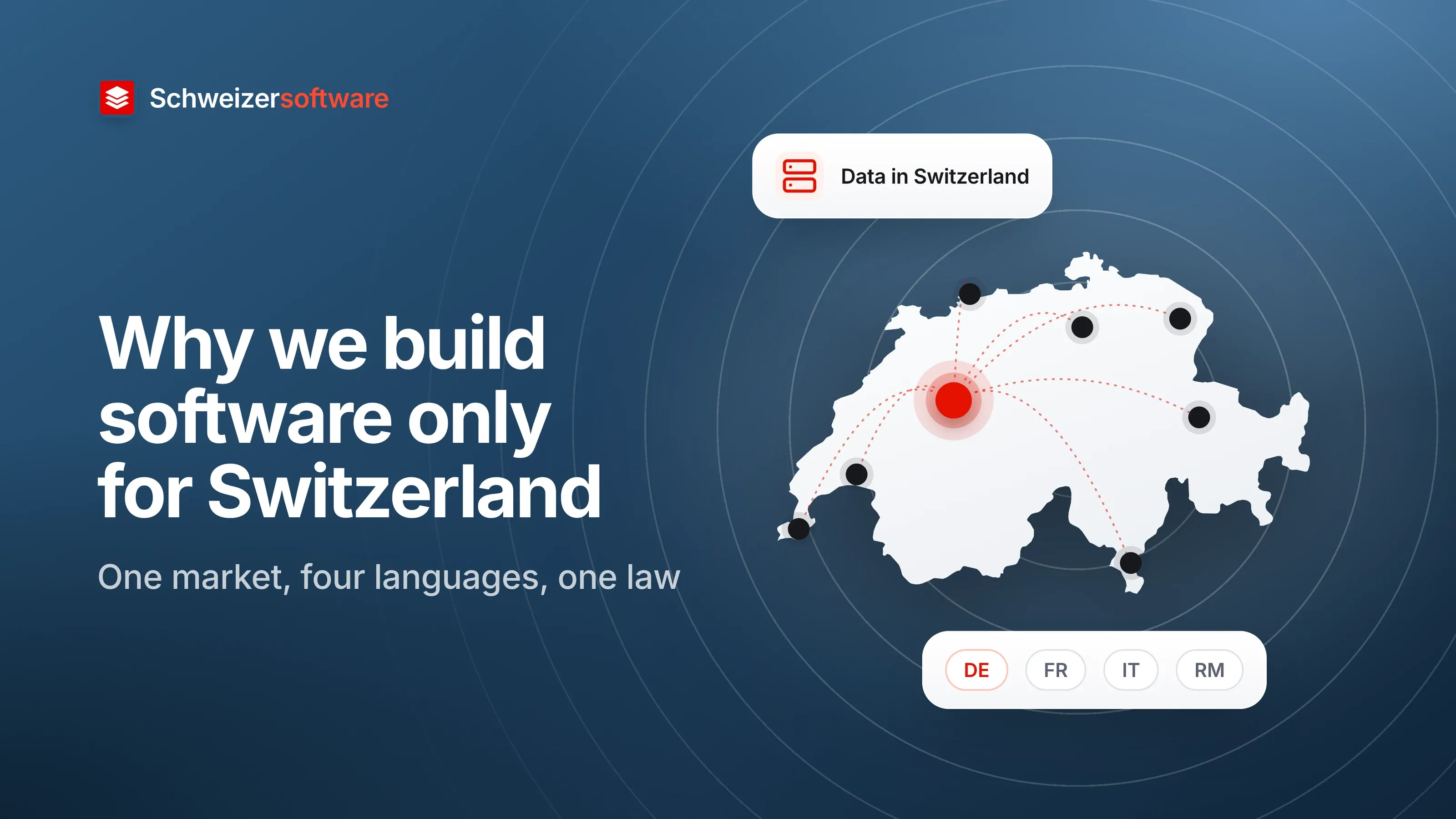
If you run a practice, a workshop, an office or an association in Switzerland, you know the moment. You go looking for software for an entirely ordinary job — appointments, invoices, registrations — and you find a dozen products that almost fit. The interface is available in German, but not in Italian. It produces invoices, but not QR-bills. The calendar knows public holidays, just not the ones in your canton. And when a customer asks where her details are actually stored, there is no answer that fits into one sentence.
None of that is a fault in those products. It follows from Switzerland not being the starting point when they were designed, but a special case added later. We build web apps exclusively for Switzerland. This post sets out what that means in practice — and what we leave out for it.
Four languages, not one language with three translations
Article 4 of the Federal Constitution names four national languages: German, French, Italian and Romansh. Under Article 70, the official languages of the Confederation are German, French and Italian, with Romansh added in dealings with people who speak it. The cantons decide their own official languages. The Federal Statistical Office also records that 12 per cent of the population give no national language at all as their main language.
For software, this is more than a language switcher in the footer. A registration form that fits one column in German needs noticeably more room in French. A term that is obvious in Zurich is a different word in Ticino, not merely the same word in another language. Date formats, forms of address and invoice wording shift with it.
When multilingualism is planned from the outset, it belongs to the app: every label, every email and every printed document exists in the languages people actually work in. When it arrives later, it often stays a translation layer over an interface designed for one language — and it shows.
The small formats: francs, QR-bills, cantons
According to SIX, the QR-bill has been in circulation since June 2020 and definitively replaced the earlier payment slips on 1 October 2022; the Swiss QR Code carries the information needed for a payment in digital form. Anyone issuing invoices in Switzerland today works with that format. Software that outputs invoices as a PDF and treats the QR-bill as an add-on creates manual work at exactly that point.
Public holidays are similar. Article 110 paragraph 3 of the Federal Constitution makes 1 August the national holiday. The Labour Act puts it on the same footing as Sundays in Article 20a, and allows the cantons to treat at most eight further holidays a year in the same way — and to set them differently in different parts of a canton. A single list called “Swiss public holidays” is therefore wrong for part of the country, every year again.
Then there are the amounts themselves. Swiss francs and the Swiss number format are our starting point, not a currency setting to be changed. None of this is a large topic. It is just there every day.
The Data Protection Act as a design basis, not an afterthought
Article 7 of the Swiss Federal Act on Data Protection (FADP) requires data processing to be shaped, technically and organisationally, so that data protection rules are met — and to be considered from the planning stage onwards. Paragraph 3 requires suitable default settings that keep processing to the minimum needed for the purpose. Article 6 sets out the principles: lawful, in good faith, proportionate, for a purpose the person can recognise — and destruction or anonymisation once the data are no longer needed for that purpose.
These are statements about architecture. Which fields a form has at all, how long answers stay, who in the business sees what: those decisions are made at design time and are hard to change afterwards. Article 5 letter c also lists what counts as sensitive personal data — among them data on health, on philosophical or trade-union views, and biometric and genetic data. For a physiotherapy practice or an advice centre, that is not an edge case but the everyday.
We design our apps to those requirements. That is a statement about how we build, not a guarantee of an outcome: whether a particular processing operation is lawful always depends on what an app is used for as well.
Where the data sit — and what location does not answer
Our apps store their data on infrastructure in Switzerland. It makes the answer to that customer’s question short, and it keeps the case inside one legal system.
Being honest means saying what a location does not answer. Article 16 FADP governs the disclosure of personal data abroad and ties it to conditions — a determination by the Federal Council that the state concerned offers adequate protection, for instance, or contractual safeguards. Article 19 requires that the person be informed about the collection, and, where data go abroad, about the country as well. A data centre in Switzerland therefore says nothing yet about who accesses it from where, or which services run in the background.
That applies to us too. This website itself is delivered through Cloudflare, a provider with a worldwide network of data centres; the technical data arising when a page is requested may be processed outside Switzerland as a result. What is in Switzerland is the information from the waiting list and the contact form, in a data centre in Zurich. Both are stated in our privacy policy. We write it here because the difference between “developed in Switzerland” and “stored in Switzerland” otherwise blurs — for us as much as for anyone else.
What we leave out for it
A focus only counts as a focus once it costs something. Ours costs this:
| We build | We do not build |
|---|---|
| Single apps that each do one job | All-in-one suites that do everything halfway |
| Features Swiss working life actually needs | Every feature a globally used product ships with |
| Apps funded without selling data | The cheapest option on the market |
| Apps for Switzerland | Apps for other markets |
Anyone with a very particular workflow for which exactly one product exists worldwide is better served by that product than by a narrow app from Switzerland. That is not false modesty but the other side of the same decision: we build for a small market and can therefore go deep into it — but only into it.
The points in this post can be looked up for any software, ours included. In which languages does the interface really exist, and in which do the emails and the generated documents? Does the QR-bill come out of the app itself? Can public holidays be set per canton? In which country do the data sit, and which further providers are involved? The answers are usually in the provider’s documentation or privacy policy — and where they are missing, that is an answer too. The ideas we are currently working on are listed on our Ideas page; most of them are not yet available as apps.
Sources
- 1.Bundesverfassung der Schweizerischen Eidgenossenschaft (SR 101) (checked on 23 September 2026)
- 2.Bundesgesetz über den Datenschutz (DSG, SR 235.1) (checked on 23 September 2026)
- 3.Bundesgesetz über die Arbeit in Industrie, Gewerbe und Handel (Arbeitsgesetz, SR 822.11) (checked on 23 September 2026)
- 4.SIX: QR-Rechnung – Swiss Payment Standards (checked on 23 September 2026)
- 5.Bundesamt für Statistik: Sprachen (checked on 23 September 2026)
Follow our ideas
Look at our ideas and ask to be told once when one of them becomes an app. Or write to us – about an idea, about a task that deserves an app, or just to say hello.