
Garden maintenance6 min read
Garden maintenance yearly plan: seasons, pricing and rain days
How a yearly plan for garden maintenance can be built: work by month, three ways to bill it, and what a rain day changes in the weekly schedule.
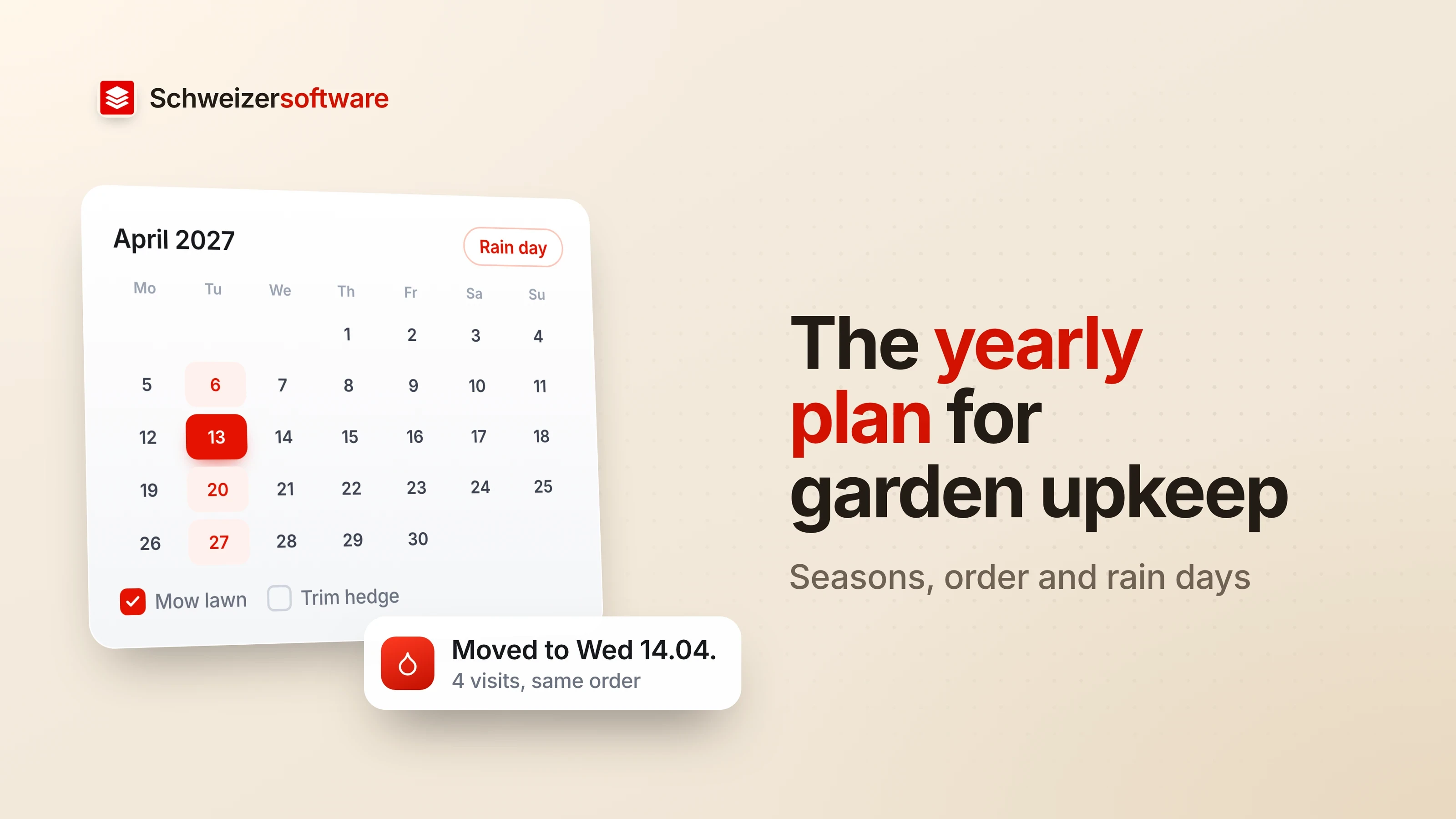
A gardener in Winterthur looks after 38 gardens. On Mondays he mows in Töss, on Tuesdays he trims hedges in Seen, on Wednesdays a rose pruning is due, and every second Friday it is the property manager’s garden. In his head it works, as long as nothing gets in the way. Then it rains for two days, a client leaves on holiday, and the plan for the week is only a list of wishes.
Anyone who looks after gardens all year works with repetition. This post describes how a yearly plan for garden maintenance can be built, what ways there are to bill it, and what a rain day has to do with the weekly schedule.
What a yearly plan contains
A yearly plan belongs to one garden. It records which jobs fall in which months and how often. One row per job is enough, as in this invented example for a terraced-house garden:
| Job | Months | Rhythm |
|---|---|---|
| Mow lawn | March to November | every two weeks |
| Trim hedge | June and October | once each |
| Weed and tend beds | April to October | monthly |
| Clear leaves | October to December | as needed |
| Winter pruning of shrubs | January and February | once |
The individual visits come out of these rows. A visit is one trip to a garden in which one or more jobs are done. When mowing every two weeks coincides with the bed-care date, it makes sense to put both into one visit: one trip instead of two.
Then there is what no plan predicts. The note “hedge needs a hard cut next spring” stands at the end of a visit and should still be there next year. Where the key is kept or which hedge belongs to the neighbour also belongs to the garden, not in a chat message.
Three ways to bill upkeep
The plan says what is done. How it is paid is a second decision, and in upkeep three models can be told apart:
| Model | What is billed | What it makes easy | What it needs |
|---|---|---|---|
| Hours and material | Time worked per person, plus material and disposal | The invoice matches what was done | Clean hour recording per visit |
| Fixed price per job | One fixed price per job, such as one hedge trim | The client knows the price in advance | A price list and experience with the effort |
| Yearly price in instalments | One fixed amount for the year, in parts | Even amounts, few invoices | A plan that states scope and rhythm clearly |
Which model suits a business depends on its clients: a property manager with many properties often thinks in fixed amounts, a homeowner with a wild garden more in hours. Mixed forms exist too, for instance a yearly price for the regular work and hours for special requests.
Where a business is subject to VAT, it appears on the invoice. According to the Federal Tax Administration, the standard rate has been 8.1 per cent since 1 January 2024; whether and from when a business is liable is explained by the FTA on its pages.
For private people it looks different than for property managers. A homeowner who hires a gardener usually wants to know roughly what the year costs and when someone comes. A condominium owners’ association also asks which resolution covers which job. A yearly plan that shows jobs, months and pricing model on one page answers both questions without anyone having to phone.
Why the soil has a say in the weather
A rain day does not only move the appointment, it also changes what makes sense on the ground. The Federal Office for the Environment explains, on soil compaction, that moisture and clay content determine how easily soil compacts: the wetter a soil, the lower its stability. As a warning sign it names water that stays on the surface for a while because it cannot soak in. The FOEN describes mainly farming, forestry and construction there; the relationships are the same for any soil.
What follows for a particular visit is for the professional on site to judge: whether a wet lawn is mown today, whether a bed can wait, whether the machine should drive on this path. For planning it only means: a rain day is rarely a free day, it is a day on which something else makes more sense.
The season bar: the year at a glance
A table like the one above is clear for one garden, not for forty. A bar with twelve months then helps, on which each visit is a mark: lawn cuts as a row of small marks, the hedge trim as two single ones, the leaves as a bar at the end of the year. It shows at a glance in which week a garden bundles many jobs and where a gap remains. Whoever drags a mark into another week moves the visit, not the whole plan.
What a rain day triggers in the weekly schedule
A maintenance business plans on two levels. The week decides which visits are due. The day decides who is where and when. Rain intervenes in the second level, and the question is how much of the first it takes along.
If a day is cancelled, the visits of that day need a new place. There are three ways:
- To the next working day. Everything slides by a day, the order stays. In return what was planned for that day anyway is pushed back.
- Back to the weekly list. The visits are “due this week” again and are distributed over days anew when the weather is clearer.
- Decide one by one. One visit goes ahead despite the rain, another does not, for example because there is something to do indoors or under cover.
Then there are the people at the other end: anyone who announces visits does not want to phone every client individually when something moves. Two things make it easier when they are in the plan: a fixed order, so nobody has to recalculate all the time, and a visible difference between “due this week” and “placed on a day”. A rain day can then be shown in one step instead of twenty phone calls.
What does not belong on the plan: products on paved surfaces
Planning also includes what a business does not do. The FOEN states that herbicides must not be used on or along roads, paths, squares, terraces and roofs, and that plant protection products can be used only on vegetated ground such as lawns, beds and gardens. The ban is in the Chemical Risk Reduction Ordinance, Annex 2.5. Whoever keeps the squares and paths of a garden in the plan can provide a separate row there for hand work, sweeping or mechanical means.
How our idea approaches it
We are building a web app for gardeners with upkeep contracts. Its yearly plan will appear per garden as a bar of twelve months; from the plan it will derive the visits that are due in the week, and a rain day will be movable to another day in one step, in the same order. Billing can be by hours and material, per job or with a yearly price in instalments. All in CHF, on infrastructure in Switzerland.
Sources
- 1.BAFU: Bodenverdichtung (checked on 6 November 2026)
- 2.BAFU: Pflanzenschutzmittel im Hausgarten und beim Liegenschaftsunterhalt (checked on 6 November 2026)
- 3.Chemikalien-Risikoreduktions-Verordnung (ChemRRV, SR 814.81), Anhang 2.5 (checked on 6 November 2026)
- 4.ESTV: Schweizer Mehrwertsteuersätze (checked on 6 November 2026)
Be told when it launches
This idea is still being planned. Sign up and we will write to you once, when it becomes an app. Signing up is non-binding – no newsletter, no advertising.
View the idea