
Dog grooming salon6 min read
The Dog Card in a Grooming Salon: What Goes on It and What Does Not
Size, coat, behaviour, last cut: what a dog card in a grooming salon holds, where the data protection act applies and how animal welfare rules and the microchip fit in.
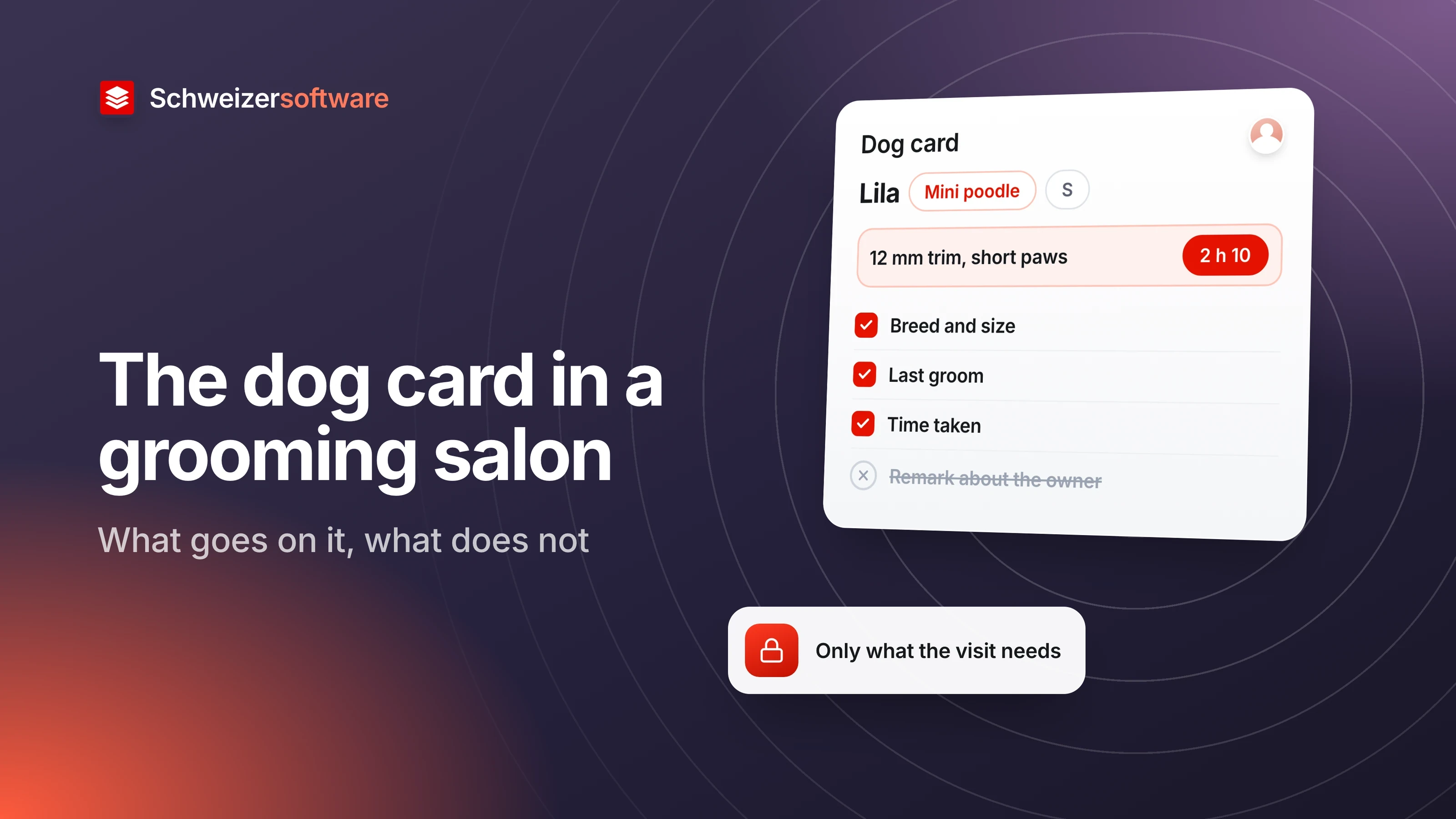
A dog groomer in Thun has kept her clients in a ring binder for years. One page per dog: “Lila, miniature poodle”, then “12 mm clip, short paws”, “fidgets at the ears”, date and price. Since a second groomer started working two days a week, he reads the binder too, and the entries are no longer just memory aids for one person. Some pages also say something about the owner: “often phones just beforehand”, “always wants a discount”.
A dog card is the most important tool of a grooming salon, because it prepares the appointment: it says how long the dog needs, what was done last time and what to watch for. This post goes through what belongs on such a card, where the law has a say and which details a salon may prefer not to write down.
Two halves: the dog and the person behind it
A dog card holds two kinds of information. Some describe the animal, others the person who brings it. The Federal Act on Data Protection (FADP, “DSG” in German) defines personal data as all information relating to an identified or identifiable natural person (Art. 5 lit. a DSG). A dog is not a person. But as soon as its card is attached to an owner, with a name, a phone number and appointments, the card as a whole generally contains personal data.
| Half | Typical fields |
|---|---|
| Dog | name, breed, size, coat type, photo, notes, groom history, time taken |
| Person | name, phone, e-mail, address for home visits, consents |
The distinction helps when building the card: everything in the first row serves the purpose “prepare the appointment properly”. For the second row it is worth asking whether a field is actually needed.
What belongs to the dog
A card that helps at the grooming table is short and built the same way as the next one. This selection is common:
- Breed and size. Size often decides duration and price. There is no uniform legal classification; each salon sets its own classes, for example by weight and shoulder height, and writes them down for its clients.
- Coat and condition. Coat type, length, whether it is matted. A matted dog needs more time, and a note on it explains later why the appointment ran long.
- The last cut. Length in millimetres, shape, special wishes. This is the detail read most often next time, which is why it works best at the top.
- Time taken. How long the dog really needed last time is more reliable than an estimate by breed.
- Handling notes. Sensitive ears, needs breaks, dislikes the dryer.
- Rhythm. Every six weeks, every ten weeks: that tells you when the next appointment is due.
The microchip: a number that already exists
In Switzerland dogs must be identified with a microchip. The Epizootic Diseases Ordinance requires this no later than three months after birth and in any case before the dog is passed on by the keeper at whose home it was born (Art. 17 TSV). At identification the veterinarian records, among other things, the dog’s name, sex, date of birth, breed and coat colour in the dog database.
A grooming salon does not run this database and does not have to replicate it. The chip number can, however, be a unique feature on the card when two dogs among the clients share the same name. Whether a salon notes it is its own decision; Art. 17 TSV contains no duty for salons to keep the number.
Behaviour, aids and stopping a groom
Two provisions of the Animal Welfare Ordinance (TSchV) touch on what the notes say.
Aids. Under Art. 76 para. 5 TSchV, aids placed around a dog’s muzzle to prevent bites must be anatomically shaped and allow sufficient panting. A card reading “needs muzzle” therefore does not say everything: for dogs that are secured for protection, the kind of aid matters too.
Mistreatment and overexertion. Art. 16 para. 1 TSchV prohibits mistreating, neglecting or unnecessarily overexerting animals. If an appointment is stopped because the dog is stressed, the card records it in a sentence: what was done, what was not and why. The next appointment can then be planned differently, for example in two shorter parts. At the same time the note is an explanation for the owner if the price differs from the quote.
What the card does not have to carry
The more a card holds, the more applies to it. The FADP requires that personal data be processed proportionately (Art. 6 para. 2) and only for a specific, recognisable purpose (Art. 6 para. 3). For the card this mainly means that notes about the owner are something different from notes about the dog.
| Note | What it says something about | Observation |
|---|---|---|
| “Bites at the paws” | the dog | helps the appointment |
| “Owner is difficult” | the person | a judgement rather than a fact |
| “Often brings the dog late” | the person | concerns the schedule; could be phrased as a note on the appointment |
| “Owner’s date of birth” | the person | not required for grooming |
The law also requires data to be accurate (Art. 6 para. 5) and gives the person concerned a right of access (Art. 25 DSG): anyone who wants to know what a salon has stored about them can ask for the personal data being processed. A card whose notes could be shown to the owner without embarrassment usually has the right measure. There is also the duty to inform (Art. 19 DSG): when collecting data the salon tells the owner at least who it is, what it needs the data for and, where relevant, to whom it passes it on.
How long the card stays
Again there are two rules for two parts of the records.
The invoice. Accounting vouchers such as receipts and invoices must be kept for ten years, counted from the end of the financial year (Art. 958f para. 1 OR). That concerns what was sold and paid.
The card. There is no such period for notes on the dog. The FADP requires personal data to be destroyed or anonymised as soon as it is no longer needed for the purpose of processing (Art. 6 para. 4). The purpose of a dog card is grooming; if a dog has not come for years, part of that purpose has been served. A salon can therefore set a period after which a card is reviewed. That also brings clarity for access requests: under Art. 25 para. 2 lit. d DSG, the retention period or the criteria for it are part of the answer. The invoice stays in the books that way, even if the card is long no longer kept.
A card that fits the salon
A good dog card is a few lines long, built like all the others and readable at the grooming table: dog, size, last cut on top, time taken, handling notes. It holds details about the owner only as far as the appointment needs them. The FADP also requires privacy-friendly default settings (Art. 7): in software that means only the fields the salon actually uses appear.
The idea for dog grooming salons that we are working on follows this order. The app will keep the dog card with the last cut on top, record the time taken and derive the length of the next appointment from it. It will store the data on infrastructure in Switzerland.
Sources
- 1.Bundesgesetz über den Datenschutz (DSG, SR 235.1), Art. 5, 6, 7, 19 und 25 (checked on 6 November 2026)
- 2.Tierseuchenverordnung (TSV, SR 916.401), Art. 17 Kennzeichnung der Hunde (checked on 6 November 2026)
- 3.Tierschutzverordnung (TSchV, SR 455.1), Art. 16 und Art. 76 (checked on 6 November 2026)
- 4.Obligationenrecht (OR, SR 220), Art. 958f (checked on 6 November 2026)
Be told when it launches
This idea is still being planned. Sign up and we will write to you once, when it becomes an app. Signing up is non-binding – no newsletter, no advertising.
View the idea