
Driving school8 min read
The driving-school car: dual pedals, L plate and planning
Which rules apply to driving-school vehicles in Switzerland, from dual pedals and extra mirrors to the L plate, and how a driving school plans its cars.
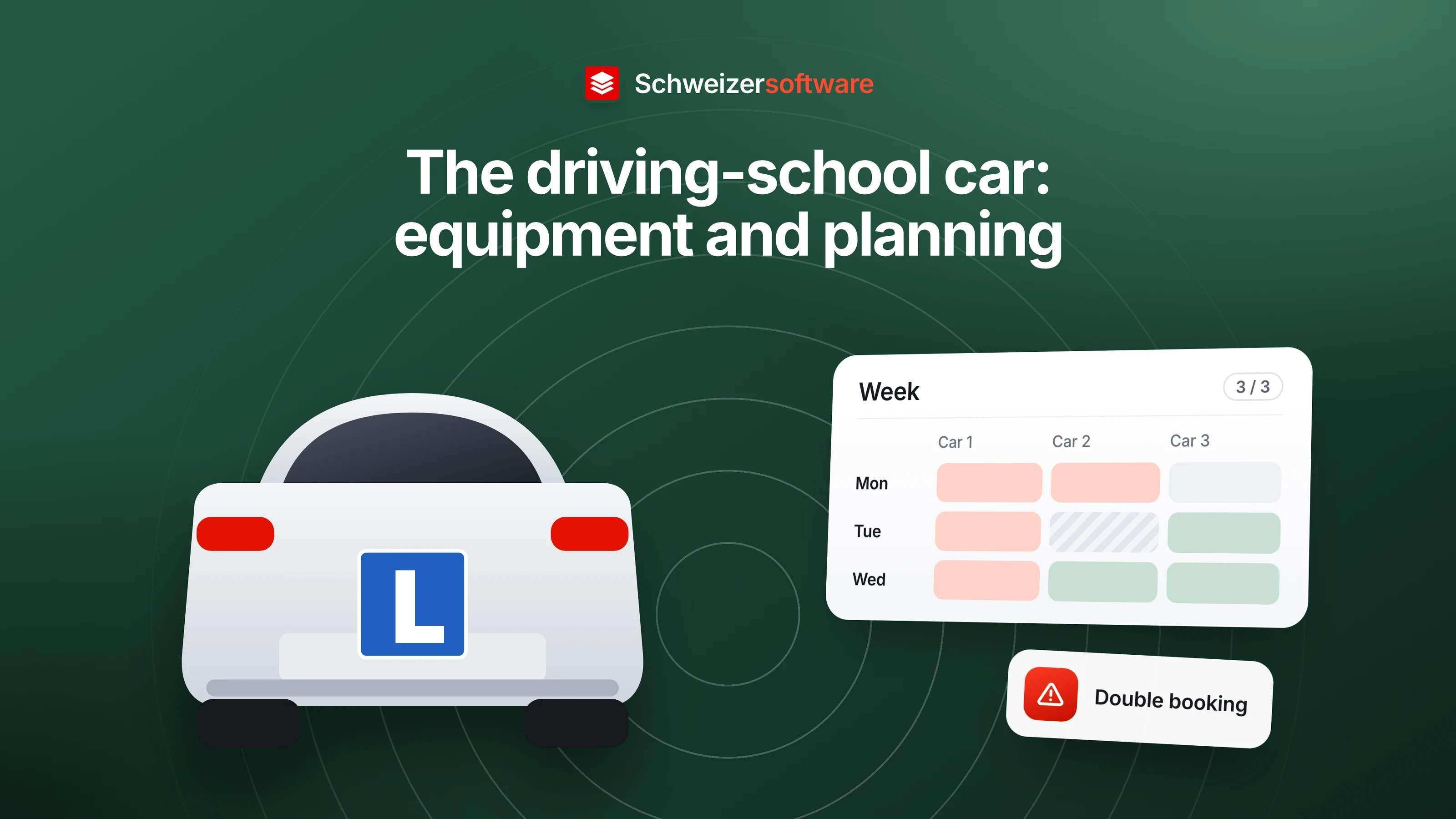
A driving school in Lugano has two instructors and three cars: two with a manual gearbox, one automatic. On an autumn Tuesday one of them is in the garage for its service, and the 5 pm lesson is booked all the same. The garage offers a replacement car. May it be used for teaching without pedals on the passenger side? And where does the L plate belong when the learner arrives for the lesson in her parents’ car?
Rules for driving-school vehicles come from four ordinances: the ordinance on driving instructors (FV), the ordinance on the admission of persons and vehicles to road traffic (VZV), the traffic rules ordinance (VRV) and the ordinance on the technical requirements for road vehicles (VTS). Added to these are explanations from ASTRA, the Federal Roads Office. This article summarises what these texts say about equipment and marking, and describes what follows from it for planning the vehicles.
What counts as a driving-school vehicle
In 2009, in its explanations on Art. 10 FV, ASTRA set out what is meant: driving-school vehicles are vehicles that the driving instructor provides for practical teaching. In principle, practical driving instruction takes place with such vehicles.
The explanations name two exceptions:
- If the customer provides the vehicle, it is not a driving-school vehicle. Then only the rules for learner drives under Art. 27 VRV apply.
- No driving-school vehicle is needed if the learner does not need a learner’s permit for the vehicle, that is for practice drives, or, with a vehicle combination, already holds the licence for the towing vehicle.
The lesson in the parents’ car is therefore possible. For this car, the rules of an ordinary learner drive apply, not the equipment rules of the FV.
The equipment under Art. 10 FV
Art. 10 FV sets out what a driving-school vehicle must have:
| Requirement | What the FV requires |
|---|---|
| Principle | The requirements for test vehicles under Annex 12 No. V VZV |
| Pedals, category B | The same foot-operated controls for the instructor as for the learner |
| Pedals, categories C and D | A second brake and clutch pedal, also for C1 and D1 |
| Rear-view mirrors | Additional mirrors with, if possible, the same field of view as for the learner |
| Displays | Speedometer and the displays essential for operational safety visible from the passenger seat |
For category B, “the same foot-operated controls” means in concrete terms: in its test confirmation, the canton of Aargau asks, for cars with a manual gearbox, for accelerator, brake and clutch pedals on the passenger side, and for automatics for accelerator and brake pedals. The pedals return to their starting position by themselves. For the mirrors, the same form names additional mirrors left and right and, for passenger cars, an interior mirror.
Two exceptions are stated directly in Art. 10 FV. Replacement vehicles are exempt from the pedal rule. And for vehicles adapted to a learner’s disability and approved by the licensing authority, a gradable parking brake that the instructor can easily reach is sufficient.
The principle in the first row refers to test vehicles. For category B, Annex 12 No. V VZV requires a motor car of category B that reaches at least 120 km/h. For category A it is a motorcycle without a sidecar with two seats, with or without a power limit depending on the licence; a motorcycle of subcategory A1 does not count as a test vehicle for A. Test vehicles must also have no extraordinary driving aids (Art. 88 VZV).
Marking: the L plate and the vehicle registration document
Anyone who drives with a learner’s permit drives with an “L”. Under Art. 27 para. 1 VRV, motor vehicles driven by holders of a learner’s permit carry a blue plate with a white “L”, clearly visible from behind. If no learner drive is taking place, it is removed. This applies to the driving-school car just as it does to the parents’ car.
The dimensions are in Annex 4 No. 5 VTS. The plate is square and is fixed as close to vertical as possible at the rear:
| Dimension | Four-wheeled vehicles | Two- and three-wheeled vehicles |
|---|---|---|
| Side length | 16.0 cm | 12.0 cm |
| Height of the “L” | 10.0 cm | 8.0 cm |
| Length of the horizontal bar | 6.0 cm | 5.0 cm |
| Stroke width | 2.0 cm | 1.5 cm |
The second column also applies to light and small motor vehicles.
The car’s role also shows in the vehicle registration document. The canton of Aargau enters “driving-school vehicle” in field 17 (special use) when a test confirmation on the equipment is presented that is not older than 30 days. How other cantons handle this is described by their road traffic offices.
For the lesson itself, Art. 27 para. 2 VRV regulates the seating: on learner and test drives with motor cars, the accompanying person sits next to the person driving, except on practice grounds, when reversing or when parking, and can at least easily reach the handbrake. ASTRA derives from this seating arrangement that the additional pedals are fitted at the passenger seat; for coaches with no seat beside the driver it allows dual controls where the accompanying person takes a seat.
And the driving-school motorcycle?
The rules on pedals and mirrors in Art. 10 FV are tailored to cars, lorries and buses; for motorcycles the FV names no dual controls. What remains is the principle that a driving-school vehicle meets the requirements for a test vehicle, so for category A a two-seat motorcycle without a sidecar in the suitable power class. On a motorcycle the instructor does not sit alongside. In the motorcycle basic training, for instance, she rides ahead on a motorcycle of her own according to the VPGS framework programme (the ASTRA ordinance on motorcycle basic training), or rides along as the passenger in individual exercises. Learners may not carry passengers on a motorcycle who do not themselves hold the corresponding licence (Art. 27 para. 3 VRV). The L plate is smaller on a motorcycle: 12 instead of 16 centimetres side length.
Vehicle inspection and service
Like any other vehicle, the driving-school car is officially inspected periodically. The licensing authority summons the keeper for it (Art. 33 VTS). For light passenger cars and motorcycles, Art. 33 VTS names the first inspection five, at the latest six years after first being put into service, the next after three years and then every two years. At the keeper’s request a vehicle can be re-inspected at any time. Which date applies to a particular vehicle is stated in the canton’s summons.
Unlike a private car, however, a driving-school car is booked with lessons. For planning, the inspection intervals therefore matter less than the small outages: service, tyre changes in autumn and spring, a repair after a parking damage. Every outage hits lessons that are already booked.
Planning vehicles and lessons
For the driving school in Lugano, one car is not interchangeable with another. Someone who learns on an automatic does not suddenly drive a manual in the next lesson. A weekly plan shows where it gets tight:
| Day | Car 1 (manual) | Car 2 (manual) | Car 3 (automatic) |
|---|---|---|---|
| Monday | Instructor M. | Instructor S. | free |
| Tuesday | Instructor M. | Service | Instructor S. |
| Wednesday | Instructor M. | Instructor S. | Instructor S. from 4 pm |
| Saturday | Test 9 am | Instructor S. | Instructor M. |
On Tuesday it works out only because the automatic car is free. If the instructor had learners on a manual that day, the garage’s replacement car would remain. Art. 10 FV exempts replacement vehicles from the pedal rule; whether the lesson should take place without pedals on the passenger side is nevertheless the instructor’s decision, especially with a learner in her first hours.
What eases planning is a few fixed details per lesson: which car, which meeting point, manual or automatic. If the car is in the booking, a double booking is noticed before two instructors stand at the same car park. And if a service appointment is entered as a blocked time, it is possible to see early which lessons need another car.
What is left of this
A driving-school vehicle is an ordinary car with a few additional duties: the requirements for a test vehicle, pedals and mirrors for the instructor, displays that can be read from the passenger seat, and an L plate as soon as someone with a learner’s permit drives. Where these rules end, at the parents’ car or at the replacement vehicle, the driving school’s planning begins.
Our idea for driving schools treats the vehicle as a fixed part of every lesson. The app that is to come from it will assign a vehicle and a meeting point to every lesson, show doubly booked vehicles before anyone waits in vain, and store the data in Switzerland.
Sources
- 1.Verordnung über die Zulassung von Fahrlehrern und Fahrlehrerinnen und ihre Berufsausübung (Fahrlehrerverordnung, FV, SR 741.522), Stand 1. April 2023, Art. 10 und 29 (checked on 10 October 2026)
- 2.Verkehrszulassungsverordnung (VZV, SR 741.51), Stand 1. Januar 2026, Art. 88 und Anhang 12 Ziff. V (checked on 10 October 2026)
- 3.Verkehrsregelnverordnung (VRV, SR 741.11), Stand 1. Oktober 2026, Art. 27 (checked on 10 October 2026)
- 4.Verordnung über die technischen Anforderungen an Strassenfahrzeuge (VTS, SR 741.41), Stand 1. Oktober 2026, Art. 33 und Anhang 4 Ziff. 5 (checked on 10 October 2026)
- 5.Verordnung des ASTRA über die praktische Grundschulung für Motorrad-Fahrschüler und -Fahrschülerinnen (VPGS, SR 741.512.1), Anhang (checked on 10 October 2026)
- 6.ASTRA: Erläuterungen und Weisungen betreffend die Fahrschulfahrzeuge, 14. Mai 2009 (veröffentlicht durch das Strassenverkehrsamt des Kantons Bern) (checked on 10 October 2026)
- 7.Kanton Aargau, Strassenverkehrsamt: Prüfbestätigung für Fahrschulfahrzeuge (checked on 10 October 2026)
- 8.Kanton Wallis, Dienststelle für Strassenverkehr und Schifffahrt: Informationen für Fahrlehrer (checked on 10 October 2026)
Be told when it launches
This idea is still being planned. Sign up and we will write to you once, when it becomes an app. Signing up is non-binding – no newsletter, no advertising.
View the idea