
Nail studio8 min read
Nail studio hygiene in Switzerland: what cantons inspect
What cantonal authorities check in nail studios, what self-monitoring the food law requires, and how studios can document cleaning and products.
Updated on
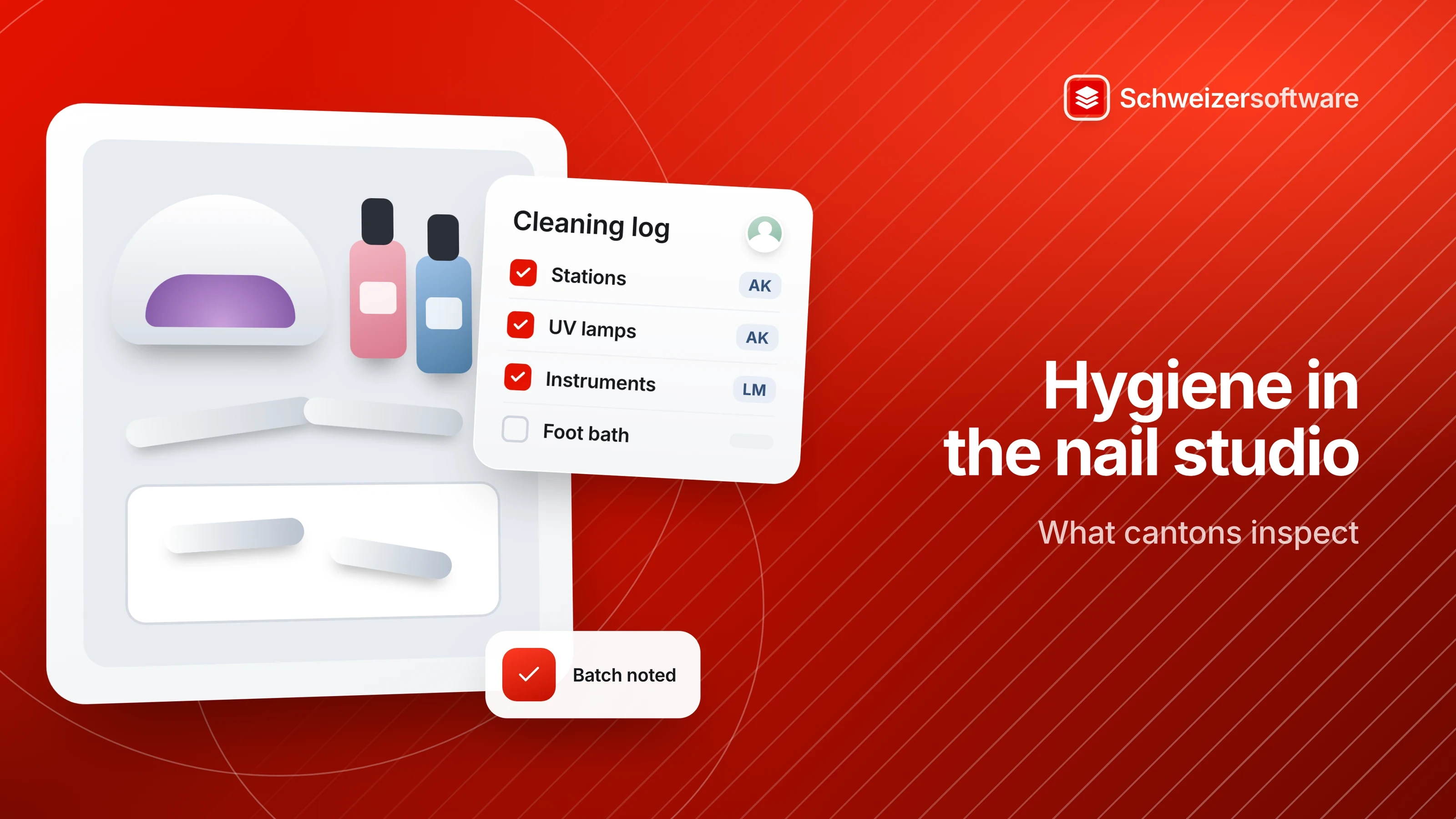
A nail technician opens her own studio in Aarau: one room, two stations, a shelf of gels, polishes and care oil, which she also sells. While setting up, a question comes up that no course fully answered: who actually inspects a nail studio, and what is the studio’s own responsibility?
The answer is less obvious than for tattoo studios. For those there is an explicit notification duty and a dedicated ordinance. For nail studios, federal law names nothing comparable. Rules still apply, and they are found mainly in food law and in the cantons’ information sheets.
Why food law also concerns nail studios
The Food Act (LMG; in French LDAl, in Italian LDerr) does not only regulate food but also consumer articles. Under Art. 5 let. b LMG, these include cosmetics and other substances and preparations that come into contact with the body from the outside. Gel, polish, primer and care oil belong in this world.
Two terms are defined broadly. Under Art. 6 LMG, placing on the market means any form of passing on, with or without payment, keeping ready for delivery, offering and delivering itself. The Lucerne Food Control and Consumer Protection Service puts exactly this definition at the start of its information sheet on cosmetics. And the Food and Consumer Articles Ordinance (LGV; ODAlOUs in French, ODerr in Italian) understands a consumer articles business as an operational unit that, among other things, stores, treats, distributes or hands over consumer articles (Art. 2 LGV).
How cantons read this in practice is shown by a campaign of the Cantonal Laboratory of Basel-Stadt. It examined 54 gel nail polishes; according to its release of 24 May 2024, half of the samples came from nail studios, the rest from manufacturers, online shops and retail. 50 products were objected to, and a ban on sale or use was issued for 31. According to the laboratory, the products were without exception intended for professional use. For this laboratory at least, the nail studio is a place where inspections happen.
Who inspects, and what for
For questions of food law, the cantons are responsible, depending on the canton the Cantonal Laboratory or a food inspectorate. Art. 30 LMG describes what this official control does: it is risk-based and checks in particular
- whether the self-monitoring rules are complied with,
- whether people who handle consumer articles observe the hygiene rules and have the necessary expertise,
- whether products, premises and equipment comply with the provisions.
The authorities can take samples for this and inspect documents and records. That also says what can be asked about during a visit: the products on the shelf, the state of the premises and equipment, and the self-monitoring documents.
There is also a second authority that rarely comes into the studio, but becomes important when an offer goes beyond cosmetics: the cantonal health directorate. Its information sheet “Rechtliche Grundlagen Kosmetik” from the Canton of Zurich names two points that can concern nail and foot care studios:
- The treatment of nail fungus with laser or light may only be carried out, since 1 June 2024, by someone with the “Nagelpilz” certificate of competence. According to the information sheet, every person who offers and carries out this treatment needs it, not just one person in the business.
- The treatment of warts is on the list of treatments that the information sheet reserves for physicians or directly instructed practice staff.
Some cantons also regulate cosmetic professions themselves. Ticino, for example, requires under its “Regolamento concernente l’esercizio della professione di estetista” a permit for a list of specific services, including lymphatic drainage for aesthetic purposes, electric epilation, permanent make-up, microblading and microneedling. Nail care is not on this list; a studio in Lugano that offers such services alongside nails, however, operates within its scope.
What self-monitoring means in a small studio
The central duty is in Art. 26 LMG: anyone who produces, treats, stores or places consumer articles on the market ensures that the legal requirements are met and is obliged to self-monitor. Official control does not release anyone from this.
The LGV fills this in. For every business, a responsible person with a business address in Switzerland must be designated (Art. 73 LGV). Self-monitoring must be ensured in a form adapted to the safety risk and the scale of production (Art. 74 para. 4 LGV). For consumer articles businesses it includes, among other things, checking product safety, sampling and analysis, traceability for cosmetics, withdrawal and recall, and documentation (Art. 75 LGV). Documentation is to be kept in writing or equivalent form, and micro-businesses, that is, those with up to nine employees, may reduce it appropriately (Art. 2 and 85 LGV).
The Cantonal Laboratory of Zurich describes what this can look like in its information sheet “Selbstkontrolle Gebrauchsgegenstände”. It sums up the core in three steps: set requirements, implement them, document the implementation. Its example is cleaning: create a cleaning instruction, clean, fill in a cleaning log.
The information sheet is written for all kinds of consumer articles businesses, from manufacturers to retail. For a small nail studio that makes nothing itself, the fitting elements can be translated roughly like this:
| Element from the Zurich information sheet | What it can look like in a nail studio |
|---|---|
| Business description, responsibilities | Who is the responsible person, which services are offered |
| Goods receipt with label check | Look at the labels of new gels and polishes when unpacking |
| Suppliers and document checks | File delivery notes and suppliers’ documents |
| Storage | Date opened products, keep an eye on shelf life |
| Cleaning and disinfection | Plan for stations, devices and instruments, with date and initials |
| Personal hygiene and training | Short instruction for the team, note courses attended |
| Traceability | Record who each product was obtained from |
| Emergency plan for withdrawal and recall | Contact of the Cantonal Laboratory and the steps in case of a recall |
The right-hand column is a reading, not an official requirement. How extensive your own self-monitoring must be depends, under Art. 74 and 85 LGV, on the risk and the scale of the business; the competent cantonal authority can advise on this.
Recording cleaning and disinfection
For the cleaning log, the Zurich information sheet names the contents a form can have: requirements on frequency, on cleaning agents, on how it is carried out per room or device and on occupational safety, plus the date and initials of the person who cleaned.
In the Aarau studio, that could be one page per week: the two stations, the UV or LED lamps, the instruments, the foot bath and the floor, each with the agent, frequency and a column for initials. Which disinfection is appropriate for which instrument is answered by manufacturers, training and professional association; the official sources cited here set no requirements of their own on this for nail studios.
Products, batches and recalls
The second large part of self-monitoring concerns products. Cosmetics must be traceable across all stages of distribution, and anyone dealing in them must be able to tell the cantonal authority who the products were obtained from; direct supply to consumers is excepted (Art. 83 LGV). For a studio, this means above all knowing where every gel and polish comes from.
The Lucerne information sheet lists what is on the label of a cosmetic product, including the list of ingredients, the name and address of the manufacturer, importer or distributor, the best-before date, where applicable the shelf life after opening, the batch number and warnings. These details can be checked at goods receipt, and the batch number is the detail by which a product can be matched to a recall. Which substances are permitted or limited in nail products is a topic of its own; the information sheet refers to Art. 54 LGV and the annexes of the European Cosmetics Regulation for this.
If the responsible person finds, or has reason to believe, that a product that has been handed out can endanger health, and it is no longer under the business’s control, they inform the cantonal authority without delay (Art. 84 LGV). The Zurich information sheet names an emergency plan with the steps and the contact details of the Cantonal Laboratory. For a studio that sells care products, this mainly concerns the products already with clients.
Where to find the answers for your own canton
Most cantons publish information sheets on self-monitoring and on cosmetics on the pages of their Cantonal Laboratory or food inspectorate; those cited here from Zurich and Lucerne are examples. Questions about individual treatments are answered by the cantonal health directorate. Anyone opening a studio will find the information that applies to their own canton at both offices.
The web app for nail studios that we are working on concerns the administration around the appointment: bookings, client records with nail cards and receipts. Self-monitoring remains each studio’s own responsibility, and the app will not replace it.
Sources
- 1.Lebensmittelgesetz (LMG, SR 817.0), Art. 5, 6, 26 und 30 (checked on 10 October 2026)
- 2.Lebensmittel- und Gebrauchsgegenständeverordnung (LGV, SR 817.02), Art. 2, 62, 73–75, 83–85 (checked on 10 October 2026)
- 3.Kantonales Labor Zürich: Merkblatt Selbstkontrolle Gebrauchsgegenstände (MD-00124, gültig ab 22.08.2024) (checked on 10 October 2026)
- 4.Kanton Luzern, Dienststelle Lebensmittelkontrolle und Verbraucherschutz: Merkblatt «Anforderungen an kosmetische Mittel» (checked on 10 October 2026)
- 5.Kanton Basel-Stadt, Kantonales Laboratorium: «Sehr schlechte Konformität bei Gel-Nagellack» (24. Mai 2024) (checked on 10 October 2026)
- 6.Kanton Zürich, Gesundheitsdirektion: Merkblatt «Rechtliche Grundlagen Kosmetik» (September 2024) (checked on 10 October 2026)
- 7.Kanton Tessin: Regolamento concernente l’esercizio della professione di estetista (RL 813.650) (checked on 10 October 2026)
Be told when it launches
This idea is still being planned. Sign up and we will write to you once, when it becomes an app. Signing up is non-binding – no newsletter, no advertising.
View the idea