
Dog grooming salon6 min read
No-Show at the Dog Grooming Salon: Cancellation Deadline and Fees
What applies when an appointment at the dog grooming salon is cancelled late or the dog does not turn up: deadline, fee, deposit and notes under the CO and UCA.
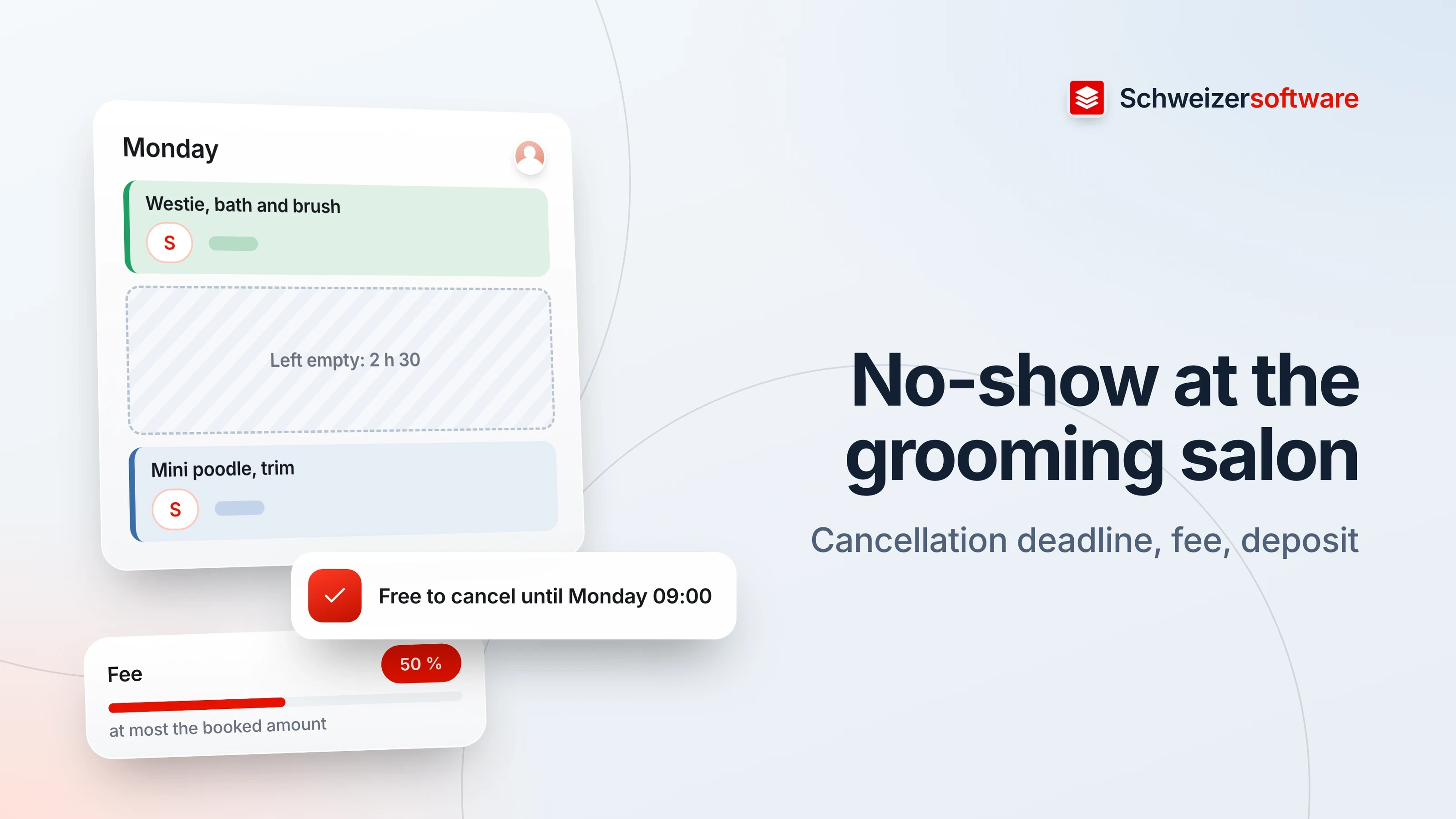
A dog grooming salon in Chur has an appointment on Monday for a large poodle: full groom, two and a half hours, a whole morning at one table. On Sunday evening at 9 p.m. a short message arrives: “Unfortunately we won’t make it tomorrow.” The morning stays empty, and a gap that long is hard to fill at short notice.
How much such a gap costs and whether the salon can charge something for it is less a question of feeling than of agreement. This post describes what the Code of Obligations (CO) says, which rules salons set in advance and where the law limits a fee. It describes and does not advise: how a salon decides remains its own matter, and in a dispute a court decides.
An appointment is an agreement
Booking usually creates a contract between the salon and the dog’s owner. The Code of Obligations knows two basic types for services, and both regulate withdrawal:
| Type of contract | What the law says about withdrawal |
|---|---|
| Mandate | Either party may revoke or terminate it at any time; if done at an inopportune time, the damage must be compensated (Art. 404 CO) |
| Contract for work | As long as the work is unfinished, the client may withdraw at any time, against payment for work done and full compensation (Art. 377 CO) |
Whether a grooming appointment is better understood as a mandate or a contract for work depends on how it is set up. What matters in practice is what both provisions share: the client can cancel the appointment, but not without consequence if it happens at an inopportune time. The law does not give “inopportune” in hours; in a dispute the court weighs the circumstances.
The damage is what really arises
Art. 404 para. 2 CO speaks of the damage the other party suffers through the cancellation. For a dog grooming salon that is not the full price but what the salon actually loses or incurs. If the appointment falls through and the time can be filled otherwise, the damage is smaller; if the table stays empty, it is larger. How large it is can be assessed in the individual case.
That is why a salon can set a rule in advance instead of calculating the damage each time. The rule fixes in the agreement what applies to a late cancellation or a no-show.
Saying the rule beforehand: deadline and amount
A rule usually has two parts: a cancellation deadline up to which cancelling is free, and a fee for cancelling after the deadline or not turning up. The amount is up to the salon. Three example rules show what they can look like:
| Rule | Effect |
|---|---|
| Free until 24 hours before, nothing after | simple; the salon bears the gap |
| Free until 24 hours before, then 50 %, no-show 100 % of the booked price | covers part of the loss or all of it |
| Deposit from new clients, offset against the fee in case of a no-show | the fee has already been paid |
Two considerations limit such a rule. First, a contractual penalty (in the CO, the penalty agreed for the case of non-performance) may be set by the parties at any amount, but the court must reduce excessively high penalties at its discretion (Art. 163 paras. 1 and 3 CO). The higher a fee is in relation to the booked service, the more likely this framework is touched. Second, Art. 8 of the Unfair Competition Act (UCA, “UWG” in German) makes it unfair to use general terms and conditions that, contrary to good faith, create a significant and unjustified imbalance between rights and obligations to the detriment of consumers. Whether a rule falls under this can only be judged in the individual case.
Making the rule visible
A rule helps most when the client could see it before booking. A salon can therefore show it where the booking is made: on the booking page, in the confirmation and in the reminder. A short sentence in the client’s language helps, for example: “Free cancellation until Monday 09:00. Afterwards up to 50 % of the booked price; no-show up to 100 %.” A note that appears only in the terms and conditions can be overlooked more easily. Repeating the deadline in the reminder does not replace the rule, but keeps it present.
A rule sensibly leaves two cases open: if the salon cancels, for example because of illness, it will provide for no fee. And if a dog dies or falls acutely ill, the salon decides case by case whether to charge the fee.
Deposit: what the law means by earnest money
A salon can ask new clients for an amount in advance. The Code of Obligations has a term for money given at the conclusion of a contract (“An- oder Draufgeld”). Under Art. 158 para. 1 CO it counts as earnest money (Haftgeld), not as forfeit money (Reugeld). Earnest money stays with the recipient without deduction from their claim, unless the contract or local custom provides otherwise (para. 2). If forfeit money was expressly agreed, the giver may withdraw from the contract by leaving the amount paid (para. 3).
For daily practice this means: what the deposit is meant to be is better written into the agreement than left to one word. “Deposit is credited; in case of a no-show we keep it up to the amount of the fee” is clearer than “deposit non-refundable”.
Recording a no-show without noting too much
If a fee is charged or a note “no-show” is added to the dog card, that is information about a person and therefore personal data. The FADP requires such data to be processed proportionately (Art. 6 para. 2), only for a specific and recognisable purpose (Art. 6 para. 3) and to be destroyed or anonymised once it is no longer needed (Art. 6 para. 4). The person concerned can request access under Art. 25 FADP. A factual entry (“Appointment 14.02. no-show, fee charged”) is therefore something different from a judgement about the person.
What can be made simpler in daily work
The work lies less in the law than in the process: a deadline that clients know; a notice before the appointment; a short invoice in case a fee arises; a factual entry; and an open amount that does not get forgotten. Then there is the bookkeeping: if a fee is charged, the invoice is an accounting voucher that is kept for ten years (Art. 958f CO).
The idea for dog grooming salons that we are working on takes up this process. The app will record the cancellation deadline and state it in the confirmation and the reminder, propose a fee for a late cancellation or no-show that is not meant to exceed the booked amount, and send it with a QR-bill. It will store the data on infrastructure in Switzerland.
Sources
- 1.Obligationenrecht (OR, SR 220), Art. 158, 163, 377, 394, 404 und 958f (checked on 6 November 2026)
- 2.Bundesgesetz gegen den unlauteren Wettbewerb (UWG, SR 241), Art. 8 (checked on 6 November 2026)
- 3.Bundesgesetz über den Datenschutz (DSG, SR 235.1), Art. 6 und 25 (checked on 6 November 2026)
Be told when it launches
This idea is still being planned. Sign up and we will write to you once, when it becomes an app. Signing up is non-binding – no newsletter, no advertising.
View the idea