
Beauty studio8 min read
Running a beauty studio: treatments, rooms, client file and sales
What running a small beauty studio in Switzerland involves: many treatments of different length, treatment rooms, devices, client file, product sales and billing.
Updated on
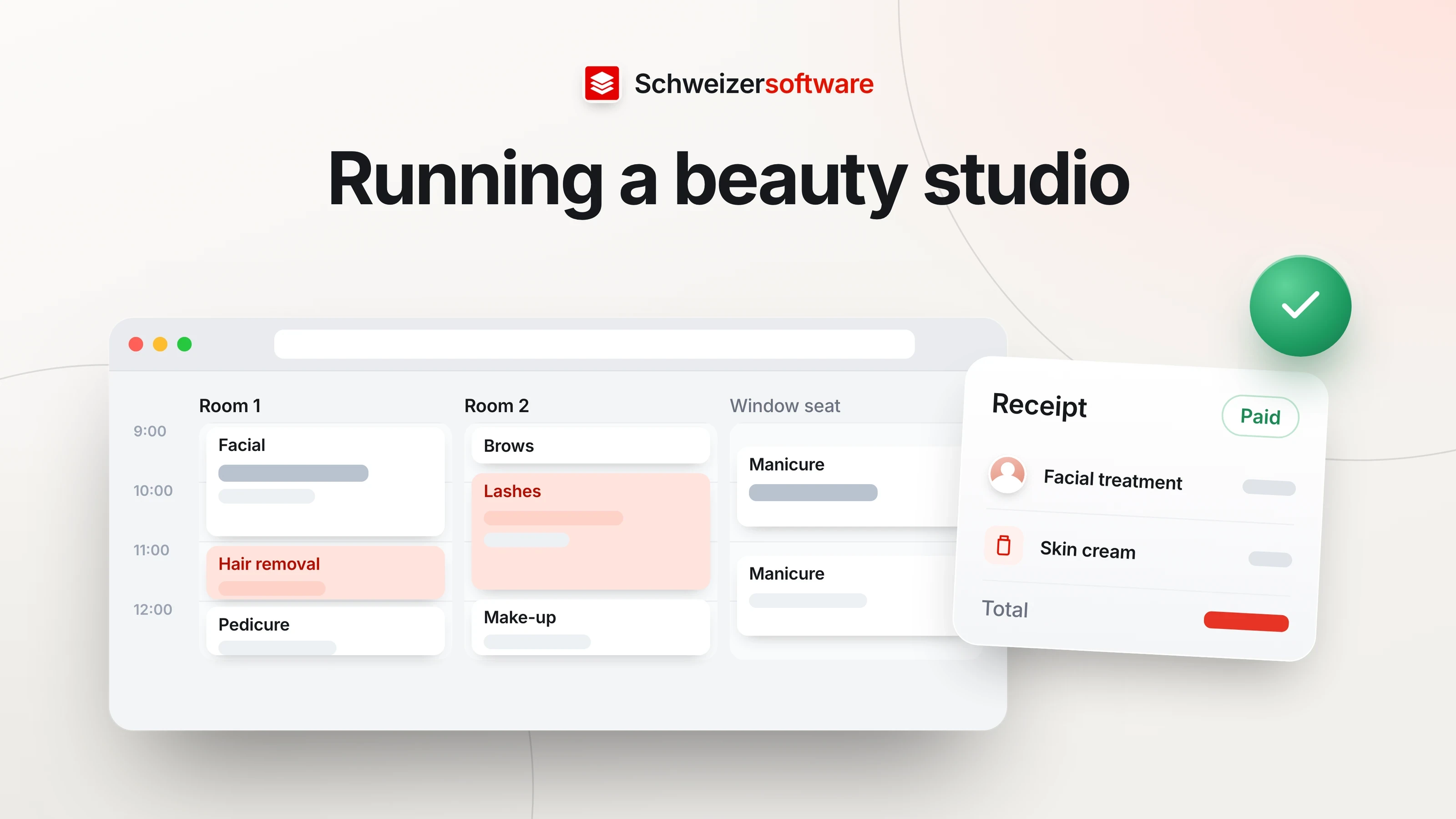
A beauty studio in St. Gallen has two treatment rooms and a small manicure station by the window. The owner works full time, a beautician three days a week. On Tuesday the diary shows a one-hour facial, two brow and lash tints, leg hair removal, a pedicure and, in the evening, make-up for a wedding. In between, the studio sells skincare products, redeems a gift voucher and takes calls for next week.
Each of these tasks is simple on its own. The administration gets demanding where they come together: in one calendar that has to show two rooms, two people and very different treatments at the same time. This article describes what running a small beauty studio involves and how to judge a solution for it, whether paper diary, spreadsheet or software.
What sets a beauty studio apart from other appointment businesses
The job profile on berufsberatung.ch shows how broad the daily work is. Besides facial and body care, the tasks of a Swiss beautician (Kosmetiker/in EFZ) include hair removal, make-up, manicure and pedicure, and massages by hand or with devices. Add advice and the sale of skincare products. And, explicitly, the office work: organising the day from the appointment calendar, managing client data, keeping the books on income from treatments and products, checking stock and ordering supplies.
Three things follow for the administration:
- Many treatments of very different length. Fifteen minutes for the brows, an hour and a half for an elaborate facial. A fixed one-hour grid fits neither.
- Rooms and devices are scarce. Two rooms are two places, and the device for hair removal may stand in only one of them.
- Not everyone offers every treatment. One person does lash extensions, the other does not. Some treatments need a certificate of their own.
The treatment catalogue as the foundation
Every administration starts with a list of all treatments. For a diary that is meant to check by itself whether an appointment fits, each treatment needs four details: duration, room, a device if any, and the people who offer it. For the studio in St. Gallen an excerpt looks like this; the figures are examples.
| Treatment (example) | Duration | Room | Who |
|---|---|---|---|
| Classic facial | 60 min. | Room 1 or 2 | both |
| Brow shaping and tint | 20 min. | Room 1 or 2 | both |
| Lash extensions, new set | 120 min. | Room 2 (couch) | beautician |
| Hair removal, legs | 45 min. | Room 1 (device) | owner |
| Manicure | 40 min. | Window station | both |
| Pedicure | 50 min. | Room 1 or 2 | both |
| Day make-up | 45 min. | Room 1 or 2 | owner |
Two additions make such a list work in daily practice. First, buffers: after a treatment the couch is made up again, the tools are cleaned and the room is aired. Attaching that as fixed minutes to the treatment makes for more honest planning than an average time. Second, combinations: brow and lash tints are often booked together and take less time together than one after the other. A separate entry for the combination saves clients doing the sums.
What matters is that processing times and breaks are built into the stored duration, so that a booking page offers only time slots that really work.
Rooms, devices and who performs what
In a beauty studio the room is often the real bottleneck. The owner in St. Gallen could do a hair removal at 2 pm, but Room 1 is taken by a pedicure and the device stands only there. A diary that knows only people will still offer that slot. A diary that treats rooms and devices as resources in their own right will not.
Then there is the question of who may perform a treatment. According to the Federal Office of Public Health (BAG), people who carry out cosmetic treatments with lasers or intense pulsed light (IPL), for example, have needed a certificate of competence since 1 June 2024. berufsberatung.ch also notes that certain treatments, such as laser therapies, require a course and a permit. Which treatments exactly are affected is described by the BAG on its pages on non-ionising radiation.
For the administration this means a simple link: each treatment is tied to the people who offer it. If the beautician does not yet hold a certificate, the treatment does not appear in her calendar. Recording that in the diary rather than in someone’s head prevents a temp from being assigned a treatment on Saturday that she does not perform.
The client file: what gets recorded
Before a facial, what the beautician knows about the skin matters: skin type, earlier reactions to products, perhaps an allergy. According to the job profile, part of the work is to examine the skin, determine its characteristics and, where something looks unusual, recommend a dermatological check. The treatment history in the file shows what was used last time and how the skin reacted.
Part of this information concerns health. The Federal Act on Data Protection (FADP) counts health data among sensitive personal data (Art. 5 let. c FADP). Under Art. 6 FADP, personal data may only be collected for a specific purpose that is evident, must be processed proportionately, and must be destroyed or anonymised once no longer needed for that purpose. For a small studio this mostly means: note only what matters for the treatment, and decide who sees the file. Anyone who keeps client file and diary apart can show a temp the calendar without showing her the skin notes. More on this in the article on the client file in a beauty studio.
Product sales and stock
Selling skincare products is part of many studios. After the treatment the beautician recommends a cream and the client takes it home right away. This creates two tasks for the administration.
One receipt for both. Treatment and product belong on the same receipt. If the studio is subject to VAT, the receipt shows the tax. The Federal Tax Administration (FTA) gives 8.1 per cent as the standard rate; according to its list, the reduced rate of 2.6 per cent applies to foodstuffs and medicines, for example.
Stock that is right. The products on the shelf are tied-up money. Anyone who counts stock at the point of sale sees when a line is running low and reorders before the regular client faces an empty shelf. Then there are products used up in the room, such as masks or wax. They are not sold, but they too need reordering.
Vouchers, packages and billing
The studio in St. Gallen sells gift vouchers, especially many before Christmas. There are also packages, such as five facials for one total price. Both mean the same: the money has come in, the service follows later, perhaps in parts. Without a list that records which voucher is open for what amount and how many treatments of a package remain, every redemption turns into a search. How studios number, redeem and account for vouchers is described in the article Gift vouchers in your studio.
At the end of the day comes billing. Whether a studio charges VAT depends on turnover: according to the FTA, the threshold for liability is CHF 100,000 in turnover from services in Switzerland and abroad. A studio with business clients, for example for make-up at an event, issues an invoice with a payment part. For that, Switzerland has the QR-bill, which according to SIX finally replaced the payment slips on 1 October 2022 and can be issued on paper or digitally.
The records stay too. Sole proprietorships with a turnover below CHF 500,000 only have to keep books on income, expenses and assets, under Art. 957 para. 2 of the Code of Obligations (CO). For businesses subject to full bookkeeping, Art. 958f CO provides for keeping the books and accounting records for ten years. Which duties apply to a particular studio is a question for its own fiduciary.
How to measure an administration
The following questions can be put to any solution, including your own spreadsheet. They help to compare providers without being swayed by the length of a feature list.
| Criterion | The question |
|---|---|
| Treatment catalogue | Does each treatment have its own duration, a buffer and combinations? |
| Rooms and devices | Does the diary check room and device, not only the person? |
| Who offers what | Can you set per person which treatments she performs? |
| Online booking | Does the booking page only offer times when room and person are free? |
| Client file | Can you control who sees skin notes and allergies, and can they be deleted? |
| Sales and stock | Are product and treatment on one receipt, and does stock count along? |
| Vouchers and packages | Are open amounts and remaining treatments visible at any time? |
| Billing | Are there receipts with VAT and QR-bills in CHF? |
| Data and languages | Where is data stored, can it be exported, and in which languages is the booking page available? |
For a self-employed beautician with one room and a manageable offer, a well-kept diary can be enough. A studio with two rooms, a device, part-time staff and a shelf full of products reaches the limits of separate lists sooner.
Back to St. Gallen
The owner starts with the treatment catalogue: each treatment with duration, buffer, room and the people who offer it. After that she keeps appointments in one place only, separates the skin notes from the diary and records vouchers with a number and remaining balance. Tuesday does not look calmer, but in the evening it can be closed in minutes instead of an hour.
Our idea for beauty studios starts at the same point: the app will bring appointments with team member, room and device, deposits, courses and packages, treatment cards with photos, simple product sales and billing with TWINT and QR-bill together in one place, with data in Switzerland. Vouchers are not planned for the first version.
Sources
- 1.berufsberatung.ch: Kosmetiker/in EFZ (checked on 10 October 2026)
- 2.BAG: Behandlungen mit nichtionisierender Strahlung und Schall (z.B. Laser) (checked on 10 October 2026)
- 3.Bundesgesetz über den Datenschutz (DSG, SR 235.1), Art. 5 und 6 (checked on 10 October 2026)
- 4.ESTV: MWST-Steuerpflicht (checked on 10 October 2026)
- 5.ESTV: Schweizer Mehrwertsteuersätze (checked on 10 October 2026)
- 6.Obligationenrecht (OR, SR 220), Art. 957 und 958f (checked on 10 October 2026)
- 7.SIX: QR-Rechnung (checked on 10 October 2026)
Be told when it launches
This idea is still being planned. Sign up and we will write to you once, when it becomes an app. Signing up is non-binding – no newsletter, no advertising.
View the idea