
Riding stable6 min read
Turnout journal for horses: what the Animal Welfare Ordinance says
Exercise, turnout, journal: what Art. 61 of the Animal Welfare Ordinance and the FSVO fact sheets require for horses, when entries are due and who keeps the journal.
A farm in the Emmental keeps eleven horses. Seven are boarded, four belong to the farm. Most are ridden five days a week, two are retired. In the morning someone takes some of them to the pasture, in the evening others to the paddock, and on rainy days part of them stay in. A sheet hangs in the feed room on which a stroke is sometimes made. Anyone wanting to know whether every horse was outside in the last few days has to reconstruct it.
This article describes what the Animal Welfare Ordinance says about exercise, turnout and the turnout journal, and what the Federal Food Safety and Veterinary Office (FSVO) writes about it in its fact sheets. It is a description, not advice, and no substitute for information from the cantonal veterinary office.
Exercise, use, turnout: three different things
Art. 61 para. 1 of the Animal Welfare Ordinance (TSchV) in the version of 1 February 2025 says: equids must be given sufficient exercise every day. Exercise includes use and turnout. Under Art. 2 para. 3 let. p TSchV, equids are horses, donkeys, mules and hinnies.
The FSVO fact sheet 11.5 sorts the terms like this:
- Use is work under the saddle, in hand or in harness, and exercise in a horse walker (Art. 2 para. 3 let. o TSchV).
- Turnout is free movement outdoors in which the animal can determine gait, direction and speed itself, unhindered by hobbles, reins, leads, harness, ropes, chains or the like (Art. 2 para. 3 let. c TSchV).
Someone who rides a horse every day has use, but not yet turnout. The two terms stand side by side in the ordinance. According to the FSVO, use in place of turnout is possible only under the expressly regulated exceptions (see below).
How much turnout, depending on the horse
The ordinance distinguishes by how the horse is used. The FSVO’s fact sheet 11.6 summarises it in a table of three categories:
| Category | Requirement for turnout |
|---|---|
| Equids in use (ridden, driven, worked in hand or exercised in a horse walker daily) | at least two hours on at least two days a week (Art. 61 para. 5 TSchV) |
| Weaned youngsters up to 30 months, not yet regularly used | at least two hours every day, with at least one companion (Art. 59 para. 4 and Art. 61 para. 4 TSchV) |
| Broodmares with foals and equids over 30 months that are not used | at least two hours every day (Art. 61 para. 4 TSchV) |
The fact sheet also states that equids in use must get turnout on days without physical work, so that the daily exercise under para. 1 is preserved. The turnout area itself must meet the minimum dimensions of Annex 1 table 7 (Art. 61 para. 2 TSchV); the figures there are given by height at the withers.
Exceptions that belong in the journal
The ordinance names two kinds of deviation.
Covered area. In extreme weather and ground conditions, turnout may exceptionally be given on a covered area (Art. 61 para. 3 TSchV). What counts as extreme is set out in Art. 32 para. 1 of the FSVO Ordinance on the Keeping of Farm Animals and Pets (HaustierV): muddy ground after heavy rainfall, heavy or persistent rain in the cold or strong wind, storm winds and black ice posing a risk of falling in the turnout area.
Doing without turnout. Turnout can be dispensed with for at most four weeks, provided the horses are used daily during that time (Art. 61 para. 6 TSchV):
- for horses newly stabled at the establishment,
- in extreme weather and ground conditions between 1 November and 30 April,
- during deployment in military service,
- on tour for show or sport purposes or during exhibitions.
According to Art. 8 para. 5 HaustierV these exceptions must be entered with the reason, and for military service and for tours or exhibitions also with place and occasion. Fact sheet 11.6 shows abbreviations as examples, such as “H” for turnout on a covered area, “E” for a newly stabled horse or “V” for taking part in a multi-day event.
What belongs in the journal and when
Art. 61 para. 7 TSchV states in one sentence: turnout must be entered in a journal. The details are in Art. 8 HaustierV, which fact sheet 11.6 reproduces:
- Deadline. Turnout must be entered in the journal after three days at the latest.
- Groups. If turnout takes place in groups, it can be entered per group. With a group entry it must be traceable that every animal gets the minimum turnout due to it, for example through a list with name, description and UELN of each horse.
- Daily periods. If an animal or group is given turnout every day during a period, one entry on the first and one on the last day of that period is enough.
- No journal with permanent access. For horses with permanent access to a turnout area that meets the minimum dimensions of Annex 1 table 7 number 31 TSchV, no turnout journal needs to be kept. The FSVO gives boxes with permanently accessible runs and multi-room group housing as examples.
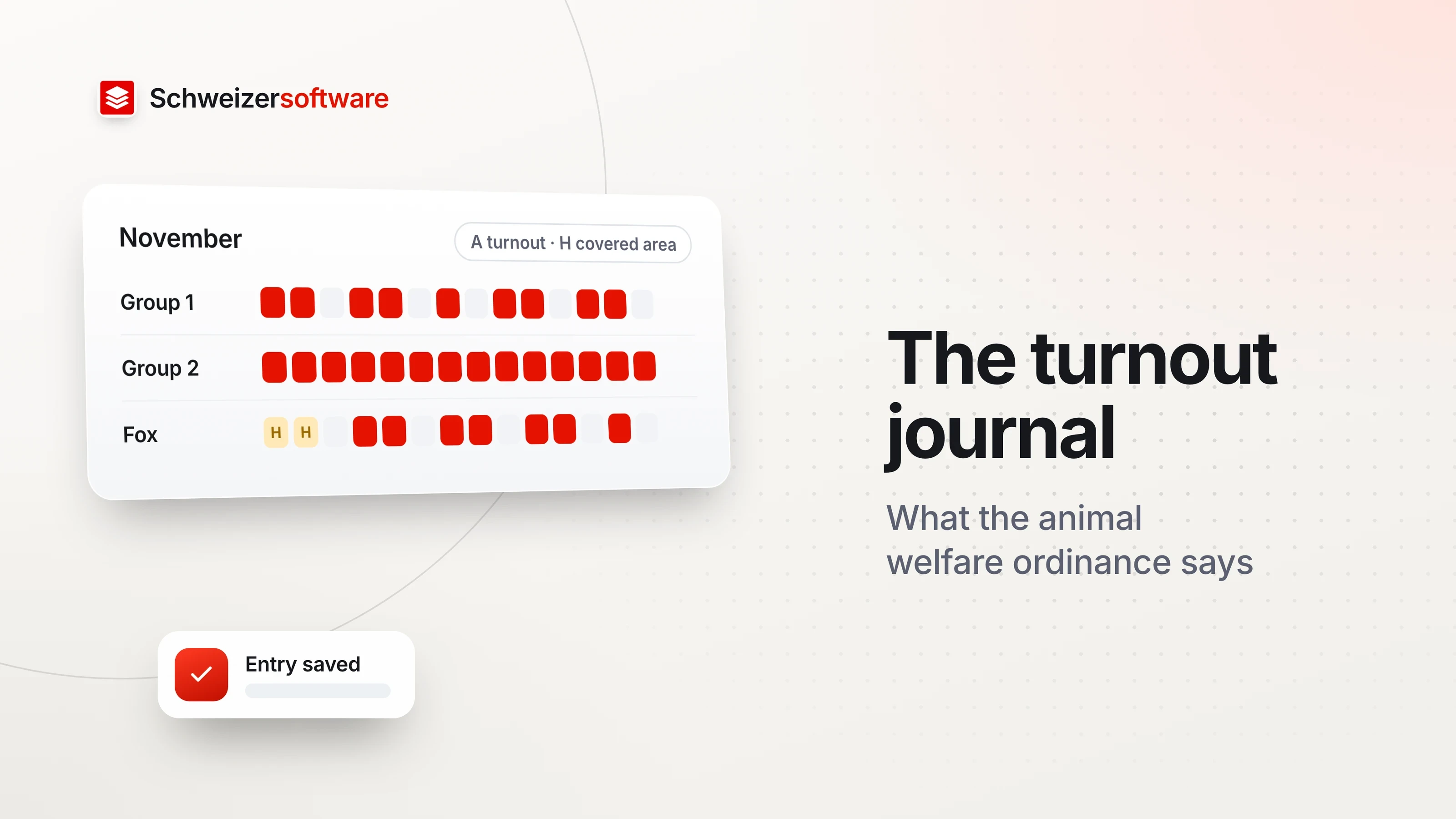
The ordinance prescribes no format. In fact sheet 11.6 the FSVO shows two possibilities: an ordinary monthly calendar if only one group of a category is present, and a table with one row per horse or group and one column per day if horses get turnout individually or on changing days.
Who keeps the journal
According to fact sheet 11.6 the animal keeper keeps the journal. There is an exception: if, as the FSVO writes, it is agreed by contract, for example in a livery yard, that someone else takes over this duty, such as the horse’s owner, the journal can lie with that person. What a boarding contract says is for the contracting parties.
In the daily life of a small yard
Some practical questions follow from the rules, and each business answers them for itself: who makes the entry, in the yard or in the evening? How can a group be kept so that it stays clear which horses belong to it? Where does the journal lie so it is at hand for an inspection, and how are exceptions such as “H” on black ice marked?
As an idea we are building, we picture the turnout journal in the riding stable app like this: it will show the horses by group, allow an “All out” entry with one tap, record exceptions with a reason and output the journal as a PDF for an inspection. What a yard enters and keeps with it remains its own responsibility.
Sources
- 1.Tierschutzverordnung (TSchV, SR 455.1), Art. 59–61, Stand 1. Februar 2025 (checked on 6 November 2026)
- 2.BLV: Fachinformation Tierschutz 11.5, Auslaufvorschriften für Pferde und andere Equiden (checked on 6 November 2026)
- 3.BLV: Fachinformation Tierschutz 11.6, Führen des Auslaufjournals (checked on 6 November 2026)
- 4.BLV: Pferde und Esel (checked on 6 November 2026)
Be told when it launches
This idea is still being planned. Sign up and we will write to you once, when it becomes an app. Signing up is non-binding – no newsletter, no advertising.
View the idea