
6 min read
Why our apps show no advertising
What advertising in an app means technically, what the FADP requires when third parties are involved, and what “no advertising” means for our apps — and what not.
Software costs money before anyone uses it: for development, for running the servers, for maintenance. Someone pays for it. Either the people who use it, or someone else — advertisers, for example, who get attention in return.
For our apps, we have made a decision: they show no advertising. This post explains why, what that means in practice and where the statement ends. It describes how we do things, not how others do.
What advertising in an app means technically
Advertising on a website or in a web app is usually not delivered by the operator itself but through third-party services. To do so, the page embeds program code, images or embedded frames from other servers. MDN, Mozilla’s developer documentation, describes what happens: embedded content from other websites can trigger further requests that set so-called third-party cookies. MDN names advertising as one of the purposes of such cookies — for instance to count impressions and to record users’ interests so that more relevant ads can be shown.
Even without a cookie, an embedded service learns something: the browser contacts it, and technical details are transmitted in the process, such as the IP address and the page the request comes from.
What the FADP requires when third parties are involved
The Data Protection Act does not prohibit advertising. It does, however, set out principles that apply whenever third parties are embedded:
- Personal data may only be collected for a specific purpose that is recognisable to the data subject (Art. 6 para. 3 FADP).
- Anyone collecting personal data informs the data subject appropriately — among other things about the recipients (Art. 19 paras. 1 and 2 FADP).
- If personal data is disclosed abroad, the country also belongs in this information (Art. 19 para. 4 FADP).
For an app with advertising, this means: the advertising services and their purposes belong in the privacy policy, and the people who use the app should be able to see what happens to their data. For an app without advertising, this part falls away.
Why we do without it
Three reasons, in the order in which they count for us:
- The documents are personal. Our apps are meant for forms, PDF files and images — often things like payslips, registrations or photos of one’s own family. An environment without third-party services suits such content better.
- The bill should stay simple. Anyone who pays for an app should know what they are paying for. Anyone who does not pay for it should not pay with their data.
- The explanation should be short. A privacy policy that does not have to list advertising services is shorter and easier to understand — and so also easier to check.
What advertising does to design
Advertising needs attention: it works when it is seen, and it is more likely to be seen when someone stays on a page longer. A tool has the opposite goal. Someone who wants to shrink a PDF wants to be done and move on. In our view, these two goals fit together poorly, and we do not want to shape the design of our apps around a goal that is not that of the people using them.
What we count on instead
If not advertising, then the people who use the apps. Our commitment here is: fair, clear prices in Swiss francs that a small business can decide on without a procurement process. We will name a figure as soon as it is settled — before that, it would be a promise we might not be able to keep.
That also means: our apps will not be the cheapest. We do not make software cheap by making money from data. That is the price of the commitment, and we would rather say so openly.
What “no advertising” means for us
In concrete terms, the commitment means for our apps:
- No advertising networks. No code from advertising services is embedded in the apps, and no ad placements are sold.
- No tracking for advertising purposes. No third-party cookies, no tracking pixels, no profiles of users’ behaviour.
- No sale of data. We do not sell, rent or pass on data.
- No AI training. We do not use the data to train AI models.
This website, too, embeds no advertising, no social media buttons and no third-party videos. How we count visits here without setting cookies is described in the post Why this website sets no cookies.
What “no advertising” does not mean
The statement has limits, and they are part of it:
- We talk about our own apps. On this website we present them, and anyone interested in one can ask to be notified when it launches. That is advertising for ourselves, without third-party services.
- “No advertising” does not mean “free of charge”. Which parts of an app will be usable without payment will be stated on its page as soon as that is settled.
- Other services may be involved. An app needs data centres and other technical service providers. Which ones they are belongs in the privacy policy of the app in question. “No advertising” concerns advertising services, not every third party.
Questions to ask of any app
Regardless of our apps, three questions help in assessing a piece of software:
- Who pays for the app? The users, advertisers or someone else?
- Which third-party services are embedded? Advertising, analytics, embedded content?
- Is this in the privacy policy? And is it described in a way that makes the purpose recognisable?
The answers do not say whether an app is good or bad. They say what you are choosing when you use it.
How to check for yourself
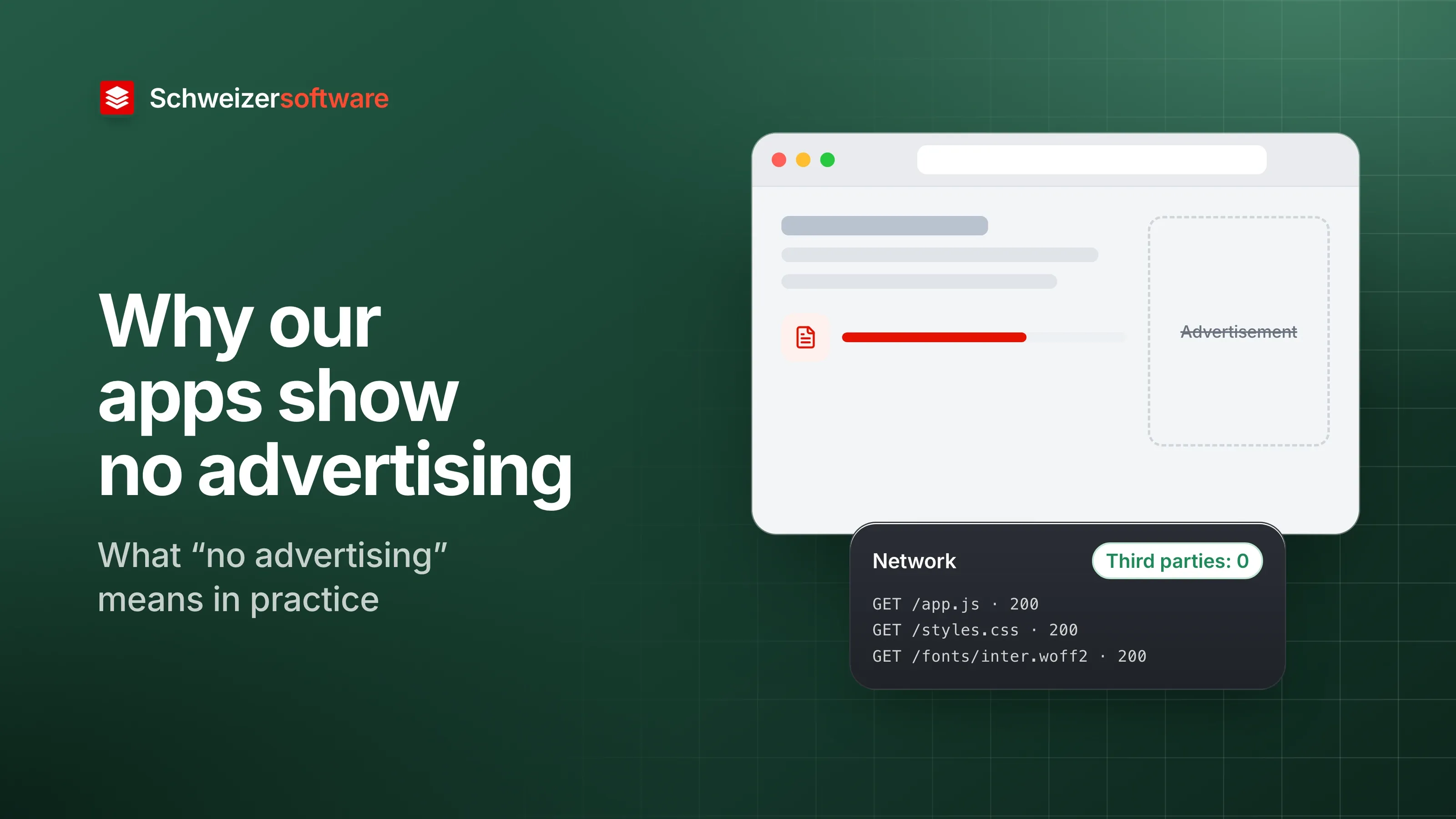
Whether a page embeds third-party services can be checked in the browser. In the developer tools, the “Network” view shows which servers are contacted when a page loads. If only the provider’s own addresses appear there, no third-party services are involved. How to read this view is described in the post Processing in the browser.
A commitment is only worth as much as the possibility of checking it. This one can be checked with a few clicks — on this website today, and on our apps as soon as they launch.
Sources
- 1.MDN Web Docs: Third-party cookies (checked on 25 September 2026)
- 2.Bundesgesetz über den Datenschutz (DSG, SR 235.1) (checked on 25 September 2026)
Follow our ideas
Look at our ideas and ask to be told once when one of them becomes an app. Or write to us – about an idea, about a task that deserves an app, or just to say hello.