
Garden maintenance6 min read
Work reports in garden maintenance: hours, photos, invoice
What a work report in garden maintenance can contain, how the invoice is made from it, and what the Swiss Labour Act states about recording working time.
A homeowner in Zug opens the invoice for spring and wonders whether mowing really needed to happen three times. The gardener knows: the hedge was wet, one appointment fell through, and the garden got an extra cut instead. It is just not written down anywhere. A report written on the day of the visit answers such questions before they are asked.
This post describes what a work report for garden maintenance can contain, how it becomes the basis of the invoice, and what the Labour Act states about recording working time. It describes, it does not advise: whether and how the rules affect a particular business is for a professional to clarify.
What a report can contain
A report is the note on one visit to a garden. A few fields are enough if they are filled in every time:
| Field | What it is for |
|---|---|
| Garden, date, people | Who was where and when |
| Jobs done | What of the planned jobs was actually done |
| Hours per person | The basis for billing by effort and for working time |
| Photos before and after | What was found and what was left |
| Material, green waste, machines | What arises besides working time, with quantity |
| Extra work | “The client also wanted the next bed”, clearly separate from the plan |
| Note for next time | What should not be forgotten at the next visit |
What matters is where the report is written: where the work took place, ideally on the phone and in a few minutes. Whoever fills it in from memory at the desk in the evening tends to write what was planned rather than what happened.
A special case are visits that do not take place. “Garden not accessible” or “postponed because of rain” is a report too. It explains later why a month had fewer visits than the plan, and whether a trip was made.
From report to invoice
When billing by effort, the report is the source of the invoice. The lines come from the reports of a month, a client or a garden: hours, material, disposal. This saves collecting things afterwards and lets invoice and report match.
Two decisions arise, and the businesses make both themselves:
- Rounding the hours. Some businesses record to the quarter hour, others to the minute. What matters is that the same rule applies to every person and every garden.
- What goes on the invoice. Only working time, or also travel, machines and green waste as separate lines.
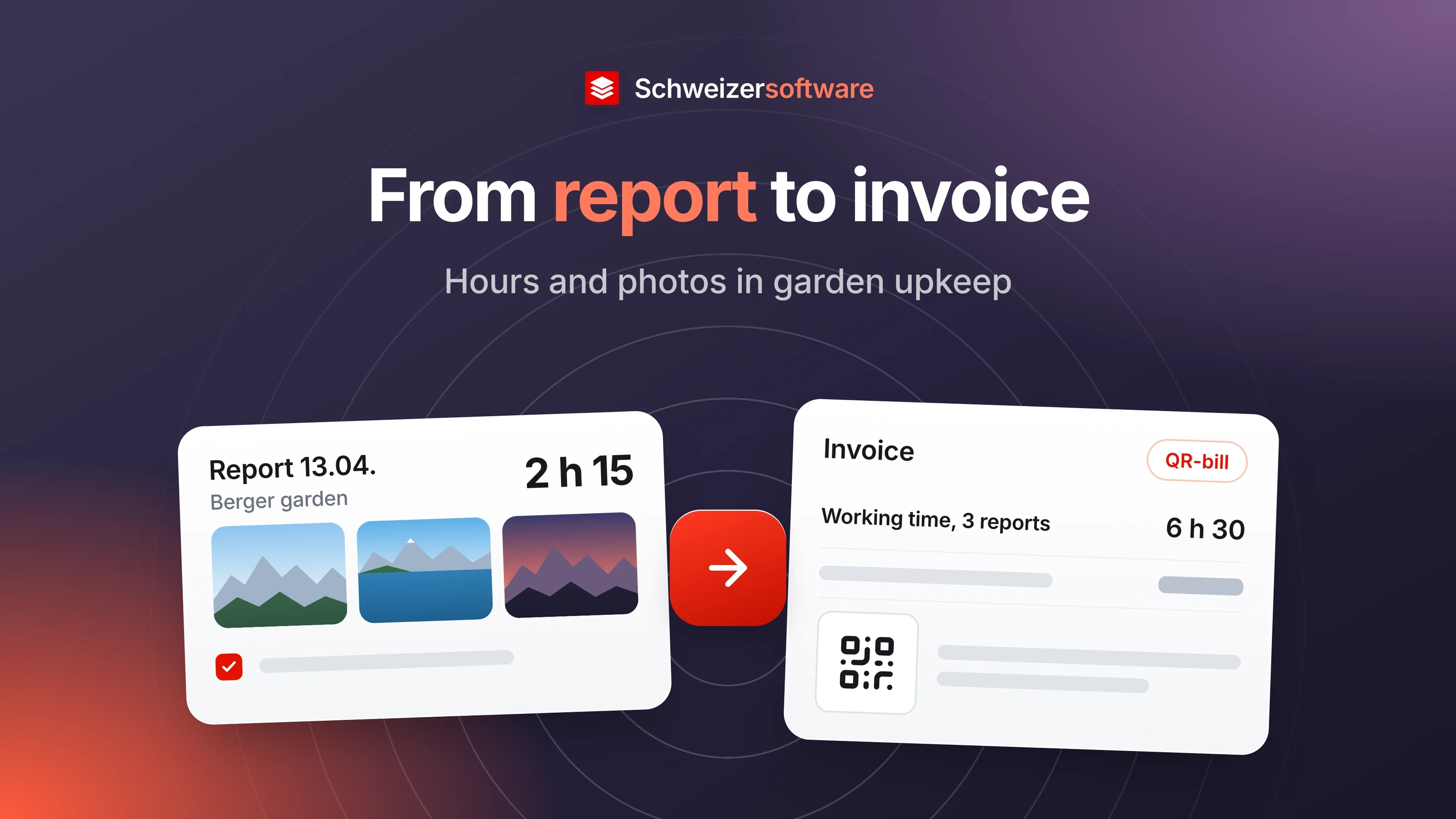
An example: for the Berger garden there are three reports in April, twice 2 hours 15 minutes and once 2 hours, each by the same person. Recorded to the quarter hour that makes 6 hours 30 minutes. In addition there are two loads of green waste from the report of 13 April. The invoice thus has two lines, and each can be traced back to a report.
For the invoice, the Federal Tax Administration notes on Art. 26 of the VAT Act that it must clearly identify the supplier, the recipient and the type of service, and that it is to be issued on request. The report supplies the description of the service.
Where a business charges a yearly price in instalments, the report is not the basis of the amount, but it remains the proof of the service. It then shows what was done for the agreed amount.
The working time of employees
Anyone who employs staff has, in the report, part of the working-time data as well. The Labour Act requires employers to keep the information needed for enforcement ready (Art. 46 ArG). What falls under it is described by Ordinance 1 to the Labour Act in Art. 73. According to SECO, the record must contain:
- the duration as well as the start and end of daily and weekly working time, including compensatory and overtime work,
- the position and length of breaks of half an hour or more.
According to the federal SME portal, the records are to be kept for five years. The law prescribes no tool: paper, spreadsheet, software, time clock or mobile app are possible as long as the information is correct.
SECO describes easements for two cases:
| Provision | Content |
|---|---|
| Art. 73a ArGV 1 | Waiver of working-time recording under narrowly defined conditions, possible since 1 January 2016 |
| Art. 73b ArGV 1 | Simplified recording of only the total daily working time; in businesses with fewer than 50 employees it can be agreed individually in writing |
Whether a gardening business falls under the Labour Act, whether a collective labour agreement applies and which rule fits depends on the circumstances of the business. SECO and the SME portal explain the basics; in case of doubt, advice from a professional is the right way.
In everyday terms: if a report contains hours per person anyway, start, end and break can be recorded in the same step. The information is then there without being written down a second time. A day with several gardens results in a series of reports whose times together make up the working day.
Photos and notes in daily work
Photos before and after are the part of the report that costs the least time and clarifies the most: a picture of the hedge before the cut answers the question of how long it was. A photo after the visit records the state in which the garden was handed over, and a photo of a problem, such as root damage on a path, makes a conversation with the client concrete. Pictures can stay with the report and thus with the garden instead of in a private chat; that way they can be found when someone needs them later.
The report for the client
A report is first of all for the business. But it can also go to the client: as a short message, as a PDF or as a link to a page in the browser. A property manager with several properties sees what happened at which one, a private owner sees the photos and the hours they will find again on the invoice. Whether and when a report is shared is the business’s decision; not every note, such as the remark about difficult access, is meant for the client.
How our idea approaches it
We are building a web app for garden maintenance in which the report will be the heart: written on the phone in a few minutes, with hours per person, photos, material and green waste. From the reports that have not yet been billed, the app will create an invoice with a Swiss QR-bill. It will record each person’s hours with start, end and break and export them as CSV or PDF; it does not calculate wages.
Sources
- 1.SECO: Arbeitszeiterfassung (checked on 6 November 2026)
- 2.KMU-Portal: Arbeitszeiterfassung, Pflicht für Arbeitgebende (checked on 6 November 2026)
- 3.Verordnung 1 zum Arbeitsgesetz (ArGV 1, SR 822.111), Art. 73, 73a und 73b (checked on 6 November 2026)
- 4.ESTV: Art. 26 MWSTG, Ausstellung der Rechnung (checked on 6 November 2026)
Be told when it launches
This idea is still being planned. Sign up and we will write to you once, when it becomes an app. Signing up is non-binding – no newsletter, no advertising.
View the idea