
Cleaning company6 min read
Hours records in cleaning: what is noted per day in Switzerland
What the Labour Act and the cleaning sector’s collective agreement for German-speaking Switzerland say about hours records: daily details, travel time, retention.
A cleaning firm in Baden, in the canton of Aargau, employs four people. The hours are in a notebook: “Mon 8–12 office Bahnhofstrasse, 13–16 practice”. When an employee asks at the end of the month how many hours she worked, the owner works it out at the kitchen table. The trip between the two clients is written down nowhere, and whether the break at half past eleven lasted thirty minutes or twenty, nobody knows for certain in the end.
That comes with the work in cleaning: short visits at different places, often early or in the evening, with journeys in between. On the question of what has to be put in writing, two sets of rules speak in German-speaking Switzerland. This article describes both, without judging what applies to a particular firm.
Two sets of rules that complement each other
| Rules | For whom |
|---|---|
| Labour Act (ArG) and Ordinance 1 (ArGV 1) | Businesses that employ people |
| Collective labour agreement for the cleaning sector in German-speaking Switzerland | Businesses that fall within its scope (see below) |
The Labour Act applies to private and public businesses. Under Art. 1 para. 2 ArG, a business exists when an employer employs one or more employees, permanently or temporarily. Someone who works alone has, in that respect, nobody whose time they would have to record.
What the Labour Act records
Art. 46 ArG obliges the employer to keep the lists and other documents showing the information needed to enforce the Act available to the enforcement and supervisory authorities. What belongs to them is set out in Ordinance 1. The State Secretariat for Economic Affairs (SECO) summarises Art. 73 ArGV 1 like this: the duration, start and end of the daily and weekly working time actually worked, and breaks of half an hour or more, must be visible. The federal SME portal gives a retention period of five years and notes that exceptions exist under certain conditions, such as a simplified recording in which only the total daily working time is noted (Art. 73b ArGV 1), and for employees in senior management positions.
What Art. 6.3 of the collective agreement names
The collective labour agreement (GAV, in German) for the cleaning sector in German-speaking Switzerland was concluded between Allpura and the unions Unia, Syna and VPOD and runs for 2026 to 2029. Its Art. 6.3 deals with the working-time record. It says that the employer keeps one for all employees, tells them the state of their working-time account every month, lets them inspect it at any time, and keeps the records for five years. Per day and employee, the article names the following details:
- the place of work or the site,
- the total working time with start and end (from/to time of day), including travel time that counts as working time, where it was incurred,
- unpaid times such as breaks (from/to time of day), where applicable.
Compared with the Labour Act, two things stand out: the place of work is named explicitly, and travel time feeds into the details.
The trip between two clients
The agreement regulates travel time in Art. 14, in the provision on allowances for employees who are not transported by the employer and do not work in the same place all day. According to it, travel time from one client to the next counts as working time; the lunch break and the usual breaks granted by the employer are excluded. Travel time from home to the usual place of work is not working time.
For the notebook in Baden that means: the trip from the office to the practice belongs, where the agreement applies, in the time record; the way from home to the first visit does not.
Who the agreement applies to
This can be described in three points that appear in the agreement and in SECO’s list:
- Place and activity. Art. 2.1.1 names the cantons of Zurich, Bern (except the administrative district of Bernese Jura), Lucerne, Uri, Schwyz, Obwalden, Nidwalden, Glarus, Zug, Solothurn, Basel-Stadt, Basel-Landschaft, Schaffhausen, Appenzell Ausserrhoden, Appenzell Innerrhoden, St. Gallen, Graubünden, Aargau and Thurgau, and businesses that carry out maintenance or special cleaning work on, in or around buildings. SECO’s list of agreements declared generally binding excludes the Italian-speaking areas of Graubünden.
- Duration. According to Art. 27.1, the agreement runs until 31 December 2029. SECO’s list shows the declaration of general applicability as running until the same date.
- Size of the business. According to the explanation at the end of the agreement, the general applicability covers businesses from six employees; essential parts, in particular the wage rules, are additionally declared generally binding in a simplified way and also apply to smaller businesses. Which articles belong to which group can be read in the agreement and in the decisions. This article does not assess it.
For western Switzerland, SECO’s list shows a separate collective agreement for the cleaning sector, declared generally binding for the cantons of Vaud, Geneva, Fribourg, Neuchâtel, Valais, Jura and Bernese Jura until 31 December 2028. This article does not describe its content.
A day as it can appear in the record
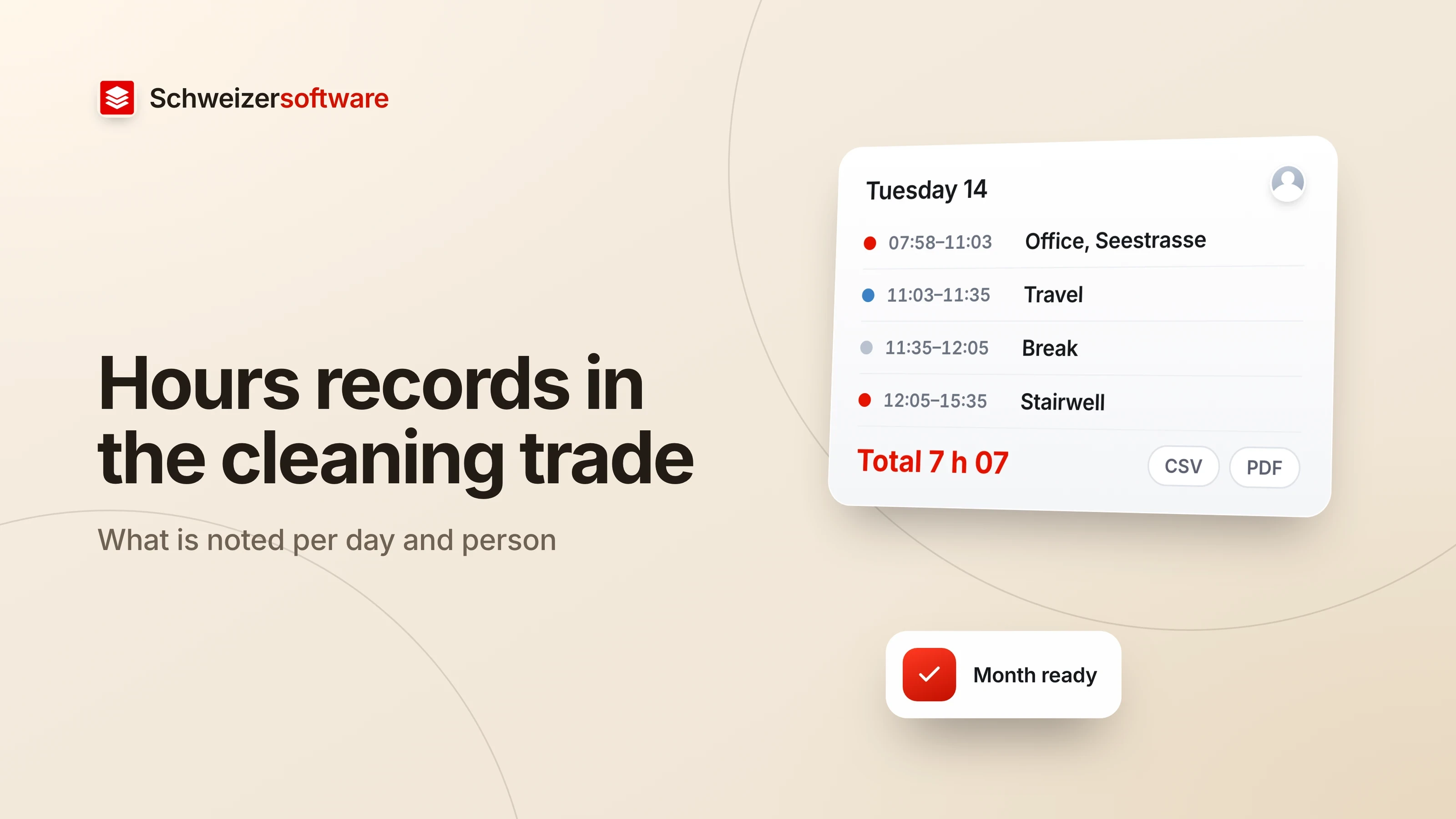
A fictitious example shows how the details fit together: on Tuesday an employee cleans an office and then a stairwell.
| From – to | Kind | Place | Duration |
|---|---|---|---|
| 07:58 – 11:03 | Visit | Office, Seestrasse | 3 h 05 |
| 11:03 – 11:35 | Travel | to the stairwell | 0 h 32 |
| 11:35 – 12:05 | Break | unpaid | 0 h 30 |
| 12:05 – 15:35 | Visit | Stairwell, Gartenweg | 3 h 30 |
In the example, visits and travel count as working time: 3 h 05 plus 0 h 32 plus 3 h 30 make 7 h 07. The break is on its own row with start and end, but is not included. The times are exact to the minute, as they occurred on site; they are not rounded to quarter hours.
Notebook, spreadsheet or app
The agreement prescribes no form. What a record has to offer follows from the points above:
- Details per day: place, from/to, travel and break.
- Monthly status: employees learn how many hours are booked.
- Inspection: they can look at any time without asking.
- Retention: five years, including for employees who left long ago.
A notebook is manageable for one person; with five it becomes confusing. A spreadsheet makes the monthly total easier; inspection for employees has to be arranged separately. If an entry is changed afterwards, the original time can be listed with it in any form. Then it is clear what was corrected and by whom.
The idea for cleaning firms that we are working on takes up these details: the app will record the start and end of a visit with one tap, suggest travel and breaks, output the month per person as CSV or PDF, and show employees their own hours at any time. It will not calculate wages, supplements or holiday entitlements; that stays with the firm and its fiduciary. The app will store the data on infrastructure in Switzerland.
Sources
- 1.GAV für die Reinigungsbranche in der Deutschschweiz 2026 bis 2029 (Allpura, Unia, Syna, VPOD), Art. 2, 6, 14, 27, 29 (checked on 6 November 2026)
- 2.SECO: Allgemeinverbindlich erklärte Gesamtarbeitsverträge (Ausgabe Oktober 2026) (checked on 6 November 2026)
- 3.Arbeitsgesetz (ArG, SR 822.11), Art. 1 und 46 (checked on 6 November 2026)
- 4.SECO: Arbeitszeiterfassung (Art. 73 ArGV 1) (checked on 6 November 2026)
- 5.KMU-Portal des Bundes: Arbeitszeiterfassung, Pflicht für Arbeitgebende (checked on 6 November 2026)
Be told when it launches
This idea is still being planned. Sign up and we will write to you once, when it becomes an app. Signing up is non-binding – no newsletter, no advertising.
View the idea