
Moving company6 min read
Documenting moving damage: photos, note and deadlines
A scratch on a wardrobe during a move: what the Code of Obligations and industry terms say about reporting, deadlines and liability, and what a damage note can record.
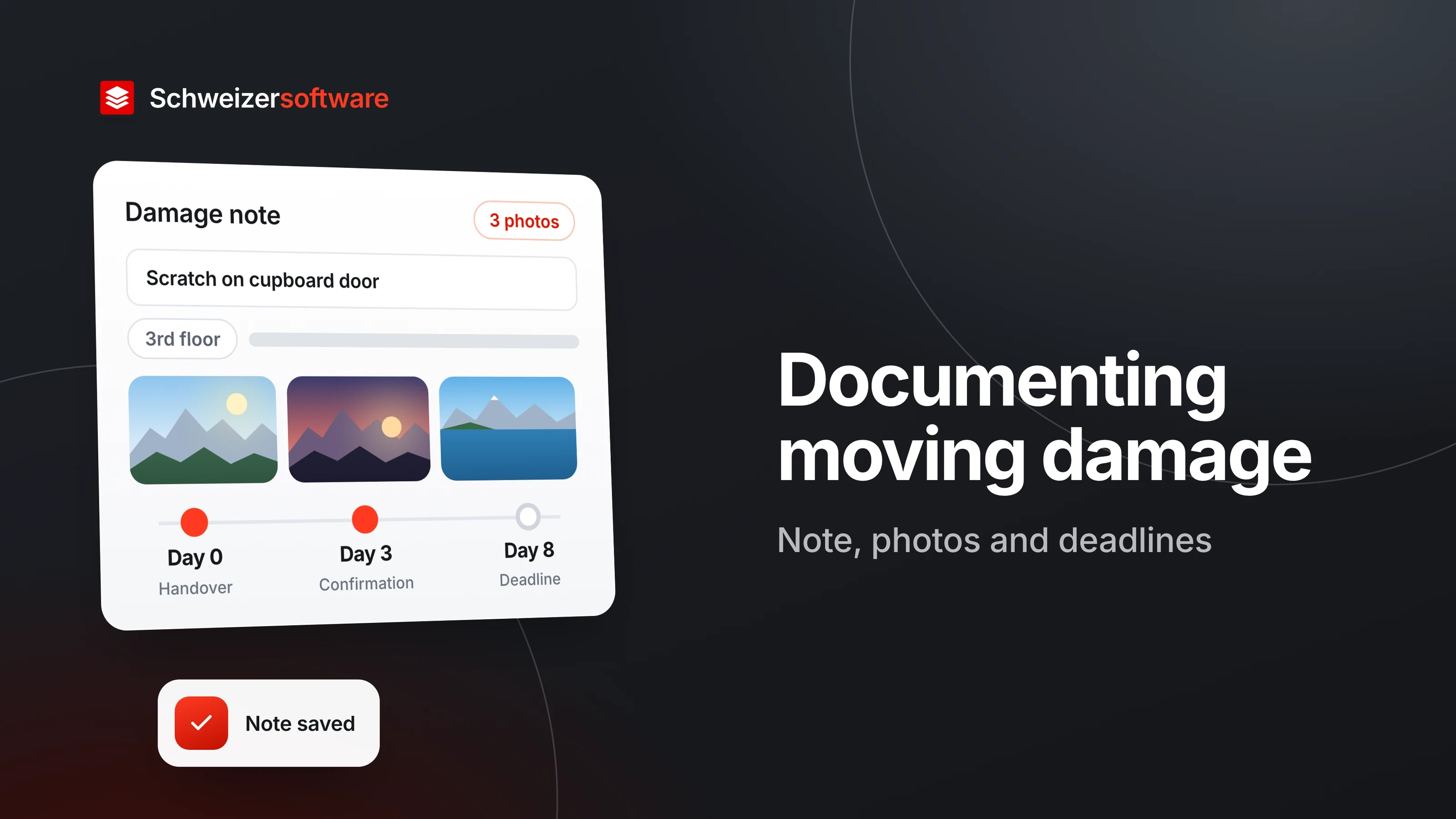
The move to Zug is almost done. In the stairwell the customer notices a scratch on the cupboard door. “That was not there before,” he says. The team leader remembers the door already had a mark when it was loaded. Both have a phone in their pocket, but nobody knows exactly who should photograph what and when, and the receipt is already prepared.
This article describes what the Code of Obligations and the general moving terms of an industry association say about reporting damage, which deadlines appear in them and which details a damage note can record. It does not assess an individual case and does not replace advice.
What the Code of Obligations says
The Code of Obligations regulates the contract of carriage in Art. 440 ff. A carrier is anyone who undertakes, for payment, to transport goods (Art. 440 CO). Whether a move falls under it in an individual case, we do not assess here; the terms of the industry association SMA, at any rate, call the member firm a carrier. For that case the law provides, among other things:
- Liability (Art. 447 and 448 CO): for loss, the full value is to be compensated, unless the carrier proves that the natural nature of the goods, fault or an instruction of the sender or recipient, or circumstances that even a careful carrier could not have averted, are the cause. The same applies under the same conditions to delay, damage and partial loss. Deviating agreements remain reserved.
- Acceptance without reservation (Art. 452 para. 1 CO): anyone who accepts the goods without reservation and pays the freight loses all claims, except in cases of deliberate deception and gross negligence.
- Damage that is not visible (Art. 452 paras. 2 and 3 CO): the carrier remains liable for damage not externally visible if the recipient discovers it within the time in which an inspection was possible or reasonable and notifies the carrier immediately after discovery. The notice must be given at the latest eight days after delivery.
- Limitation (Art. 454 CO): claims for compensation against carriers become time-barred after one year, in the case of damage from the day the goods were handed to the addressee.
- Exclusion of liability (Art. 100 CO): an advance agreement that would exclude liability for intent or gross negligence is void.
What the industry terms provide
The general moving terms of the SWISS MOVERS ASSOCIATION (SMA, version of 21 July 2025) apply to contracts of its members. In case of conflict the order of precedence is: mandatory statutory provisions, individual agreements, the SMA terms, non-mandatory law. For reporting damage, Art. 13 provides:
- The client inspects the goods immediately after unloading.
- Complaints about loss or damage are to be made immediately on delivery and confirmed to the firm in writing within three days.
- Damage not immediately visible externally is to be reported in writing within three days of discovery, at the latest seven days after the service.
- Without a complaint within these deadlines, all liability lapses under the terms.
On liability itself, under Art. 10 the carrier’s liability for slight negligence is excluded; for gross negligence or intent it is limited to the current value of the goods. Art. 11 lists cases in which the firm is not liable, for example inappropriate packing by the client, and states that sentimental value is not compensated.
| Law (CO) | SMA terms (2025) | |
|---|---|---|
| Damage on delivery | Acceptance without reservation and payment: claims lapse, exceptions for deception and gross negligence | Complain immediately on delivery, confirm in writing within three days |
| Damage not visible | Notice immediately after discovery, at the latest eight days after delivery | Within three days of discovery, at the latest seven days after the service |
| Limitation | One year | No rule of its own in the terms |
The figures differ, and which applies in an individual case depends on the contract and on legal assessment. Both, however, name a short deadline, and both are tied to a report. That is why a note with a date and photos can matter in the first days.
What a damage note can record
The statutes do not say what a report has to look like. In a guide for customers, AXA describes that damage must be reported to the moving firm at the latest two to three days after the move by registered letter, with photos as evidence and a cost estimate, and that a receipt or work report should be signed only with the defects the firm has acknowledged in writing (status of the article: 28 April 2023). A damage note can therefore contain, for example, these details:
- When and where: date, time, job and address, room or stairwell.
- What: the affected item, described in one sentence and without judgement. A note records what was visible; how it came about is a separate question.
- Photos: an overview and a close-up, before and after, where available. AXA mentions photographing furniture and valuables before the move as an option for customers.
- Who was there: crew and customer, with the time of the report.
- What was agreed: for instance whether the damage is acknowledged, and the note about it on the receipt.
- A copy for both: the same photos and the same text, so that the firm’s version and the customer’s match.
On the value of an item, AXA writes that the party causing damage is liable only for the current value, and that the customer must prove price and date of purchase. The item can therefore be described precisely in the note.
Why reporting is hard in everyday work
The moment of reporting often falls in the busiest time of the day. The crew is tired, the van has to move, the customer wants to move in. An employee’s phone is private, the photos sit among family pictures, and the text is on a slip of paper. If someone asks a week later, the firm needs time to find note, photos and the people involved, and the customer is searching their inbox for the same thing.
Our idea for this
Our idea for moving companies provides for the job sheet on the crew’s phone: the app will take a damage note in two taps, with place, description and up to eight photos, attach the note to the job and, if wished, send the customer a copy. It records what was visible and does not judge liability. The note with its photos will be available as a PDF for the insurer.
Sources
- 1.Obligationenrecht (OR, SR 220), Art. 100, 440, 447, 448, 452 und 454 (checked on 6 November 2026)
- 2.SWISS MOVERS ASSOCIATION (SMA): Allgemeine Umzugsbedingungen, 21. Juli 2025 (checked on 6 November 2026)
- 3.AXA: Haftet die Umzugsfirma für Schäden? (Beitrag vom 28.04.2023) (checked on 6 November 2026)
- 4.Bundesgesetz über den Datenschutz (DSG, SR 235.1), Art. 5 und 6 (checked on 6 November 2026)
Be told when it launches
This idea is still being planned. Sign up and we will write to you once, when it becomes an app. Signing up is non-binding – no newsletter, no advertising.
View the idea