
Driving school9 min read
Motorcycle basic course: course parts, groups, confirmations
How driving schools plan the motorcycle basic training: twelve hours in three parts, five learners at most, a four-month deadline and what changes in 2027.
Updated on
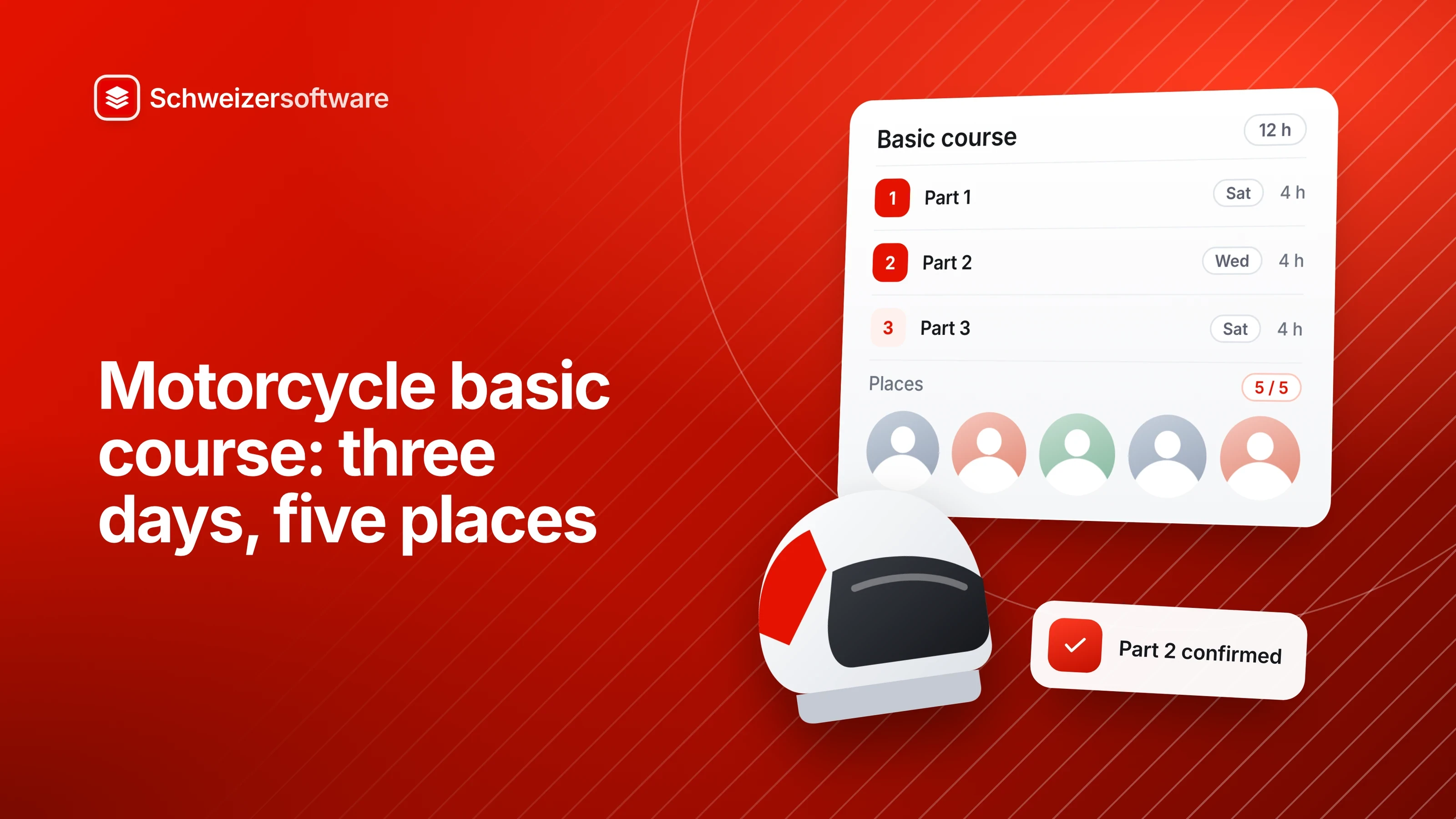
A motorcycle instructor in Lucerne notices every March that the season has begun: the first learner’s permits for categories A and A1 have been issued, and with each one a four-month deadline starts to run. Within that time the practical basic training, commonly called the motorcycle basic course, has to be completed. It has three course days, at most five places per instructor and a training ground that cannot be moved at will. Then there is the weather.
This article describes what the Ordinance on the Admission of Persons and Vehicles to Road Traffic (VZV, the Swiss ordinance on driving licences) and the ASTRA (Federal Roads Office) ordinance on practical basic training (VPGS), in force since June 2025, say about organising this course, and what is left of it when the licence rules change on 1 January 2027. How the traffic-theory course (VKU) is organised is covered in the article Organising VKU courses.
What the practical basic training is
Anyone who wants to obtain a licence in category A or subcategory A1 completes, under Art. 19 VZV, a practical basic training within four months of the learner’s permit being issued, given by a person holding a driving-instructor authorisation of category A. It lasts twelve hours. The aim is a basic understanding of riding dynamics and gaze technique, correct handling of the motorcycle, and a defensive, responsible and fuel-saving way of riding. Anyone aiming for category A may not take the course on a motorcycle of subcategory A1. If a new learner’s permit is issued later, the course does not have to be repeated.
The deadline is tied directly to the validity of the learner’s permit. For A and A1 it is valid for four months at first; once proof of the basic training is available, it is extended by twelve months (Art. 16 VZV). The canton of St Gallen describes what happens if it does not work out: without a completed basic training within the four months the learner’s permit lapses, and a second one requires a new application.
A few special cases matter for planning:
| Who | What applies |
|---|---|
| No motorcycle category yet | Course parts 1 to 3, twelve hours in total (Art. 5 VPGS) |
| A1 in credit-card format obtained before 1 January 2021, wants A | Only course part 3, while the learner’s permit is valid |
| Licence B or B1, wants A1 | No practical test after completed basic training (Art. 22 para. 3 VZV) |
The third case explains why adults with a car licence often sit in the basic course because they want to ride a light motorcycle or a scooter. According to the canton of St Gallen, subcategory A1 is entered for them without a test once the driving school has reported the course.
Three course parts, three days, at most five learners
Since 15 June 2025 the VPGS has governed the design, content and delivery. It replaced the ASTRA instructions of 2020. Four rules from Art. 6 VPGS are decisive for planning the course:
- Each of the three course parts lasts four hours, breaks included.
- The course parts take place on three different days.
- The order 1, 2, 3 is fixed; within a course part the order of the content may be adjusted.
- One instructor teaches at most five learners at the same time.
What happens in the course parts is set out in the framework programme in the annex to the VPGS:
| Course part | Focus | Where it takes place |
|---|---|---|
| 1 | Controls, braking, handling course, figure eight in the group, riding two-up | Training ground, then intersections |
| 2 | Safe braking, intersections, behaviour as a passenger, independent riding in traffic | Quiet roads, then traffic |
| 3 | Cornering uphill and downhill, braking from higher speed, roads outside built-up areas, hazard theory | Winding and special roads |
Two details have practical consequences. In course part 1 the instructor rides ahead on a motorcycle of their own, and for the two-up exercises they ride along as the passenger in turn. This is possible because the traffic rules ordinance (VRV) prohibits learners from carrying passengers who do not hold the corresponding licence (Art. 27 para. 3 VRV), while the instructor does hold one. If a motorcycle has a single seat or its total weight does not allow a passenger, the framework programme provides alternatives, such as checking from the instructor’s own motorcycle.
And the groups: anyone taking part with a light motorcycle is placed in a group of their own for course part 3 whenever possible. Mixed groups are, according to Art. 8 VPGS, the exception, for instance when too few people have registered for a group of light motorcycles only.
Planning the four months and the season
For the driving school in Lucerne this results in a calendar with fixed edges. An example:
| Learner’s permit issued | Basic training completed by | Learner’s permit then valid until |
|---|---|---|
| 10 March | 10 July | twelve months longer, so until 10 July of the next year |
| 1 August | 1 December | until 1 December of the next year |
The second row shows where it gets tight. Course part 3 requires winding routes and rides outside built-up areas, and in November such course days cannot be planned everywhere. The tests also have a season: the canton of St Gallen holds tests for subcategory A1 from 1 March to 31 October and for category A from 1 April to 31 October, and asks for registration at least eight weeks before the learner’s permit expires or before 31 October.
Some approaches suggest themselves for course planning:
- courses in fixed cycles, for instance course part 1 on a Saturday, course part 2 on the following Wednesday and course part 3 on the Saturday after, so that registrations from one month fit into the same cycle;
- recording the issue date of the learner’s permit at every registration, so that the four-month limit is visible before a course day is cancelled;
- for course parts postponed because of rain, snow or ice, a replacement date in the same cycle, as long as the deadline allows it.
What counts as “too wet” is decided by the instructor; the ordinance does not regulate it. A rule that is known at registration, however, saves discussions at the meeting point.
Notification, training ground and equipment
Anyone who wants to offer the course notifies the supervisory authority of the canton where they mainly work, in writing, before starting (Art. 3 VPGS). The notification states the start date, the training ground normally used with its location, meeting point and facilities, the course design and the instructors deployed. Cantons may require electronic notification. The canton of Valais, for instance, names a separate email address of its road traffic department for course dates, addresses and the instructors involved.
Because the course ranges from the handling course to the winding route, a driving school usually needs two kinds of places: a closed-off area for slalom, slow riding and target braking, and routes nearby that suit course parts 2 and 3. Anyone who rents the ground plans the course days around its availability.
According to the framework programme, equipment is already a topic in course part 1, in the form of suitable motorcycle clothing. For the later test the canton of St Gallen names a minimum set: a certified helmet, gloves, a jacket with long sleeves, long trousers and sturdy, closed shoes. Sending the same list along with the course registration is a simple way to make sure nobody turns up in trainers on the first day.
Check, attendance list and confirmation
At the start of each course part the learner’s permit and the vehicle registration document are checked (Art. 6 VPGS). The attendance record under Art. 4 VPGS contains:
- surname, first name and date of birth;
- for light motorcycles, the vehicle type and the number of seats, as given in items 19 and 27 of the vehicle registration document;
- the date of each course part attended, with the instructor’s initials;
- the date on which the course certificate was issued.
The attendance record is kept for three years. At the end the instructor confirms in writing participation and the achievement of the course objectives. What this proof looks like is for the cantons to decide: as an entry with date, stamp and signature in the learner’s permit, or as a separate written confirmation (Art. 9 VPGS). In the canton of St Gallen the completion is confirmed in the learner’s permit, which is then extended by twelve months.
For a driving school with several course groups this means that, per person, three course parts, three sets of initials and one certificate have to fit together. A list per course day and an overview per person of who already has which part makes make-up dates plannable.
What changes on 1 January 2027 and what stays
What changes for motorcycle learners is the path before it. From 2027, anyone who does not yet hold a licence in category A or B or subcategory A1 or B1 proves attendance of the traffic-theory course (VKU) when registering for the theory test (Art. 13 para. 1ter VZV). The VKU may be attended at the earliest six months before the minimum age (Art. 18 para. 2 VZV), for A1 on a motorcycle other than a light motorcycle that is from 15½, for A from 17½.
Until the end of 2026, the ASTRA instructions on the VKU provide that motorcycle learners attend it in parallel with the basic training. From 2027 it comes before the theory test and therefore before the learner’s permit. Accordingly, Annex 12 VZV names as admission conditions for the practical test in category A only the valid learner’s permit and the basic training. Anyone who passed the theory test under the old law but has not yet attended the VKU proves it when registering for the practical test (Art. 151q VZV). In the VKU itself the course leader now includes a motorcycle in the teaching where possible, otherwise motorcycle-specific pictures (Art. 5 VKUV, the ASTRA ordinance on the VKU).
For a motorcycle driving school this means: anyone who comes to the basic course from 2027 without a car licence has already attended the VKU. Coordinating VKU dates with basic-course dates, as the existing instructions suggest, is then no longer necessary.
What is left of this in everyday work
The motorcycle basic course is a course with fixed rules and a narrow frame: three course parts in a fixed order, five places per instructor, a deadline of four months and a season that the weather helps decide. Anyone who keeps registrations with the date of the learner’s permit, the course parts per person and the attendance lists in one place sees early on where it gets tight.
Our idea for driving schools runs the practical basic training (PGS) as a course of its own, with parts, places and a participant list. The app that is to come from it will record attendance per course part, issue the course confirmation and send those registered the place and time, with data in Switzerland.
Sources
- 1.Verordnung über die Zulassung von Personen und Fahrzeugen zum Strassenverkehr (Verkehrszulassungsverordnung, VZV, SR 741.51), Stand 1. Januar 2026, Art. 6, 16, 17, 19, 19a, 22 und Anhang 12 (checked on 10 October 2026)
- 2.Verkehrszulassungsverordnung (VZV, SR 741.51), Stand 1. Januar 2027, Art. 13, 18, 19, 151q und Anhang 12 (checked on 10 October 2026)
- 3.Verordnung des ASTRA über die praktische Grundschulung für Motorrad-Fahrschüler und -Fahrschülerinnen (VPGS, SR 741.512.1), Stand 15. Juni 2025 (checked on 10 October 2026)
- 4.Verkehrsregelnverordnung (VRV, SR 741.11), Stand 1. Oktober 2026, Art. 27 (checked on 10 October 2026)
- 5.ASTRA: Änderungen vom 19. Dezember 2025 (VZV und Verordnung über den Kurs über Verkehrskunde, in Kraft ab 1. Januar 2027) (checked on 10 October 2026)
- 6.ASTRA: Verordnung des ASTRA über den Kurs über Verkehrskunde (VKUV) vom 19. Dezember 2025 (provisorische Fassung), Art. 5 (checked on 10 October 2026)
- 7.ASTRA: Weisungen betreffend den Kurs über Verkehrskunde, 24. September 2020, Ziff. 3.2 (veröffentlicht durch das Strassenverkehrsamt des Kantons Bern) (checked on 10 October 2026)
- 8.Kanton St. Gallen, Strassenverkehrs- und Schifffahrtsamt: Merkblatt «Wichtige Informationen Kategorie A / A1», Stand 20. November 2025 (checked on 10 October 2026)
- 9.Kanton Wallis, Dienststelle für Strassenverkehr und Schifffahrt: Informationen für Fahrlehrer (checked on 10 October 2026)
Be told when it launches
This idea is still being planned. Sign up and we will write to you once, when it becomes an app. Signing up is non-binding – no newsletter, no advertising.
View the idea