
Driving school8 min read
Organising VKU courses: groups, registrations and certificates
How driving schools plan the VKU traffic-theory course: twelve places, four blocks, attendance records, certificates, and what changes on 1 January 2027.
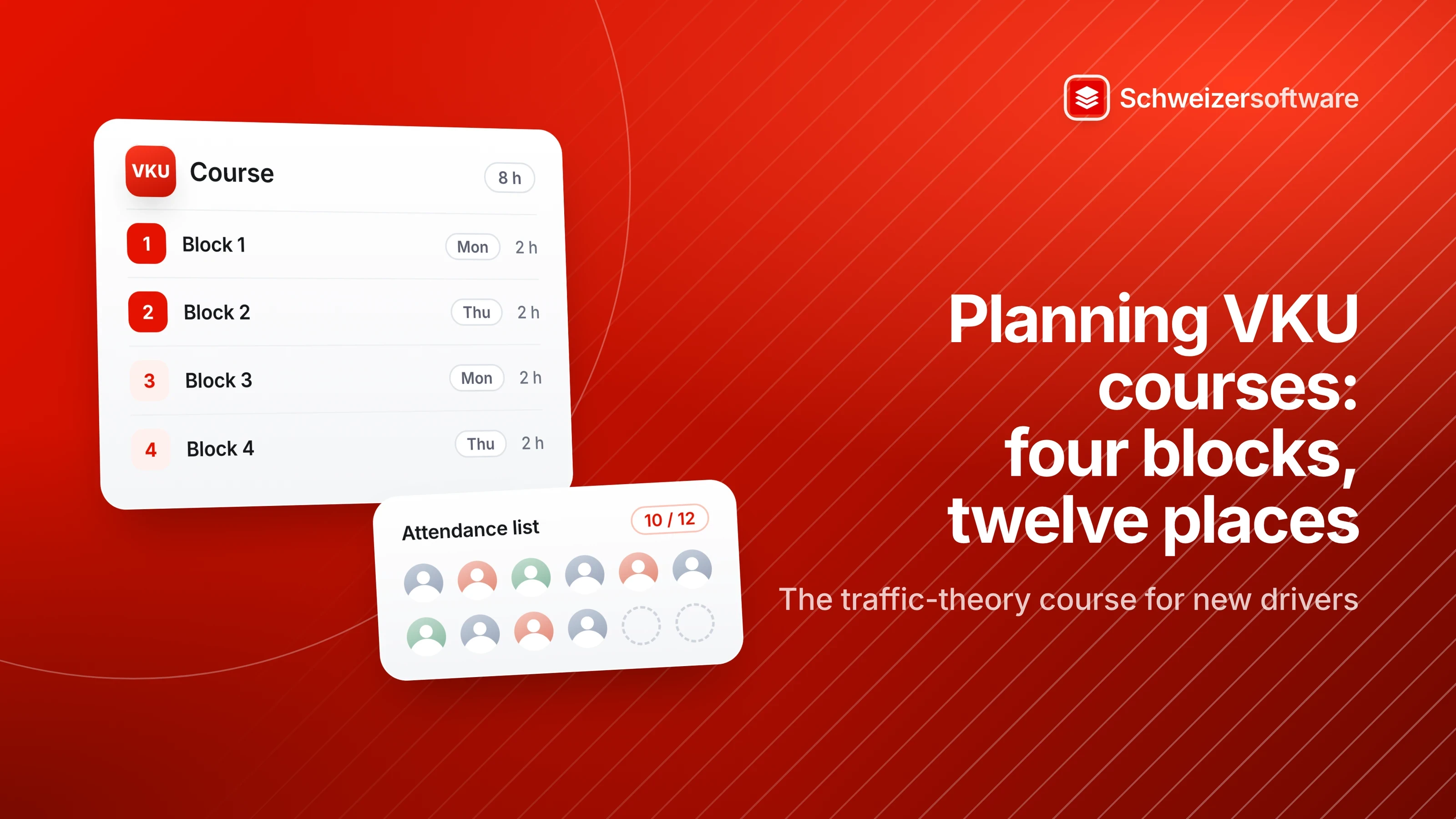
A driving school in Chur with two instructors runs a VKU, the compulsory traffic-theory course for new drivers, every month, in a rented room above a bakery. Registrations arrive by phone, message and form. A paper list records who attended which evening. Anyone who misses an evening is somehow fitted into the next course. So far that has worked.
On 1 January 2027 a good deal changes, and it affects the organisation in particular: the VKU moves to the start of the training, must be spread over four days, and is now governed by an ordinance of the Federal Roads Office (ASTRA). This article describes what the rules mean for planning VKU courses, and also touches on the first-aid course (Nothelferkurs) and the further-training course (WAB), which often end up in the same diary. For the whole training path from the learner’s point of view, see the article Driving licence in Switzerland: the road to category B.
What the VKU is and who may teach it
The Kurs über Verkehrskunde (VKU) is compulsory for everyone acquiring a first driving licence in category A or B or in subcategory A1 or B1. It lasts eight hours in total, is meant to motivate a defensive way of driving through road-sense training and hazard awareness, and takes place with a driving instructor (Art. 18 VZV, the Ordinance on the Admission of Persons and Vehicles to Road Traffic). ASTRA regulates its design, content and delivery (Art. 19a VZV).
From 2027 it does so with the Ordinance on the Traffic-Theory Course (VKUV). Until then ASTRA instructions from 2020 applied. The explanatory report justifies the change with a Federal Supreme Court ruling under which obligations in instructions are not legally binding.
Under the VKUV the following may lead the course:
- holders of a driving instructor’s licence in category A or B;
- trainee driving instructors in their training placement, if an instructor with the corresponding licence accompanies them. The explanatory report states that this instructor is present at all times and that the group therefore may not grow larger.
Anyone who wants to offer the VKU notifies the authority of the canton where they mainly work, electronically and before starting: with the address of the course venue, the course dates, and the FABER PIN and date of birth of the course leader (Art. 3 VKUV). For this the explanatory report names the online portal SARI.
What changes on 1 January 2027
| Point | Until the end of 2026 | From 1 January 2027 |
|---|---|---|
| Timing | With the learner’s permit, before the practical exam | Before registering for the theory exam |
| Earliest attendance | With the learner’s permit | Six months before the minimum age, for B at 16½ |
| Structure | Four blocks, spread over at least two days | Four blocks on four days, one block per day |
| Legal basis | ASTRA instructions | ASTRA ordinance (VKUV) |
| Content | Road sense and hazard awareness | Plus driver-assistance and automation systems |
| Teaching materials | Cantons check during the audit | Cantons set requirements or specify the materials |
The VKU content also becomes part of the theory exam. The canton of St. Gallen mentions 55 questions instead of 50. For the transition: anyone who passed the theory exam under the old law but has not yet attended the VKU shows proof of it when registering for the practical exam (Art. 151q VZV as amended from 2027).
For a driving school this means two things. Participants get younger and come earlier, often before they have even chosen a driving school. And in the first months of 2027 two groups sit in the same course: newcomers who are still before the theory exam, and learners from the old system who catch up on the VKU before the exam.
Planning groups: twelve places, four days
At most twelve people take part in a teaching block (Art. 7 VKUV). A block lasts two hours, including a ten-minute break. From 2027 exactly one block takes place on each course day (Art. 6 VKUV). Block 1, “Fahrberechtigung und Fahrzeug” (the licence and the vehicle), is attended first; blocks 2 to 4 may follow in any order.
That last rule is the most important one for planning. It allows missed blocks to be made up in a later course, as long as block 1 comes first. One possible rhythm for the driving school in Chur:
| Week | Monday | Thursday |
|---|---|---|
| Week 1 | Block 1 | Block 2 |
| Week 2 | Block 3 | Block 4 |
| Week 3 | Block 1 (new course) | Block 2 |
| Week 4 | Block 3 | Block 4 |
Anyone absent on the Thursday of week 2 can attend block 4 in week 4 if a place is still free. That leads to the real planning question: the limit of twelve applies per block, and people making up a block count towards it. A course that starts full with twelve registrations has no room for people catching up from the previous month. Two obvious options: keep one or two places free per course, or offer individual blocks additionally.
The room has requirements too. The course venue has its own entrance, enough space, good lighting, ventilation and heating, and is protected from noise, dust and smells. It may not be living space or a passageway; in a restaurant it needs a separate room with no obligation to buy anything (Art. 4 VKUV). The teaching materials and media used for interactive work must be on hand, and participants receive a summary of the most important content (Art. 5 VKUV).
Registrations: what a driving school needs to know
For the attendance record the VKUV requires the participants’ surname, first name and date of birth (Art. 8). The driving school also needs a way to reach the person, such as a phone number or email address. Nothing more is needed for the course itself. Whether the parents of a 16-year-old are informed too can be asked at registration, rather than sorted out later.
From 2027 there is a check that was not needed before: age. For category B the course may be attended six months before the 17th birthday at the earliest. With the date of birth from the registration this can be checked when the entry is made, rather than on the first evening.
At registration it helps participants if they receive everything they need at once:
- venue, access and dates of all four course days;
- that block 1 comes first and how a missed block is made up;
- how the driving school handles cancellations and whether a cancellation costs anything;
- a note that ID showing the date of birth should be at hand for the attendance record, if the driving school provides for that.
Attendance record and course certificate
For every block the course leader keeps an attendance record. Participants confirm their attendance by signature, and the course leader confirms attendance electronically (Art. 8 VKUV). The course leader keeps the attendance record for three years and gives the authority of the participant’s canton of residence access on request.
After the complete course the course leader certifies attendance. The certificate is valid without limit (Art. 9 VKUV). For the driving school this means two records that have to match: the signed list per block and the electronic entries. An overview per person of which blocks have been attended and confirmed saves searching when someone asks months later whether a block is still missing.
Reminders between course days
With four course days instead of two, the number of appointments someone has to remember goes up. A reminder the day before each block, with time and place, is a simple remedy for empty chairs. If someone who missed a block immediately receives the next dates for that block with free places, the catch-up is planned before the person wants to register for the theory exam and finds the certificate missing.
First-aid course and further-training course in the same diary
The first-aid course falls in the same period. The certificate is issued by an institute recognised by ASTRA, and only if someone attended the whole course; it may not be older than six years when the application is made (Art. 10 VZV). From 2027 a natural order emerges: first-aid course and VKU before the theory exam. A driving school that works with a recognised provider can communicate both dates together.
The further-training course after the exam (WAB, short for Weiterausbildung) is a different format. It lasts seven hours on one day, in groups of six to twelve people (Art. 27a VZV). Whoever organises it needs a licence from the canton where they are based, including at least four facilitators, their own teaching areas and insurance for the participants’ vehicles (Art. 27e VZV). That is a different framework from the VKU. For the driving school the WAB mainly leaves a reminder to its students that it is due within twelve months of the exam (Art. 27c VZV).
What this means for a small driving school
For the driving school in Chur the VKU remains a course of eight hours and twelve places. What is new is the rhythm over four days, the younger audience and a transition period with two groups of participants. Anyone who keeps registrations, attendance per block and make-up sessions in one place has the answers ready when someone asks.
Our idea for driving schools takes up exactly this course administration. The app it is meant to become will keep VKU groups with participant lists per block and automatically send place and time to everyone registered, with data in Switzerland.
Sources
- 1.Verordnung über die Zulassung von Personen und Fahrzeugen zum Strassenverkehr (Verkehrszulassungsverordnung, VZV, SR 741.51), Stand 1. Januar 2026, Art. 10, 18, 19a und 27a–27e (checked on 9 October 2026)
- 2.ASTRA: Änderungen vom 19. Dezember 2025 (VZV und Verordnung über den Kurs über Verkehrskunde, in Kraft ab 1. Januar 2027) (checked on 9 October 2026)
- 3.ASTRA: Verordnung des ASTRA über den Kurs über Verkehrskunde (VKUV) vom 19. Dezember 2025 (provisorische Fassung) (checked on 9 October 2026)
- 4.ASTRA: Änderung der Verkehrszulassungsverordnung vom 19. Dezember 2025 (provisorische Fassung) (checked on 9 October 2026)
- 5.UVEK: Erläuterungen zur Teilrevision der VZV und zur VKUV, 19. Dezember 2025 (checked on 9 October 2026)
- 6.ASTRA: Weisungen betreffend die praktische Motorrad-Grundschulung und den Kurs über Verkehrskunde, 24. September 2020 (veröffentlicht durch das Strassenverkehrsamt des Kantons Bern) (checked on 9 October 2026)
- 7.Kanton St. Gallen: Fahrausbildung 2027 – was ändert? (checked on 9 October 2026)
Be told when it launches
This idea is still being planned. Sign up and we will write to you once, when it becomes an app. Signing up is non-binding – no newsletter, no advertising.
View the idea