
Moving company6 min read
Moving quote by rooms, m³ or hours: how it is built
How small moving companies build a quote: rooms to m³ and hours, fixed price or by the hour, price limit, what a quote contains and what the Code of Obligations says.
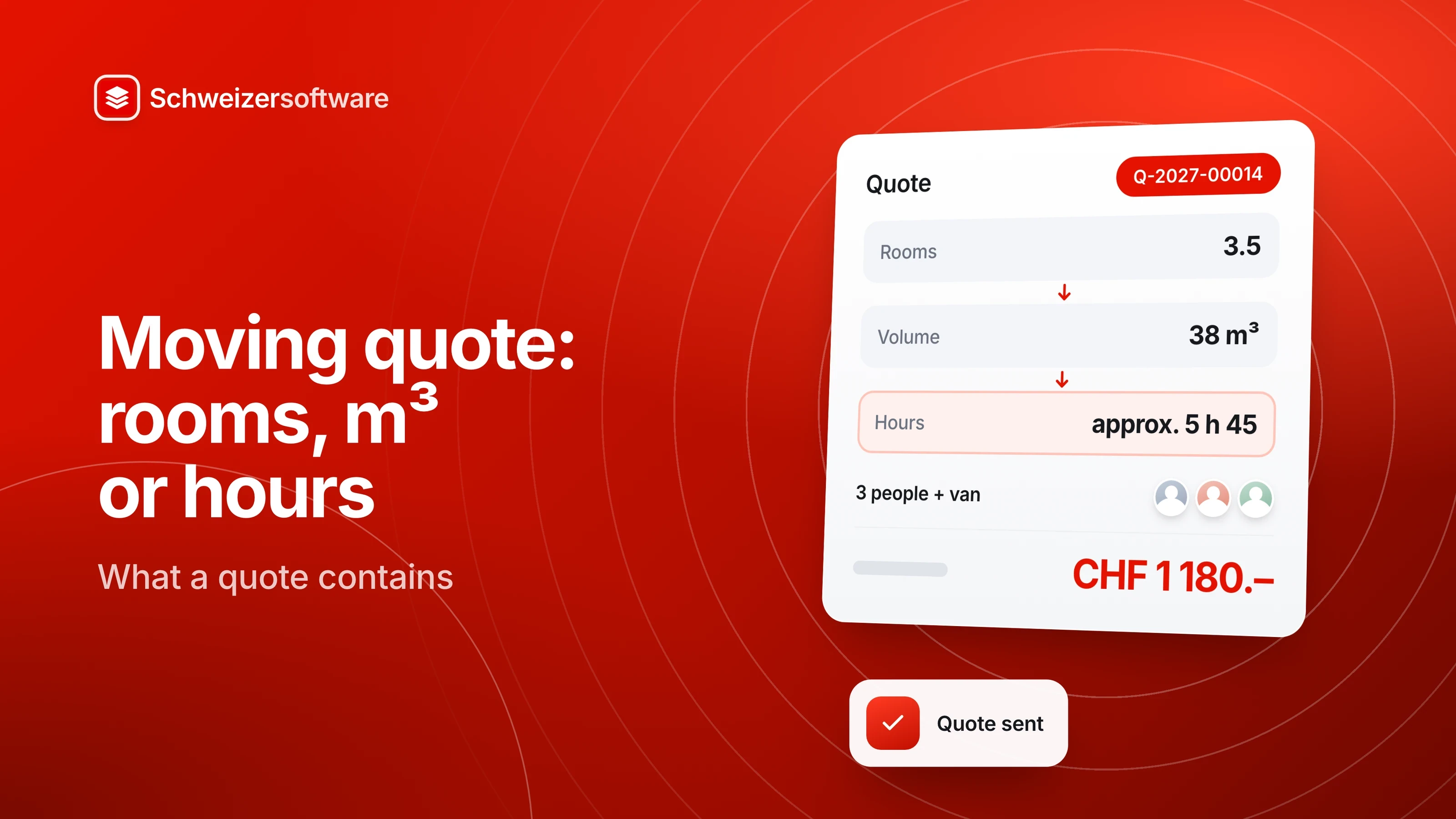
On the phone it sounds like this: a 3.5-room flat in Lucerne, third floor, no lift, the family is moving to Zug. The owner of a small moving firm has one van, two regular employees and casual helpers when needed. The quote should reach the customer by the evening. What she writes down is an estimate: how much furniture, how many people, how many hours, at what price and under which assumptions.
This article describes how such a quote can be built: from rooms to volume to hours, with a fixed price or by the hour, with or without a price limit. It shows what the Swiss Code of Obligations says about the price of a work contract and which details the general moving terms of an industry association provide for in quotes. It does not replace a legal assessment of an individual case.
Three routes to the same figure
Most quotes move between three quantities that are converted into one another.
- Rooms are the figure customers know for certain (“3.5 rooms”), but a rough measure: a flat with an attic and a cellar is bigger than one with an empty balcony.
- Cubic metres (m³) describe the load volume. They can be estimated from the rooms or, at a survey visit, from the contents of the home.
- Hours are the crew’s effort, from arrival at the first address to the end of unloading. They depend on the volume, the number of people and the access conditions.
To get from rooms to volume, every firm needs a figure from experience. The following table is a worked example of ours, not an industry standard.
| Rooms | 1 | 2 | 3 | 3.5 | 4.5 | 5.5 |
|---|---|---|---|---|---|---|
| Volume (example value) | 12 m³ | 20 m³ | 32 m³ | 38 m³ | 52 m³ | 68 m³ |
A worked example with invented figures
Suppose a firm calculates 0.4 person-hours per m³, a surcharge of 10 % per floor without a lift, 30 minutes of driving time, an hourly rate of CHF 195 for three people with a van and a travel fee of CHF 60. The figures are made up and say nothing about usual prices.
| Step | With a lift | Third floor, no lift |
|---|---|---|
| Volume | 38 m³ | 38 m³ |
| Person-hours (× 0.4, with surcharge) | 15.2 | 19.8 (× 1.3) |
| Divided by 3 people | 5.1 h | 6.6 h |
| Plus 30 minutes of driving | 5.6 h | 7.1 h |
| Rounded up to a quarter hour | 5.75 h | 7.25 h |
| × CHF 195 | CHF 1 121.25 | CHF 1 413.75 |
| Plus travel fee, rounded to CHF 10 | CHF 1 180 | CHF 1 470 |
The difference of about CHF 290 comes from the stairs alone. The general moving terms of the SWISS MOVERS ASSOCIATION (SMA) describe what they treat as normal access: at most 15 metres between vehicle and entrance, and rooms no higher than the second floor or lower than the second basement. Where that does not apply, the moving price rises by the extra effort. Anyone who records floor, lift and access in the request already has the figures that move the price.
Fixed price or by the hour
The same calculation can go into a quote in two ways.
| Fixed price | By the hour | |
|---|---|---|
| The quote states | One amount for the service | An hourly rate for the crew and an estimate of hours |
| What is billed | The agreed amount | The time actually worked |
| If the estimate is off | The firm bears the extra effort if the information was right | The customer pays the hours, provided the agreements were kept |
| Can be supplemented by | A list of what is not included | A price limit (“no more than CHF …”) |
The row “If the estimate is off” follows AXA’s account, which describes that with a flat sum the exact calculation is the moving firm’s responsibility. Without a survey visit, the customer’s information is decisive and has to be correct, otherwise extra costs fall to the customer. With a quote by the hour, the hours actually worked have to be paid if the contractual agreements, such as crew size or vehicle, were kept and the estimate was not exceeded substantially.
The law also knows this distinction for the price of a work. Under Art. 373 of the Code of Obligations (CO), where the price was fixed exactly in advance, the contractor may not demand an increase even if the work turned out larger than planned. Exception: extraordinary circumstances that could not be foreseen can give the judge reason to raise the price or dissolve the contract. If the price was not fixed or only roughly, it is set according to the value of the work and the contractor’s expenses (Art. 374 CO). And if an approximate estimate is exceeded disproportionately without the customer’s doing, the customer may withdraw from the contract (Art. 375 CO). The law gives no percentage for this.
What a quote can contain
The SMA terms apply to contracts of its members; other firms have their own. They do show which points a quote can settle.
| Item | What the SMA terms say |
|---|---|
| Addresses, floor, lift, access | The order supplies addresses, quantity and local conditions (Art. 2); different access raises the price by the extra effort (Art. 3) |
| What a fixed price covers | Loading, transport, unloading and a single placement (Art. 4); packing and unpacking, assembly, pianos and items from 100 kg, and packing material are paid separately (Art. 6) |
| Validity | Quotes lapse if not accepted within 90 days (Art. 2) |
| Acceptance | In writing; sending a signed copy electronically counts as written acceptance (Art. 2) |
| Payment | The price is due before the service begins (Art. 7) |
| Customer withdrawal | Within 14 calendar days before the move 30 %, within 48 hours 80 % of the quoted amount as lump-sum damages (Art. 8) |
| Liability and insurance | Liability rules in Art. 10 and 11; transport insurance only on the client’s express instruction (Art. 12) |
A firm using its own terms may use other figures. What matters for the quote is that the customer can see and read them before accepting.
What is hard to keep by hand
In practice a quote is written during a break, on the phone or in the evening. If the customer changes a detail, such as an extra room, a second version appears, and it has to be clear which one applies. A date that has since been taken only shows up in the calendar. And anyone who receives an acceptance only by phone has no time and no version of the terms to point to later.
A spreadsheet, a template and a well-kept diary can handle these points. They get harder when several people write quotes or several vehicles are out.
Our idea for this
Our idea for moving companies starts at this point: from the details of a request, the app will suggest volume, crew and hours, leave every value editable and offer a fixed price or billing by the hour with an optional price limit. Customers will read and accept the quote by link, and the app will record the time and the version of the terms.
Sources
- 1.Obligationenrecht (OR, SR 220), Art. 363 und 373–375 (checked on 6 November 2026)
- 2.SWISS MOVERS ASSOCIATION (SMA): Allgemeine Umzugsbedingungen, 21. Juli 2025 (checked on 6 November 2026)
- 3.AXA: Haftet die Umzugsfirma für Schäden? (Beitrag vom 28.04.2023) (checked on 6 November 2026)
Be told when it launches
This idea is still being planned. Sign up and we will write to you once, when it becomes an app. Signing up is non-binding – no newsletter, no advertising.
View the idea