
Hair salon6 min read
Recording working time in a hair salon: the GAV and the Labour Act
What Ordinance 1 to the Labour Act and the hairdressing GAV say about recording working time: details, breaks, overtime, retention and inspections.
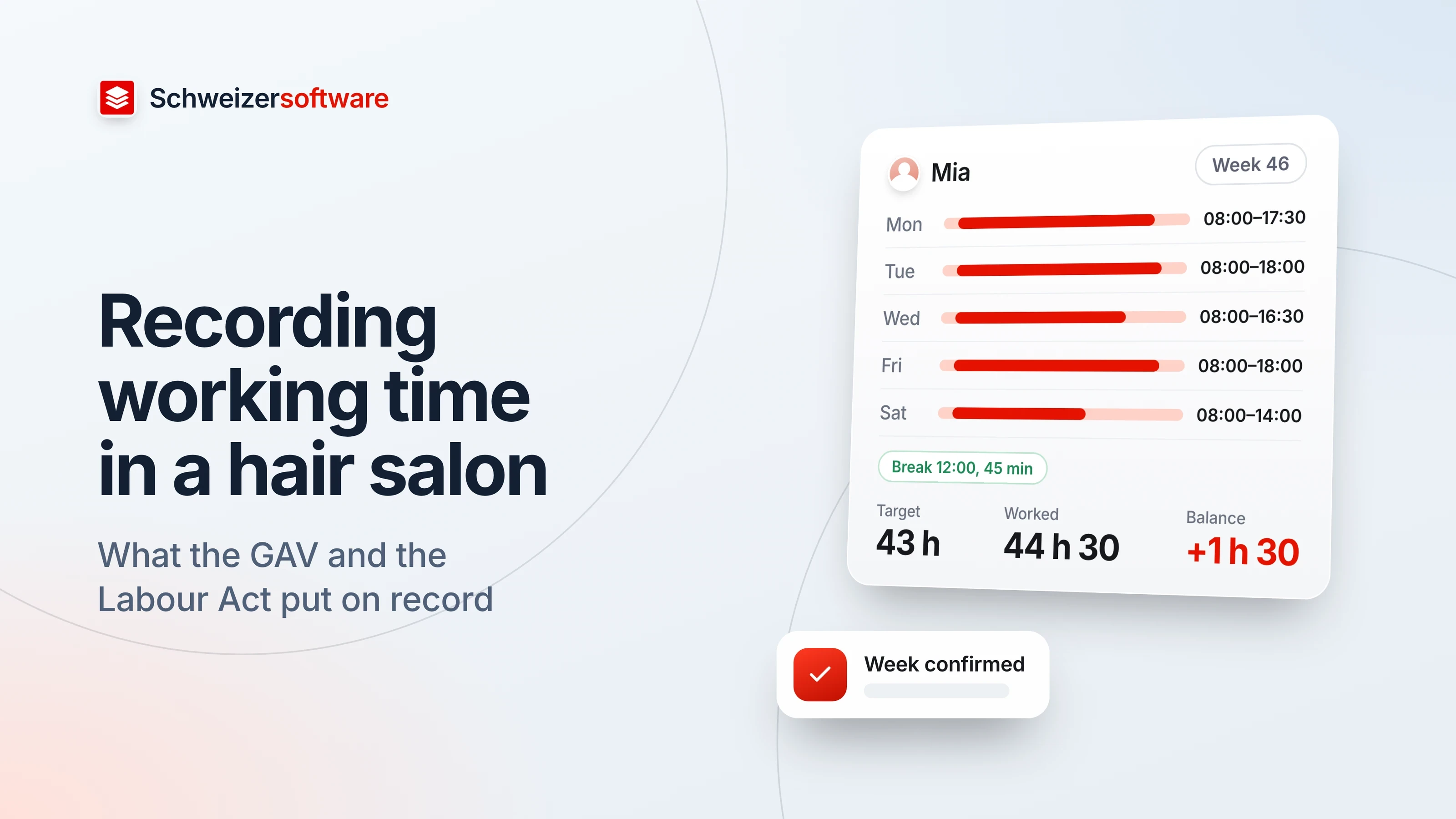
A salon in Winterthur has three employees and one apprentice. Saturdays run long because clients want appointments before the weekend; in return, Tuesday starts later. On Friday an employee asks how many hours she worked this month. The owner leafs through the diary: the appointments are there, but the time between closing and tidying up is written down nowhere.
Recording working time is not a matter of taste in a business with employees. Two texts govern it: Ordinance 1 to the Labour Act (ArGV 1) and the collective labour agreement (GAV) for the Swiss hairdressing trade. This article describes what they say. It cannot advise; whether and how a particular salon falls under them is shown by the texts themselves and by the bodies that apply them.
What the ordinance requires to be recorded
The Labour Act obliges employers to keep records and documents available for the enforcement bodies. Art. 73 ArGV 1 names what they contain. We read the version of 1 September 2024. According to para. 1, the records must contain all the details needed for enforcement, in particular:
- the personal details of the employees,
- the type of work and the dates of joining and leaving,
- the daily and weekly working time actually worked, including compensatory and extra time, and its position,
- the weekly rest days or substitute rest days granted, unless they regularly fall on a Sunday,
- the position and length of breaks of half an hour or more.
Two details stand out in a salon’s day-to-day. First, a total per week is not enough: what is required is the daily working time and its position, that is, when it began and ended. Second, the ordinance names breaks from half an hour upwards explicitly, with start and length. A 45-minute lunch break therefore belongs in the records under the ordinance; a ten-minute break does not.
Under para. 2, the records are to be kept for at least five years after they cease to be valid. Under Art. 1 ArGV 1, employees also include apprentices, interns and others who are mainly in the business for training.
The ordinance also knows exceptions. Art. 73a allows a GAV to dispense with part of the details if the person has a great deal of autonomy, earns more than CHF 120 000 gross a year (the amount is adjusted) and waives in writing. Under certain conditions Art. 73b permits simplified recording in which only the daily working time is noted. Both require further agreements; whether one exists is stated in the contract or the agreement, not in this article.
What the hairdressing GAV adds
The Federal Council declared the GAV for the Swiss hairdressing trade generally binding by decision of 14 December 2023, until 31 December 2027. It applies to employment relationships between businesses in the trade and their staff who provide hairdressing services for clients (Art. 1.3).
On working time, it says, among other things:
| Topic | What the GAV states |
|---|---|
| Maximum working time (Art. 24.1) | The weekly maximum including time on call is based on the 43-hour week, but may not exceed the 50 hours of the Labour Act. The balance must be made up within six months. |
| Recording (Art. 24.39) | The employer is responsible for recording the working time worked, including overtime, and keeps books on actual working times. If it does not, the employee’s own record is admitted as evidence in a dispute. |
| Overtime (Art. 25.1) | Overtime is work that exceeds the agreed weekly working time by more than one hour and is ordered. |
| Tolerance hour (Art. 25.2) | To finish client services already begun, the maximum working time may be extended by one hour at most, for that purpose only. All further overtime must be recorded in writing. |
| Compensation (Art. 25.3) | Overtime not compensated by equal time off within six months is to be paid with a 25 per cent supplement; by written agreement the period can be extended to twelve months at most. |
| Free day (Art. 26) | Each week, besides the day of rest, usually Sunday, there is a right to one whole day off. |
The article on recording is the clearest: it places responsibility expressly on the employer and provides that, in a dispute, the employee’s record counts if the business keeps none of its own.
How this can be reflected in a salon
The two texts yield a manageable list that looks different in every salon but has the same parts:
- Per person and day the start, the end and the breaks of half an hour or more with their position.
- Per week the agreed target time, the time worked and the difference, also as a running balance since the start of the year.
- Absences such as holidays, illness, vocational school days and public holidays, so that a week with a school day does not look too short.
- Sunday work, which under Art. 27 GAV and Art. 19 of the Labour Act needs a permit, with date and length.
- Retention for at least five years after the records cease to be valid.
On paper this is one table per person that someone countersigns every week. On a screen it can be the same table, with suggestions from the rota that are only confirmed or corrected. A table is practical where one looks at the end of the day anyway, not in a second filing place.
One question stays open in every business: who confirms? The ordinance requires the records to exist and be correct, not who keeps them. Whether employees enter their own time or the owner confirms it weekly is a business decision. A note beside a correction shows later what was originally entered.
What recording is not
Recording working time is not payroll. The GAV regulates wages, supplements and holiday pay in other articles, and the payroll record under Art. 42 GAV is a separate proof. The time sheets supply the basis for it, nothing more. Nor does recording replace the holiday and public-holiday record under Art. 33 GAV; that is another list each employer keeps per person.
How we are approaching this for the salon
In the idea for hair salons that we are working on, the app will record employees’ and apprentices’ weekly hours against the target time agreed in the contract, with start, end, breaks, absences and balance. It will not calculate wages or check minimum wages. The salon will be able to export the time sheets as a table or PDF for payroll or an inspection.
Sources
- 1.Verordnung 1 zum Arbeitsgesetz (ArGV 1, SR 822.111), Art. 73 Verzeichnisse und andere Unterlagen, Art. 73a und 73b (checked on 6 November 2026)
- 2.Gesamtarbeitsvertrag für das schweizerische Coiffeurgewerbe, gültig ab 1. Januar 2024 (Art. 24, 25, 49) (checked on 6 November 2026)
- 3.PK Coiffure: Neuerungen im allgemeinverbindlichen GAV ab 1. Januar 2026 (checked on 6 November 2026)
Be told when it launches
This idea is still being planned. Sign up and we will write to you once, when it becomes an app. Signing up is non-binding – no newsletter, no advertising.
View the idea